
InudstryLease is a trustless marketplace enabling factories to monetize idle machinery capacity and SMEs to rent hardware securely using smart contracts and AI agents
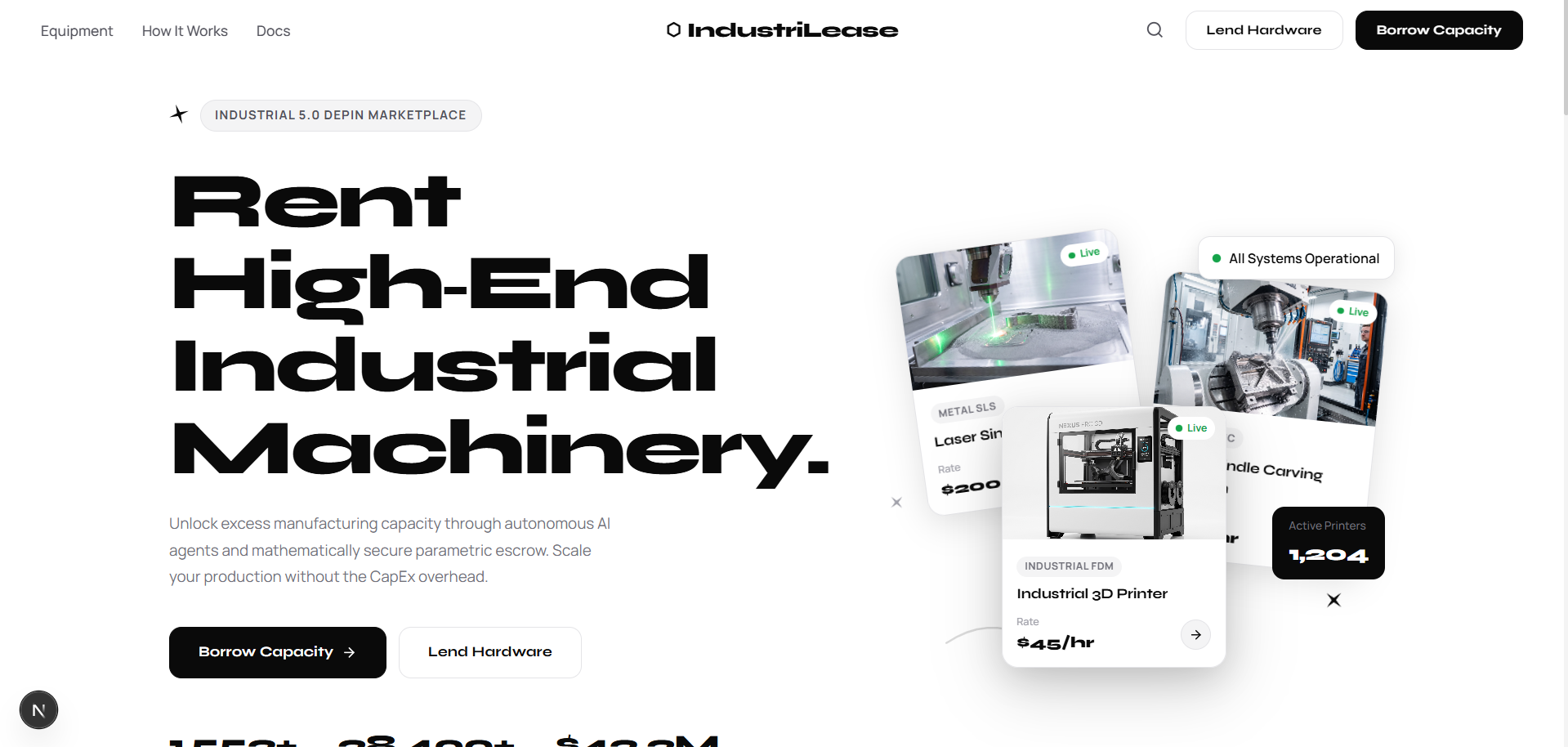
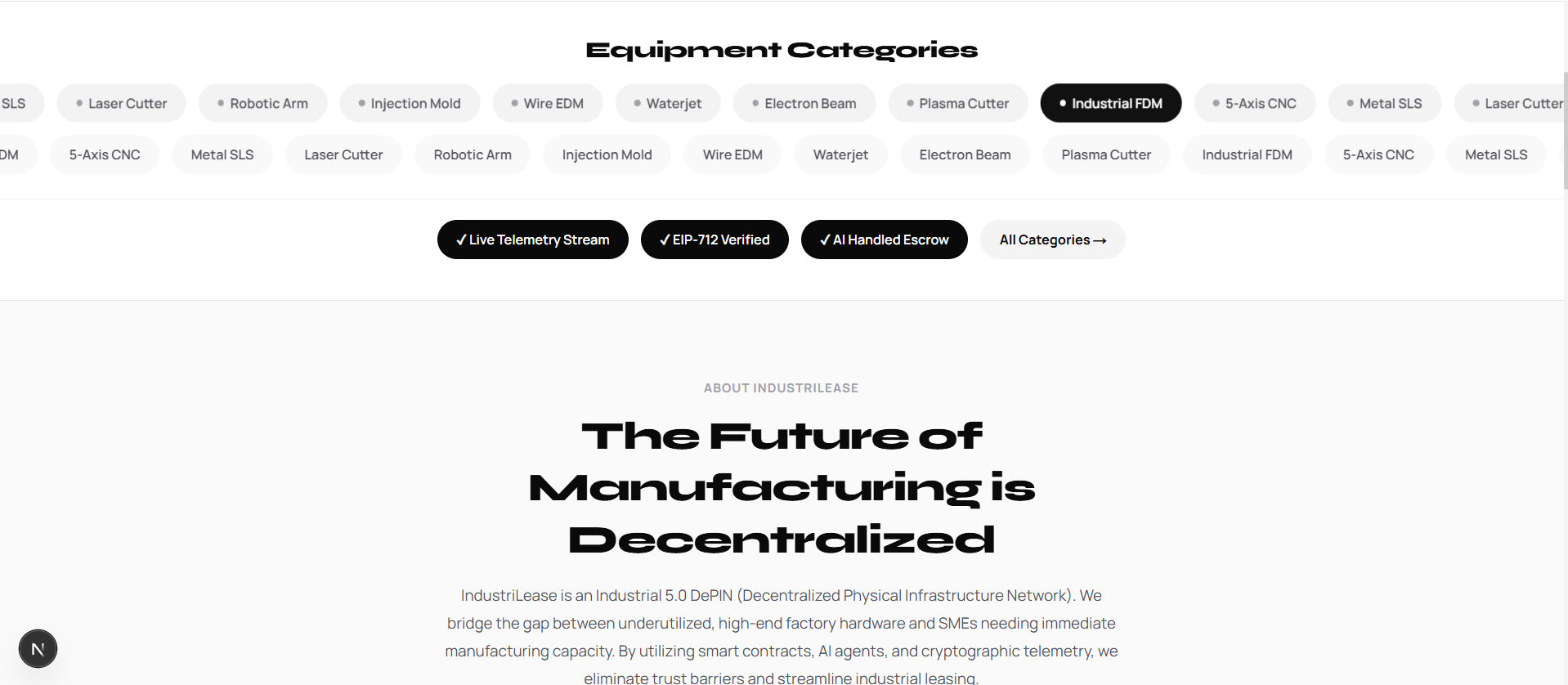
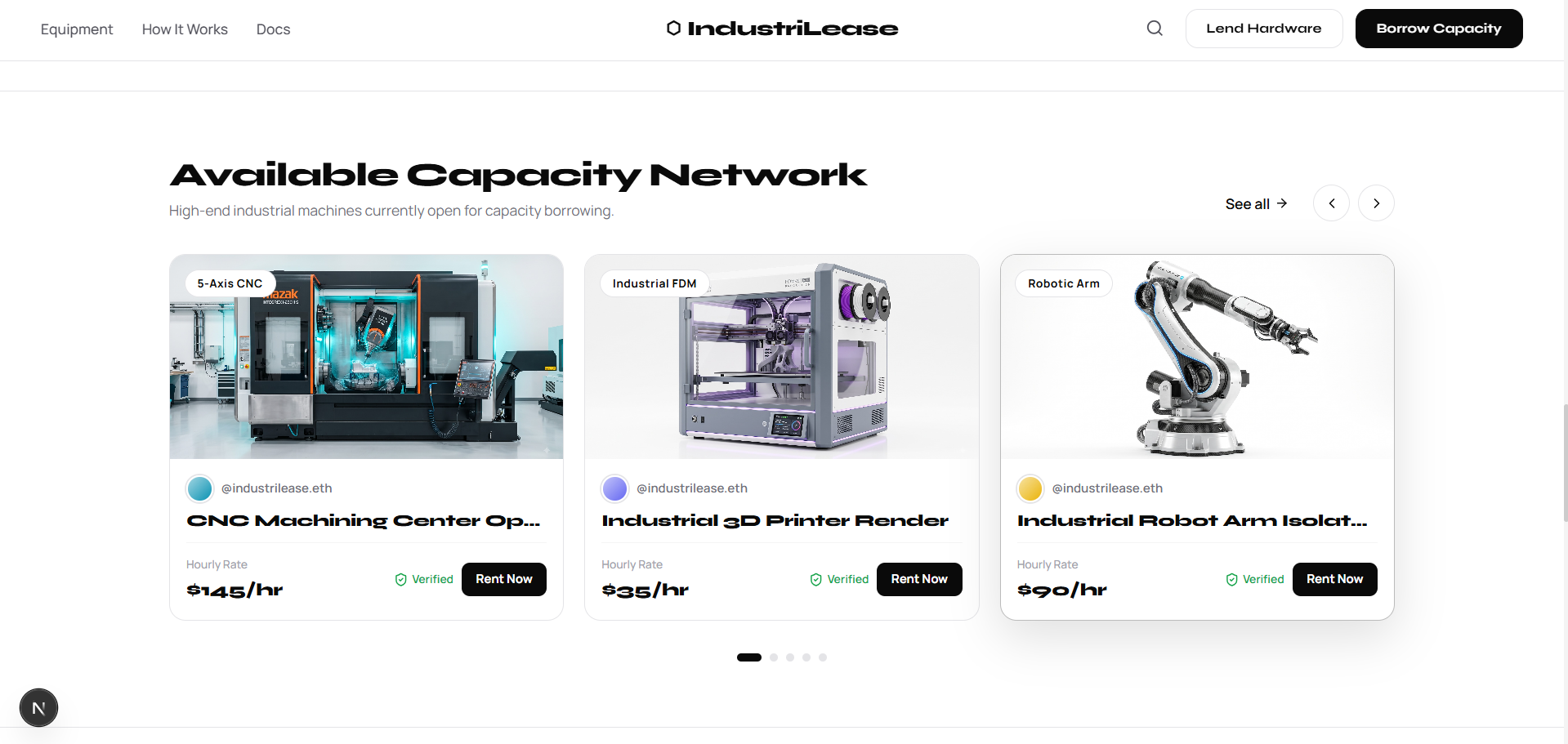
InudstryLease: A decentralized marketplace letting factories lease idle machine slots to SMEs securely using AI agents, ERC-1155, and smart escrows.
InudstryLease is a Web3-native sharing economy platform designed for the manufacturing sector. By bridging physical fabrication hardware—such as 3D printers and CNC mills—with blockchain smart contracts, the platform enables factories to tokenize and lease out their unused machine hours. At the core of the system are autonomous AI agents that act as secure session key managers, automating the listing of idle slots and ensuring that financial transactions are bound directly to verifiable, physical machine telemetry.
Modern manufacturing operations frequently suffer from expensive capital equipment sitting idle between production runs, resulting in wasted overhead and lost revenue opportunities. When factories attempt to rent out this spare capacity to external SMEs, they face high trust barriers:
Financial Risk: SMEs are hesitant to pay large sums upfront without guaranteed delivery, while factories risk processing expensive runs without payment assurances.
Lack of Validation: Traditional processes lack a secure mechanism to prove a manufacturing job was completed correctly before funds are released.
Hardware Safety Threats: Accepting raw instructions (such as G-code files) from third parties introduces severe safety risks; malicious or poorly configured files can overheat nozzles, crash machine heads, and cause thousands of dollars of physical damage.
InudstryLease introduces a trustless, safety-first framework that eliminates these risks by connecting hardware sensors directly to decentralized escrows. Under this model, machinery capacity is tokenized as semi-fungible ERC-1155 tokens representing specific calendar windows. Payments from tenants are held securely in a smart escrow contract and are only disbursed upon cryptographic proof of execution. To protect the physical assets, the platform enforces edge safety by sanitizing G-code files before they can be sent to the machine controller, filtering out parameters that exceed safe physical limits.
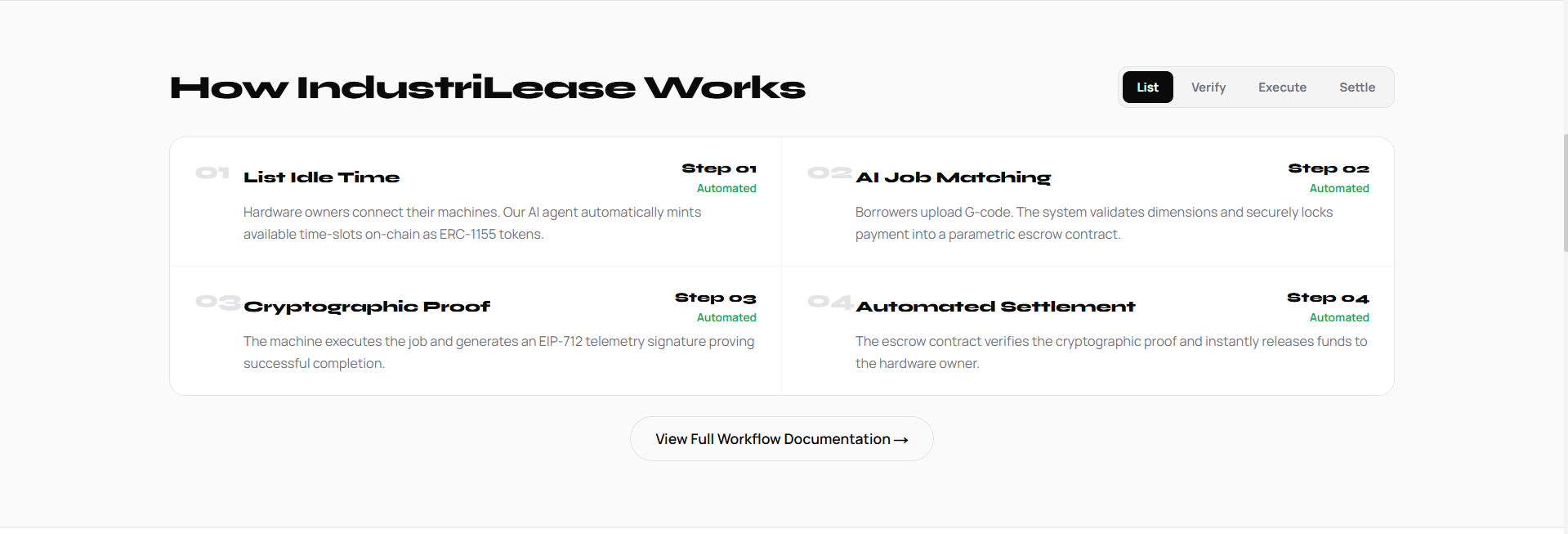
The platform operates as a coordinated loop between the physical hardware, an autonomous AI agent, and blockchain smart contracts:
Downtime Detection and Minting: An AI agent on the factory floor monitors the machine's status. When it detects an idle state, it builds and signs a transaction to mint a new slot token (MachineSlotToken.sol) on-chain.
G-code Sanitization and Booking: A tenant reviews available slots on the Next.js registry and uploads their G-code file. The system sanitizes the file line-by-line against safety limits (such as max extruder temperature of 275°C and feedrates of 5000 mm/min). Once validated, the tenant locks the rental fee into (IndustriLeaseEscrow.sol).
Execution and Telemetry Signing: The AI agent updates the slot status to executing and triggers the simulator run. As the simulator prints, it logs sensor data. On completion, the machine's secure wallet signs an EIP-712 telemetry proof containing the run details (machineId, jobId, layersCompleted, powerDrawAvg, and status).
Automated Settlement: The signed telemetry is relayed to the escrow contract, which uses ECDSA recovery to verify the machine's signature. Once validated, the contract splits the funds: 90% is sent to the factory owner and 10% goes to the protocol treasury, completing a fully automated and trustless cycle.
InudstryLease is built using a modern, multi-layered stack:
Smart Contracts: Solidity smart contracts manage the tokenization logic and financial escrows. Built with OpenZeppelin libraries, they are structured for deployment on the Sepolia Testnet.
Client & Gateway: A Next.js App Router frontend provides intuitive dashboards for both lenders and borrowers, integrating Ethers.js to handle wallet interactions and blockchain relays.
Agent Backend: Written in Python using FastAPI, Uvicorn, and Web3.py to manage background monitoring loops, parse transaction ABIs, and handle off-chain EIP-712 cryptographic signature generation.
Cache Layer: A file-based JSON store acts as a high-speed database cache to merge on-chain slots and handle offline developer fallbacks.
The core architecture is fully functional across several completed integration phases:
Verified Smart Contracts: The tokenization registry and signature-verifying escrow contracts are written, compiling successfully with aligned EIP-712 telemetry struct hashes.
Automated Python Nodes: The telemetry simulator (Simulator.py) and autonomous supervisor (agent.py) are fully functional, successfully producing and relaying Web3 proofs.
API Safety Limits: The Next.js API endpoints are integrated, including the coordinate boundaries and thermal limit checker for G-code inputs.
Looking forward, the InudstryLease roadmap focuses on enhancing security and flexibility:
Account Abstraction: Integrating ERC-7579 scoped session keys so machines can execute autonomous transaction hierarchies without manual wallet approvals.
Secure Enclaves: Implementing client-side CAD encryption (AES-GCM) to ensure designs are only decrypted inside the physical hardware's Trusted Platform Module (TPM).
Decentralized Machine Identity: Establishing on-chain machine identities (DIDs) to track maintenance history, certification records, and verify physical hardware capabilities trustlessly.
InudstryLease addresses critical economic and technological bottlenecks at the intersection of manufacturing, artificial intelligence, and decentralized systems:
Unlocking Wasted Industrial Capital: Globally, billions of dollars of high-end manufacturing machinery (such as metal 3D printers and multi-axis CNC mills) sit idle for a significant portion of their lifespans. InudstryLease creates a frictionless, fractional sharing economy—essentially an Airbnb for advanced manufacturing—allowing factory owners to turn depreciating hardware overhead into active revenue streams.
Democratizing Advanced Manufacturing for SMEs: The capital expenditure (CapEx) required to purchase advanced manufacturing equipment is a major barrier to entry for hardware startups, researchers, and SMEs. By enabling secure, hourly capacity rentals, InudstryLease allows small businesses to access industrial-grade manufacturing resources on-demand, shifting their cost model from heavy CapEx to manageable operating expenses (OpEx).
Establishing the DePIN Trust Layer: While decentralized finance (DeFi) has mastered virtual settlements, connecting blockchain networks to physical hardware execution has remained a challenge. InudstryLease provides a blueprint for DePIN (Decentralized Physical Infrastructure Networks) by ensuring that financial clearing is cryptographically and automatically triggered by physical sensor telemetry.
Eliminating Legal and Administrative Overhead: Standard leasing agreements involve slow credit checks, long-term contracts, and high legal overhead. InudstryLease automates the entire lifecycle—from scheduling to safety validation and final disbursement—reducing transaction friction from weeks to minutes.
Demonstrating Physical Edge Safety in Web3: Connecting web interfaces directly to physical machinery is risky. The project's G-code sanitization pipeline proves that decentralized platforms can safely execute remote instructions, protecting million-dollar machinery from physical damage and overheating while maintaining open access.
We took InudstryLease from a blank project structure to a fully functional, integrated multi-service prototype. Here is the progress achieved:
Designed and Deployed Smart Contracts: We developed and aligned two core Solidity smart contracts configured for the Sepolia Testnet. This included MachineSlotToken.sol (an ERC-1155 token registry that tracks machine capacity slots) and IndustriLeaseEscrow.sol (which locks rental funds and uses EIP-712 signature verification to release them upon job completion).
Created the Layer 1 Hardware Simulator: We built a Python-based hardware simulator (simulator.py) using FastAPI. The simulator runs compressed manufacturing loops and integrates an on-device Ethereum wallet to cryptographically sign telemetry payloads with EIP-712 signatures upon successful job execution.
Built the Autonomous AI Agent: We implemented the AI Agent (agent.py) to run as a background service. The agent autonomously polls the machine's state, mints new slots on-chain when the machine goes IDLE (acting as a restricted session key), and automatically intercepts telemetry proofs to relay them to the blockchain.
Developed the Edge Safety G-Code Sanitizer: We built a custom Next.js safety verification endpoint (/api/gcode/sanitize). It parses 3D printer and CNC instruction files line-by-line before scheduling, verifying temperature limits (nozzle and bed), feed rates, and XYZ motion boundaries to prevent hardware collisions or fires.
Implemented the Next.js Backend & Registry: We established a local JSON-based database cache layer (db.ts) and constructed the API routes (/api/slots) that merge on-chain registry states with local configurations, providing a unified data source for frontend queries.
Verified the Complete End-to-End Loop: We successfully ran integration tests connecting the Python nodes and Next.js services. We verified that booking a slot locks funds, triggers the simulation, generates a hardware-signed proof, and automatically releases the locked funds to the factory owner on-chain.
None