
A free on-chain watchdog for Robinhood Chain: it scans new token launches for what a chart cannot show, and writes every score to an append-only registry on chain 4663.
Robinhood Chain launches thousands of tokens a day. A dated sample on 25 September 2026 counted 1,133 launches, 552 new Uniswap v4 pools and 8 graduations in three hours, roughly 9,000 launches a day. A buyer sees a chart. The chart does not say who can still mint, who holds the supply, or whether the liquidity can leave. The public ecosystem maps list DEXs, launchpads and bridges, and no consumer safety tooling.
KAY9 is that tooling, and it is live on mainnet.
What runs today, on Robinhood Chain mainnet
The watchdog. It follows the launchpads that emit on the chain (Pons, the Uniswap v4 PoolManager, the Uniswap Liquidity Launcher, Doppler, LongLauncher and smaller ones), runs a basic scan on new tokens before anyone asks, and commits the results in batches to KAY9ScanRegistry (0x79778723c021386F3C7727289A30716edaa635A1). Full reports go to IPFS; the on-chain record holds the headline score, confidence, a flag bitmask and the block the scan was pinned to. Live since 25 September 2026: by 26 September it had committed 15 batches, 245 scans and scores for 148 distinct tokens.
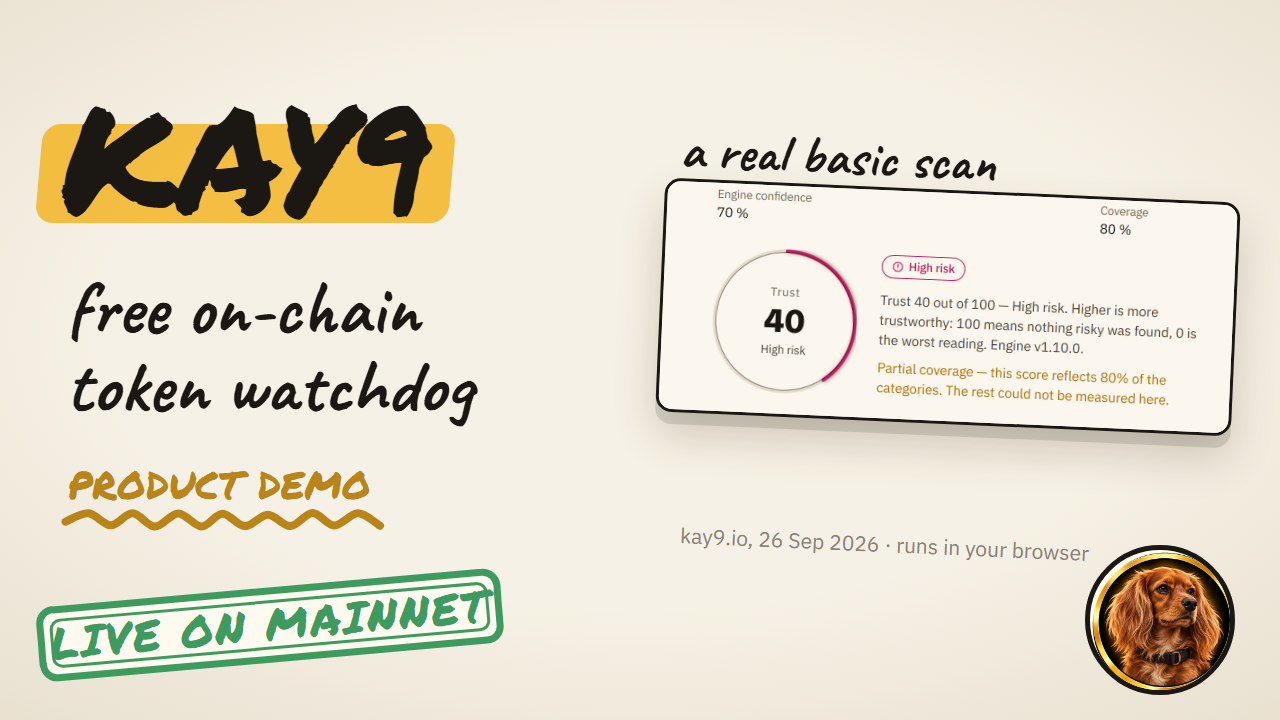
A basic scan anyone can run. On kay9.io the scan runs entirely in the visitor's browser against a public RPC: no server, no wallet, nothing sent to KAY9.
Scans on X. Mention @kay9_io scan <address or $TICKER> and the bot replies with a scan, on Robinhood Chain, BNB Chain or Solana.
USDG-aware liquidity. Most Pons launches graduate into a pool paired with USDG, not ETH. The engine prices USDG-side depth from the median of three deep native/USDG v4 pools read at the analysis block, with no oracle or third-party feed, and reads who actually holds each v4 liquidity position.
Honest by construction
A report is appended, never overwritten: a changed score is a new entry, so a token has a history, not a single number that can quietly change.
Under 60 % coverage there is no headline score; the scan says "Insufficient data" instead of guessing.
Requester neutrality: nobody can pay for a better score, and a creator's self-declaration is recorded as declared, not verified.
The wording is "KAY9 Technical Risk" and "KAY9 Audit Completed", never "safe".
Deep audits, and why there is a token
Deeper audits run through KAY9AuditHub: three auditors analyse the same token pinned to the same block, and a report publishes only with a two-of-three quorum of signed attestations. Disagreement becomes an on-chain Disputed state rather than a silent average. No audit tier has a fee. Access is a lock: a holder locks a fixed amount of KAY9 in KAY9AccessVault for 30 days and gets the full amount back, with no yield, no slashing and no owner function that can move it.
The token itself launches fairly: fixed 1,000,000,000 supply with no mint, tax, blacklist, pause or proxy; a 24-hour Uniswap Continuous Clearing Auction; every ETH raised goes into a Uniswap v4 pool at a 1 % fee whose liquidity is locked with no withdrawal path; 9 % team allocation vested at fixed calendar dates. The target date is 10 November 2026, and it is gated on 14 written conditions (4 met so far), including 30 days of the watchdog running unattended on mainnet.
Contract quality
Foundry suite of 321 tests across 24 suites plus 3 fork tests against live Robinhood mainnet state; fuzzing on the launch path; Slither on the final contract tag; full launch-cycle rehearsals on Robinhood testnet 46630 (launch, bid, graduate, migrate, claim, lock, request, attest, dispute, expire, upgrade); model reviews from two vendors (OpenAI and Anthropic) with every finding fixed and the reviews published verbatim. All deployed contracts are governed by a 48-hour timelock.
What is not done yet, stated plainly
Two of the three auditor keys are held inside the project (the developer's and the owner's; the third is with an outside person), and the threshold is two. So the quorum is not independent of the project yet. It becomes so when two keys are held outside it; that is on the roadmap, not claimed.
No deep audit has been published yet. The access vault that grants deep-audit quota deploys with the token, so the deep-audit path has run on testnet only; what runs on mainnet today is the watchdog, the basic scan and the on-chain record.
The public mainnet RPC is pruned, so creator-history signals report as unmeasured at the basic tier rather than as clean.
No paid third-party audit firm has reviewed the contracts yet.
Work between 14 September and the submission, all in the public git history of github.com/kay9T/kay9-protocol:
Mainnet. Deployed the watchdog stack to Robinhood Chain mainnet on 25 September (KAY9ScanRegistry, KAY9AuditHub, KAY9Registry, KAY9AuditorRegistry, all behind a 48-hour timelock) and started the 30-day unattended run at block 71,926,233.
Engine 1.9 → 1.10. No headline score under 60 % coverage; USDG pool pricing from on-chain v4 pools; reading who holds each v4 liquidity position.
Reviews and fixes. Remediated an external snapshot review (21 findings), then ran model reviews of the launch path and of the watchdog stack from two vendors, fixed every finding across several rounds and published the reviews.
Rehearsals. Ran the full launch and audit cycle on Robinhood testnet 46630 more than once. The rehearsal caught a real bug: a bid of exactly the graduation threshold was credited one wei short and could never graduate; fixed and re-run.
Product. Live watchdog feed on the kay9.io home page (three launches scanned at once), scan replies on X across three chains, the site in 13 languages, a score calibration run on 74 Robinhood Chain tokens, and a supply API for listing sites.
Before the Buildathon: the token, launch, access-vault and audit-hub contracts, the basic scan engine and the website existed in a first version (September 2026).
Not raised; self-funded. There is no presale and no private round. The only sale is the public 24-hour auction, and all of its ETH goes into locked liquidity, not to the team. Outside money would go to two things: an archive RPC node, so creator history can be measured, and independent operators for two of the three auditors.