
dPay - a non-custodial family budget management app powered by Metamask ERC-7715 delegation and Envio Indexer.
dPay — Delegated Family Payments
Here is a clean, submission-ready version with only headings, paragraphs, and simple lists. No boxes, emojis, tables, or diagrams.
Tagline: Your family's wallet, your keys, your control.
Managing family finances on-chain is fundamentally broken. If a family head wants to give spending money to a spouse or children, the available options are unsafe or inefficient.
The first option is transferring funds directly to another wallet. This immediately breaks custody, as once the funds are sent, there is no control over how they are spent and no way to revoke access.
The second option is sharing private keys. This is extremely insecure and exposes the entire wallet to misuse or loss.
Web2 payment apps solve this problem using custodial accounts, but this introduces centralization risks. Funds can be frozen, limits can be changed arbitrarily, and users are locked into closed ecosystems.
There is currently no non-custodial way to grant controlled spending access to family members while retaining full ownership of funds.
dPay is a non-custodial family budget management application built using ERC-7715 delegation.
The family head holds all funds inside a single smart account that acts as a family vault. Instead of transferring funds, the family head delegates spending permissions to family members.
Each member receives the ability to spend up to a predefined limit directly from the vault. No private keys are shared, no funds are pre-transferred, and custody always remains with the family head.
Permissions can be updated or revoked instantly at any time.
The family head creates a smart account vault that holds all family funds.
Using ERC-7715 delegation, the family head assigns spending permissions to family members with clearly defined limits and durations. For example, a monthly allowance for a spouse or a weekly allowance for children.
When a family member wants to make a payment, they redeem their delegation. The transaction executes directly from the family vault while enforcing the assigned spending rules.
All spending activity is indexed in real time and displayed in a unified dashboard. If needed, the family head can revoke access instantly with a single transaction.
dPay is fully non-custodial. The family head always retains full ownership of funds and only delegates spending capability.
Budgets are granular and configurable per member, supporting weekly, monthly, or custom time periods.
All spending limits are enforced on-chain through smart contract enforcers and cannot be bypassed.
Access revocation is immediate and does not rely on any centralized intermediary.
Family members do not need to pre-fund their wallets to spend.
The system supports any ERC-20 token.
The smart contract layer uses MetaMask’s DelegationManager to manage permissions, a SpendingLimitEnforcer to enforce budget constraints, and a TimestampEnforcer to handle expiry of delegations.
Envio HyperIndex indexes delegation redemption events, decodes actual spend amounts, tracks per-member usage, and exposes this data via a GraphQL API.
The backend is built on Supabase and handles authentication, family and room management, delegation metadata, and fast aggregation of indexed data.
The frontend provides a family dashboard with spending analytics, per-member budget views, and one-click delegation and revocation flows.
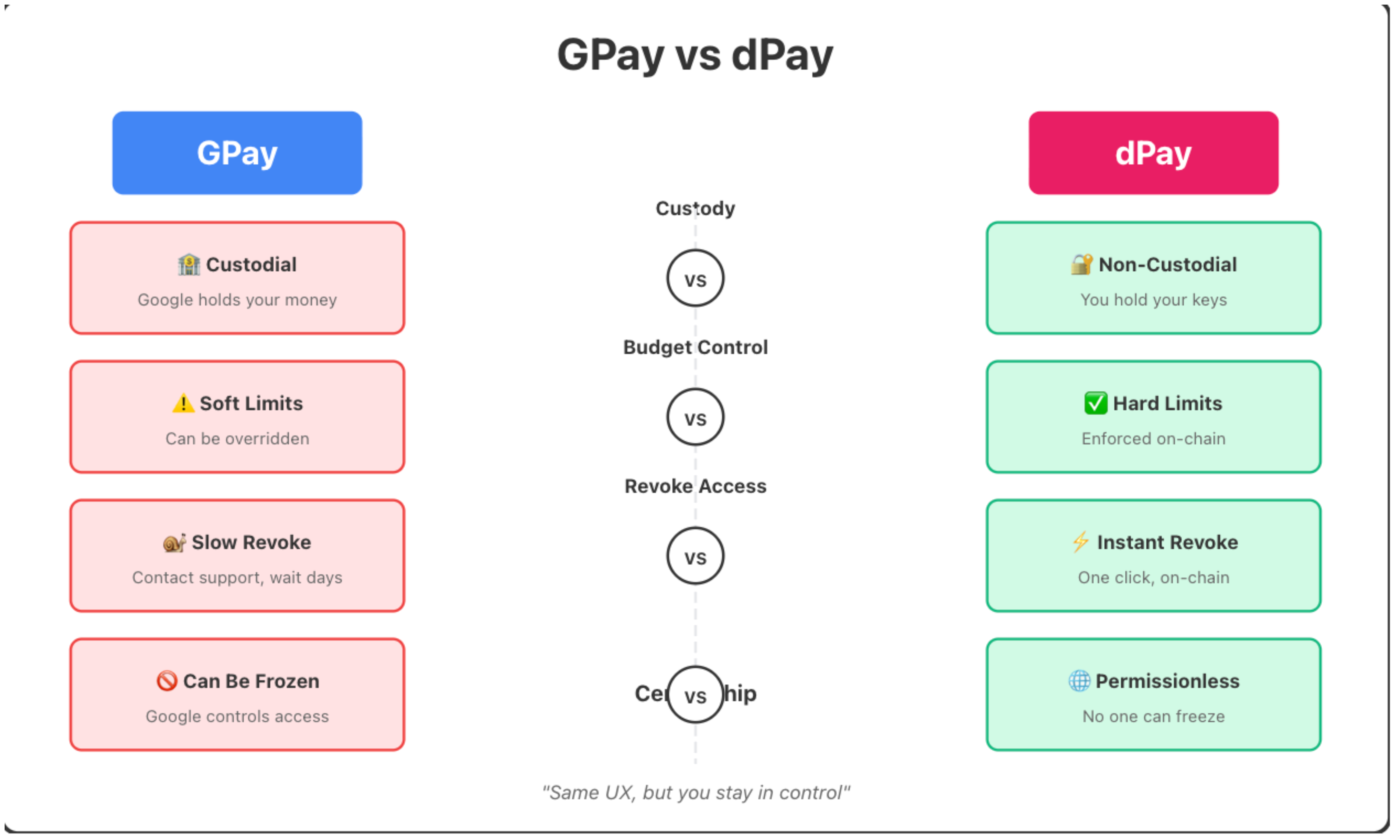
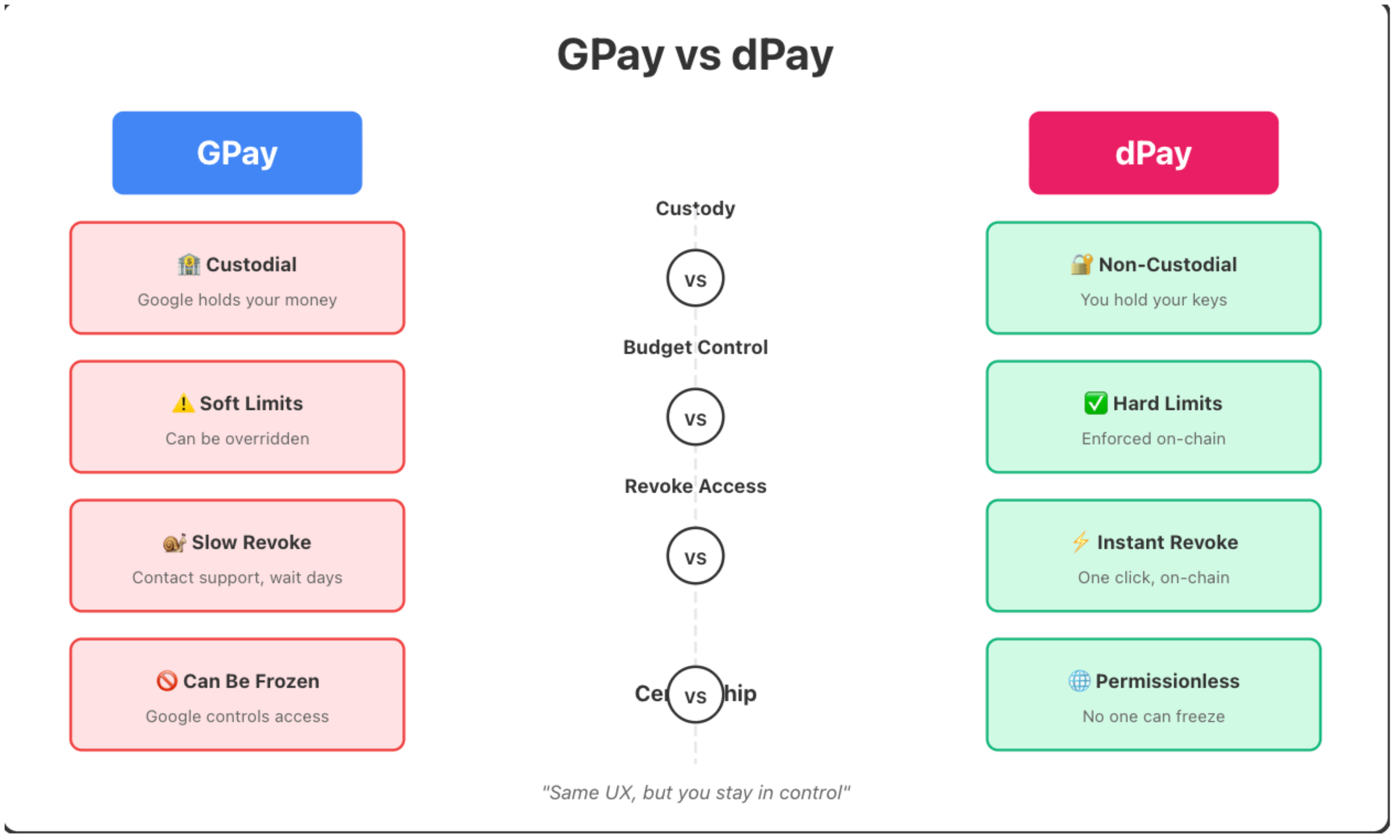
Unlike custodial payment apps, dPay does not hold user funds. All assets remain under user control.
Budget limits are enforced on-chain rather than being soft or overrideable.
Access can be revoked instantly without contacting support.
The system is permissionless and resistant to censorship or account freezing.
Parents can give children weekly allowances without transferring tokens.
Spouses can manage shared household expenses from a single family vault.
Caretakers can be granted limited spending access for elderly family members.
Travel budgets can be delegated with automatic expiration.
Exact amounts can be delegated for shared or recurring subscriptions.
Blockchain networks include Base Sepolia and Sepolia.
Delegation is implemented using the MetaMask Delegation Framework based on ERC-7715.
Indexing is powered by Envio HyperIndex.
The backend uses Supabase.
The frontend is built with Next.js, React, and Tailwind CSS.
Wallet support includes MetaMask and WalletConnect.
Introduce multi-signature family vaults for high-value spending approvals.
Add merchant whitelisting to restrict where delegated funds can be spent.
Implement real-time spending notifications.
Support budget rollovers for unused allowances.
Launch a mobile application with push notifications.
Live Demo: https://dpay-zeta.vercel.app/
GitHub: https://github.com/dumprahul/dpay
Video:
Done by Rahul Shanmugam S
What's Next
- Integrate ENS
- Multi-sig family vaults (require 2 parents to approve large spends)
- Merchant whitelists (kids can only spend at approved stores)
- Spending notifications (real-time alerts when family members spend)
- Budget rollover (unused allowance carries to next period)
- [ ] Mobile app with push notifications