
A Stylus-Compiled Investor-Grade RWA Tokenization Engine for Community-Led EV Charging Infrastructure on Arbitrum.
1. Our Demo Video (Youtube) 🌐Watch It!
2. Our Pitch Deck (PDF) 🌐Read It!
3. Our ChargeFrog Super App (Deployed on Arbitrum Sepolia Testnet) 🌐Try It!
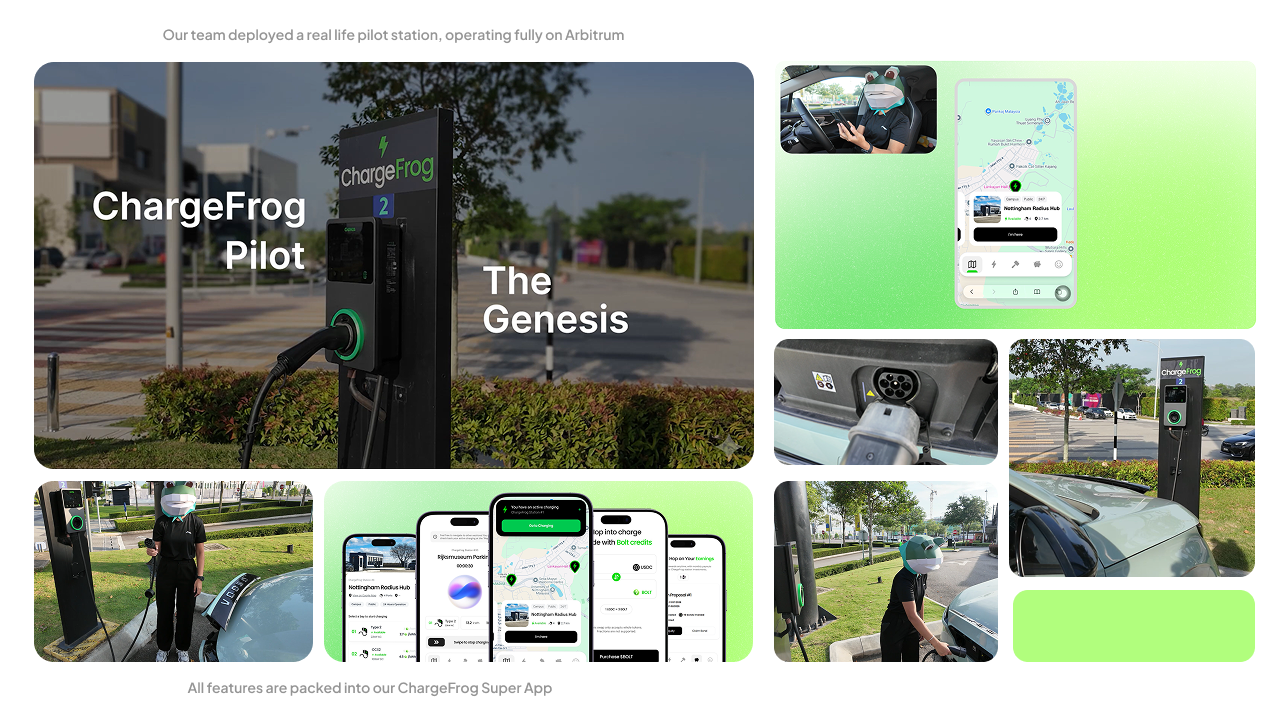
Watch our demo video for a technical deep dive into our system architecture, engineering design, and implementation. It showcases how the ChargeFrog Super App on Arbitrum interacts directly with our custom-engineered pilot charging station — deployed in the real world and successfully used to charge an actual EV.
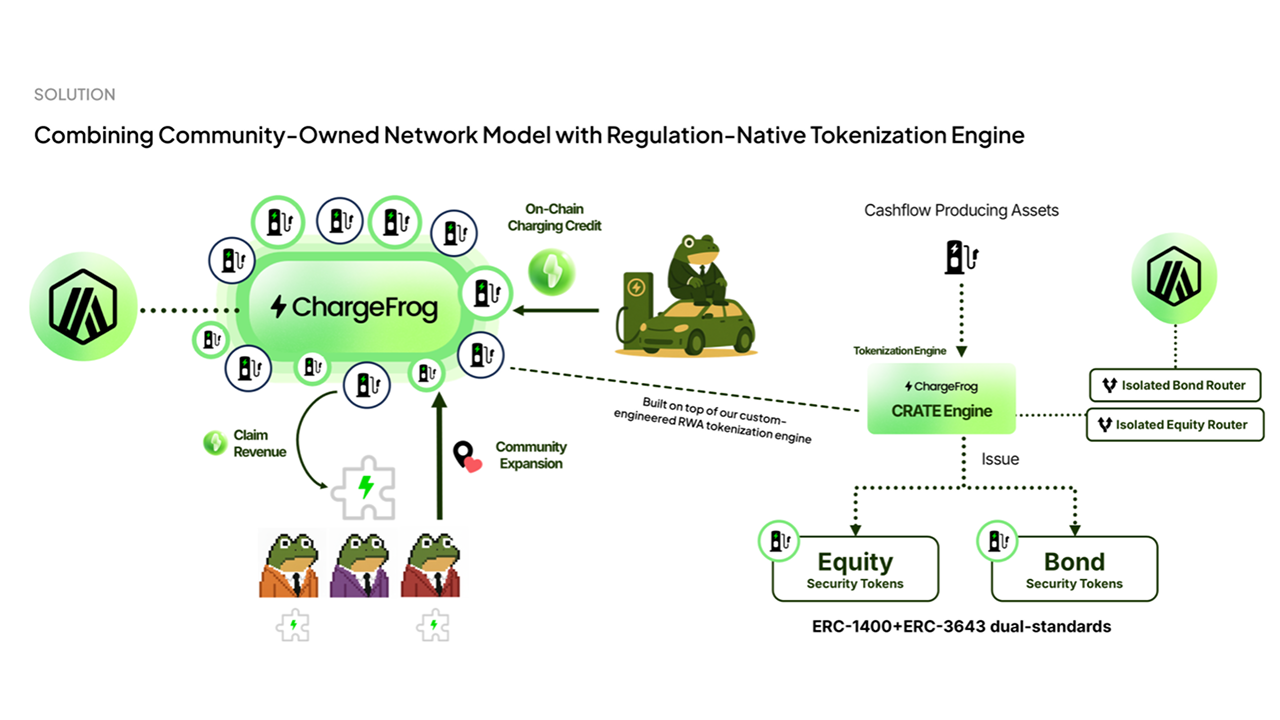
ChargeFrog turns EV charging into a verifiable on-chain business on Arbitrum: real stations, real usage, real revenue—recorded end-to-end. It tackles charging deserts by letting the community propose locations and funding each new station through fractional on-chain investment, removing high-capex gatekeeping. EV drivers pay with Bolt, an ERC-20 charging credit enforceable on-chain and spendable only at authorized ChargeFrog stations, making every charging session a provable revenue event rather than a black-box metric. Stations are funded as regulated on-chain securities, where investors receive tokenized equity or bond exposure and claim revenue pro-rata via record-date snapshots and on-chain eligibility checks.
This is powered by CRATE—ChargeFrog Regulated Asset Tokenization Engine, Arbitrum’s first end-to-end framework for investor-grade RWAs, issuing equity and bond security tokens using ERC-1400 + ERC-3643, enforcing identity-based compliance, and anchoring legal documents on-chain via ERC-1643. The result: build the network, own the cashflows, and prove everything on-chain—ChargeFrog is built to define a RWA standard on Arbitrum.
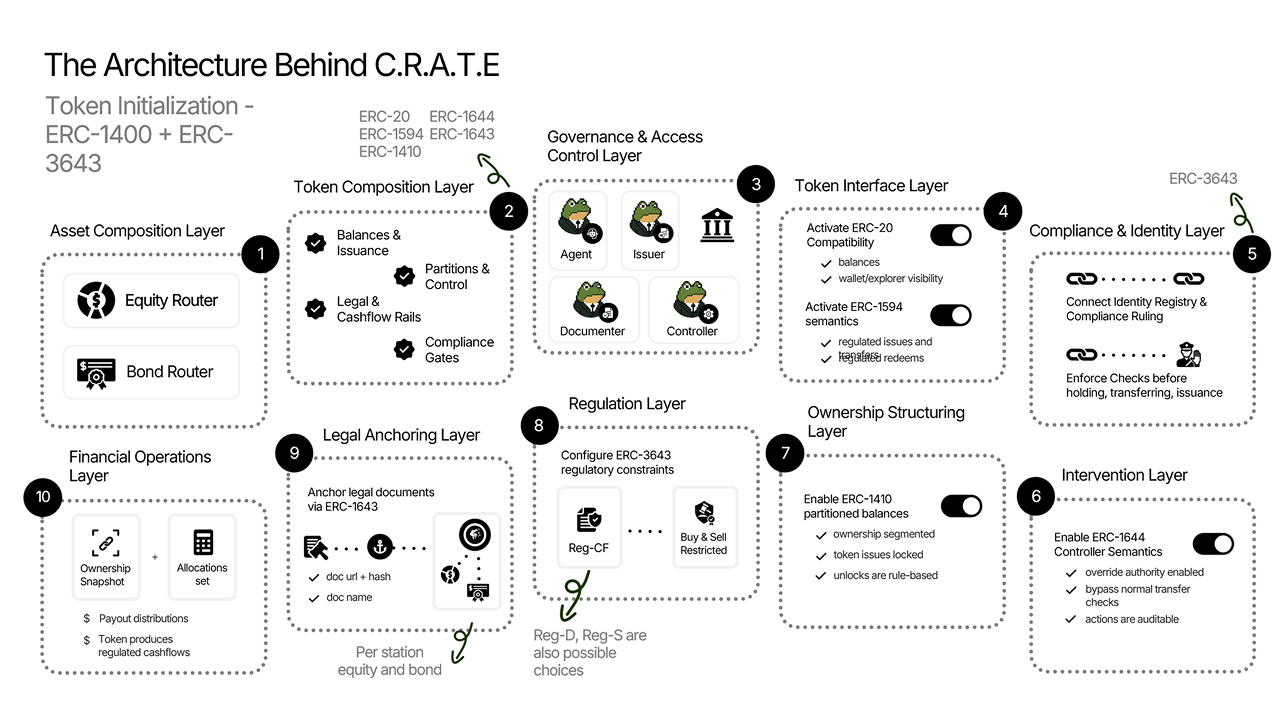
CRATE is structured as a deca-layer architecture—ten tightly integrated layers spanning asset composition, governance, compliance, regulation, intervention controls, ownership structuring, legal anchoring, and financial operations. Each layer encodes a specific institutional function directly on-chain, ensuring separation of powers, enforceable compliance, and auditable cashflow execution by design.
The whole engine smart contract layer is written in Rust, compiled with Stylus, and deployed on Arbitrum. We now have a lower gas cost for complex tokenization, access to more language ecosystem, and having a fraud proof security.
Charging Infrastructure Lag vs EV Adoption
EV adoption is scaling faster than charging deployment due to capital intensity, fragmented operations, and slow financing mechanisms — creating underserved “charging deserts.”
Infrastructure Investment Is Closed to Communities
High capex requirements and regulatory complexity prevent retail or local investors from participating in EV infrastructure ownership, concentrating deployment power among large operators.
Most RWAs Lack Enforceable Rights
Existing tokenization solutions often represent ownership symbolically while shareholder rights, compliance enforcement, and corporate actions remain manual or off-chain.
Missing Institutional RWA Primitives on Arbitrum
Developers lack standardized identity gating, compliant issuance workflows, legal anchoring, and deterministic payout rails — forcing teams to rebuild credibility infrastructure from scratch.
We shipped a working MVP on Arbitrum Sepolia demonstrating a regulation-aware infrastructure financing protocol where real EV charging usage generates verifiable on-chain cashflows, compliant ownership, and deterministic investor distributions — transforming EV infrastructure into a composable, community-owned RWA asset class.
12 main efforts of our team in this hackathon:
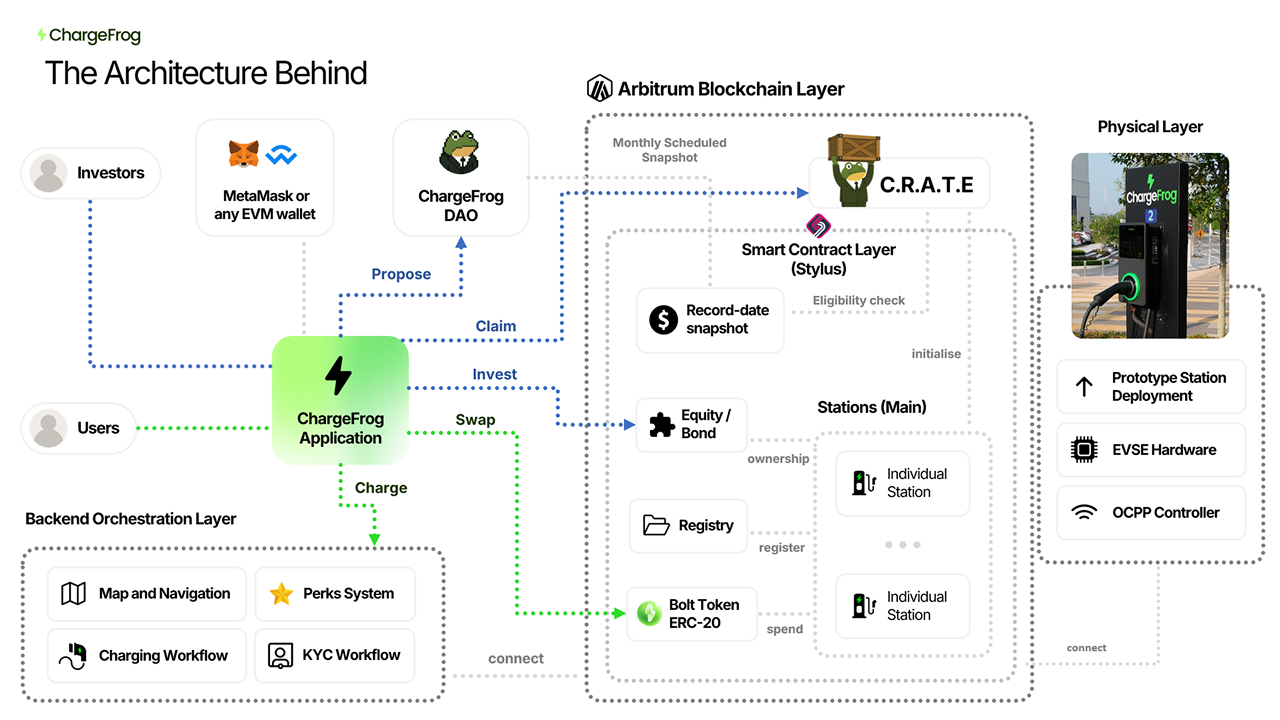
We built a full lifecycle bridge between real-world EV charging hardware and Arbitrum smart contracts, where EVSE charging events (session authorization, metering, settlement) become signed inputs driving deterministic on-chain state transitions. Every charging session becomes a verifiable revenue event recorded immutably on Arbitrum, eliminating opaque backend accounting and transforming infrastructure utilization into cryptographically provable financial truth.
We engineered CRATE (ChargeFrog Regulated Asset Tokenization Engine), a composable institutional-grade asset framework enabling compliant issuance of digital securities using ERC-1400, ERC-3643, ERC-1643, ERC-1594, ERC-1410, and ERC-1644 standards. Rather than tokenizing representations, CRATE composes enforceable shareholder and bondholder rights directly into protocol execution — including issuance constraints, identity gating, transfer validation, disclosure anchoring, and controller intervention semantics.
Each EV charging station is initialized as isolated Equity and Bond assets with independent treasuries, governance roles, compliance registries, and storage boundaries. This eliminates cross-asset contagion risk and enables independently auditable infrastructure financing where governance authority, entitlement accounting, and operational risks remain scoped per station.
Investment is executed as a protocol-enforced issuance rather than an off-chain subscription workflow. Capital flows directly into station treasuries while ERC-1594 compliant digital securities mint atomically upon successful ERC-3643 identity validation. Ownership finality, compliance enforcement, and treasury funding occur within a single transaction boundary — removing custodial ambiguity and delayed allocation risk.
We implemented corporate finance primitives directly on-chain, including record-date snapshots, entitlement computation, fully funded payout pools, eligibility revalidation, and claim windows. Monthly revenue distributions execute as deterministic corporate actions rather than discretionary payouts, ensuring pro-rata settlement strictly based on snapshot ownership using ERC-1410 partitioned balances.
We introduced Bolt, a protocol-restricted ERC-20 charging credit that can only be spent at authorized ChargeFrog stations. Smart contract enforcement ensures every token spend maps to a specific station and session, routing funds into station treasuries automatically. This creates a closed-loop payment rail where consumption directly produces investor revenue attribution without reconciliation layers.
Compliance enforcement occurs pre-issuance, pre-holding, and pre-transfer through ERC-3643 identity registries backed by off-chain KYC providers. Regulatory constraints such as Reg-CF eligibility are enforced as executable logic rather than operational policy, enabling jurisdiction-aware participation while maintaining permissioned ownership semantics.
Core economic and compliance logic executes through Rust-based Stylus smart contracts compiled into WASM for deterministic execution with EVM interoperability. This architecture enables complex financial computation — snapshot accounting, partition enforcement, payout validation, and authorization controls — without sacrificing gas efficiency or composability within Arbitrum’s ecosystem.
We built an immutable Station Registry smart contract acting as the single source of truth for network governance and lifecycle orchestration. It tracks proposal submission, funding rounds, issuance state, operational transitions, and authorization eligibility, ensuring backend orchestration cannot override infrastructure ownership or operational state.
We delivered a unified DApp integrating charging UX, regulated investment onboarding, credit swaps, station governance, and investor claims. The application acts as a signed transaction interface submitting verifiable operations to Arbitrum — abstracting Web3 complexity while preserving non-custodial ownership and protocol enforcement.
We implemented governance rails allowing users to propose new station locations and push successful proposals into compliant funding rounds. Capital allocation becomes demand-driven rather than operator-controlled, directly addressing charging desert deployment inefficiencies through market signaling encoded on-chain.
From capital inflow → charging usage → treasury accounting → snapshot entitlement → payout claim, every economic transition emits verifiable on-chain events. The system eliminates spreadsheet reconciliation and post-hoc audits by embedding auditability into execution itself.
ChargeFrog is an early-stage initiative, and our participation in the Arbitrum Open House NYC: Online Buildathon is focused on raising seed funding to bring the idea to life and execute a well-defined pilot phase.