
Escrow that makes silence unprofitable — USDG bounty escrow, on-chain revenue splits and an AI critic for creators. Live on Robinhood Chain Testnet + Arbitrum
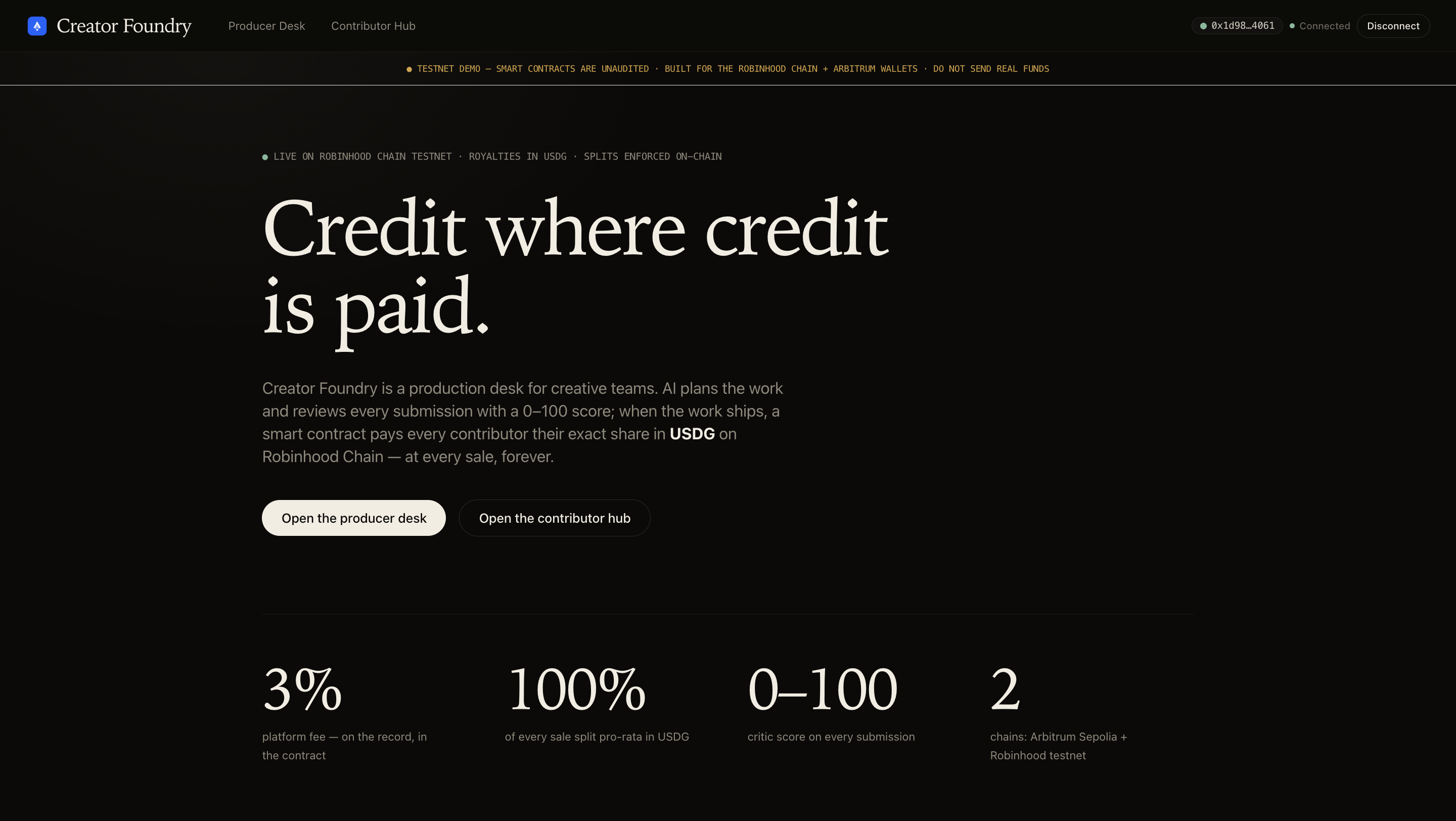
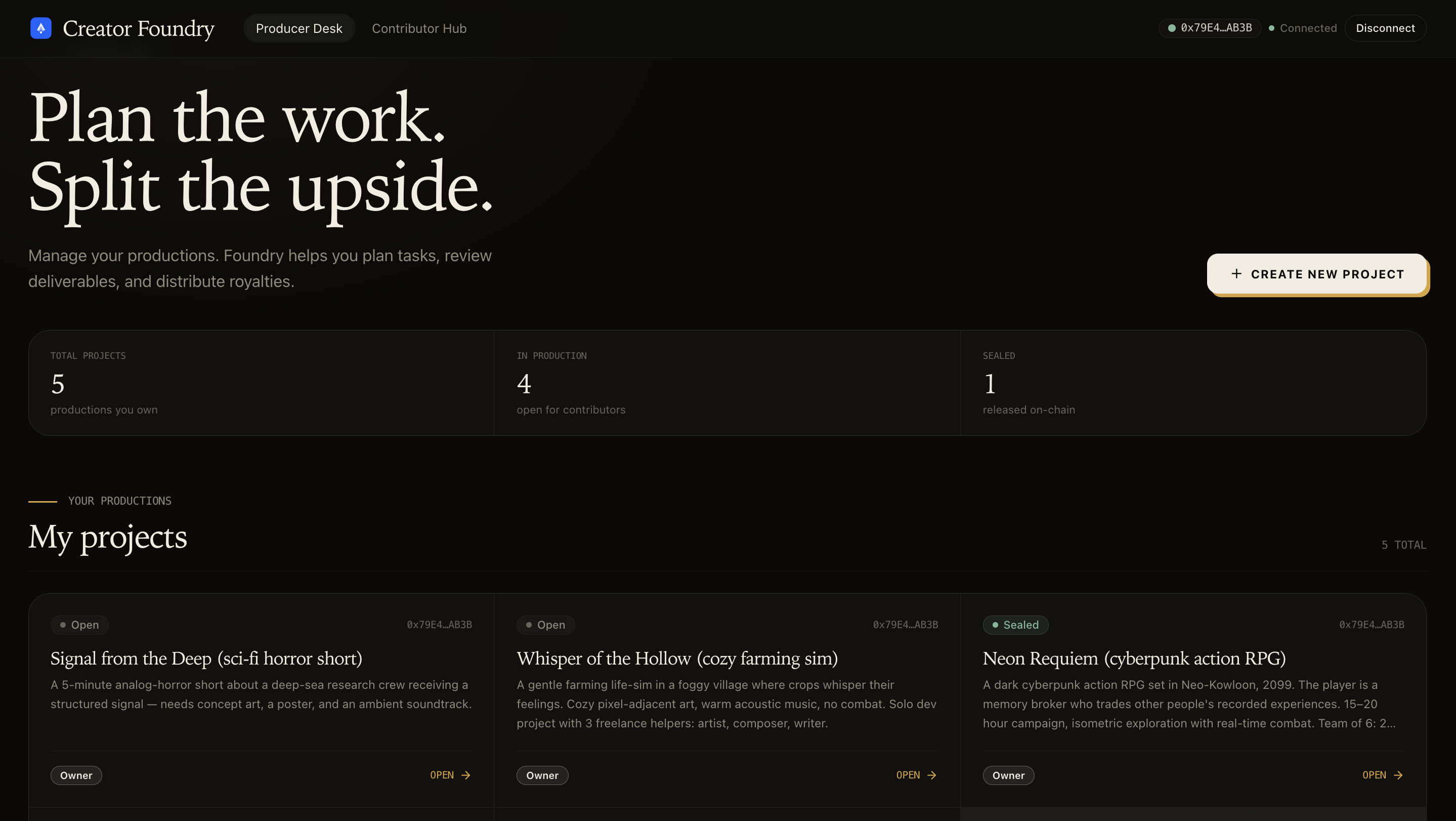
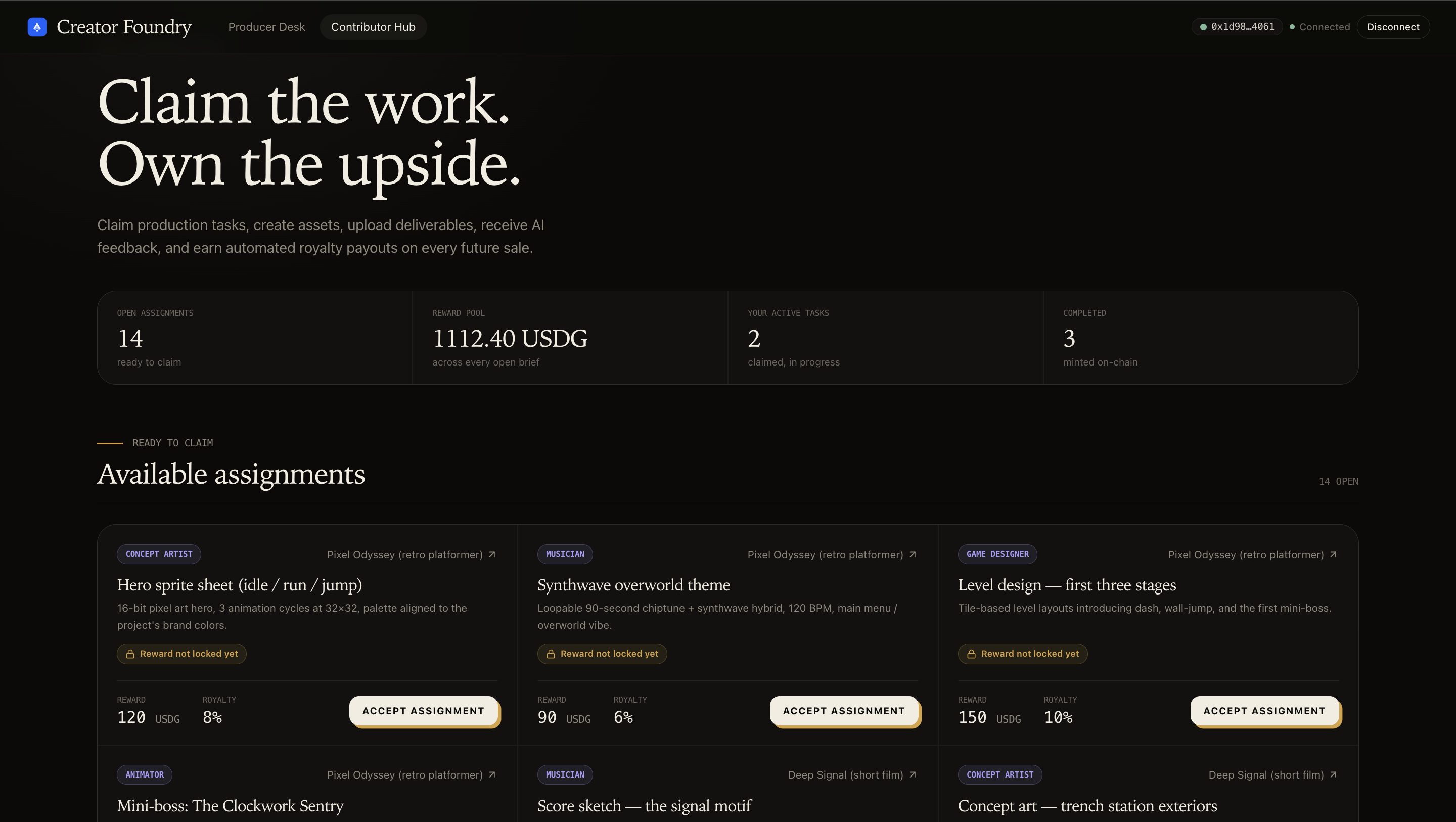
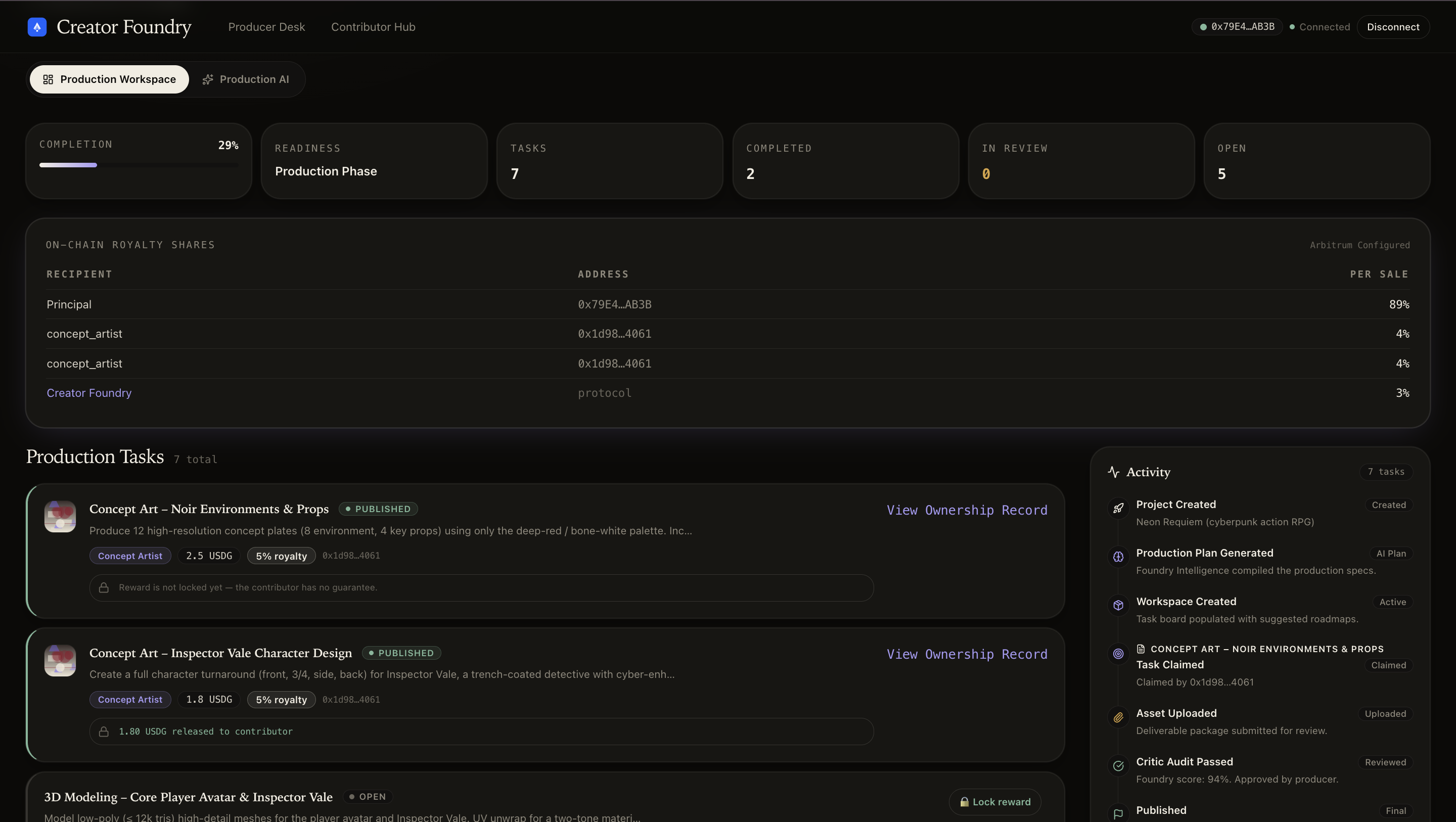
Creator Foundry is an AI-powered creative production protocol where contributor rewards are locked on-chain before work begins.
The problem: Creative work is often commissioned on trust. Contributors spend days producing assets before payment is guaranteed, while attribution, royalties, and revenue splits are frequently handled off-chain through spreadsheets or centralized platforms.
Creator Foundry changes that workflow by making the financial commitment, authorship, review, and revenue distribution verifiable on-chain.
How it works:
AI plans the production. An AI production director converts a creative brief into scoped bounties containing the role, reward, and deliverable requirements, while maintaining persistent project context such as genre, palette, and characters.
The reward is locked before work starts. The producer deposits Paxos USDG into
BountyEscrowtogether with a hash of the brief. The contributor can verify that the reward is already funded before accepting the work.The contributor delivers and attests. After completing the work, the contributor submits the deliverable and signs its hash through
attestDelivery(), creating a verifiable link between the submission and the on-chain record.AI evaluates the work. A trained critic scores the submission from 0–100 using a frozen CLIP ViT-B/32 model with a trained MLP head. It evaluates style consistency, palette match, and technical quality against the project's art direction. The model is deterministic: identical inputs produce identical scores.
One approval creates proof and releases payment. Approval simultaneously mints an ERC-721 proof-of-authorship NFT with ERC-2981 royalty support and releases the escrowed USDG. The critic score and artifact hashes are included in the token metadata, making the review part of the provenance record.
The escrow has independent safety clocks. The delivery and review stages use separate bounded time windows. If the delivery deadline passes without delivery, the producer can reclaim the escrow. If the producer fails to review a completed delivery within the review window, anyone can trigger
autoRelease(), allowing the contributor to receive the locked reward without depending on the producer.Future sales distribute revenue pro-rata on sale, permissionlessly. An immutable on-chain split table records contributor shares. When a work is sold, permissionless
release()distributes USDG pro-rata to the participants. The platform fee is explicitly represented on-chain and capped by the contract.Proven on-chain — not mocked.
The complete bounty lifecycle has been executed on Robinhood Chain Testnet using real Paxos USDG:
fund → assign → mint authorship NFT → release escrow — AI score 80
The resulting on-chain state confirms the escrow was released, the contributor balance increased from 0 to 1.8 USDG, and
ownerOf(1)points to the contributor.The royalty lifecycle was also executed:
commit immutable split table → sell artwork for 3 USDG → permissionless
release()— shares paidEvery stage is represented by an actual transaction and can be independently verified.
Chains & contracts: Robinhood Chain Testnet (Chain ID 46630, Arbitrum Orbit) is the primary demo network, with Arbitrum Sepolia (421614) also supported. The deployed
AssetNFT,Splits, andBountyEscrowcontracts are source-verified. The repository includesnpm run verify, which performs 37 read-only verification checks covering contracts, transaction records, escrow state, NFT ownership, split configuration, and balances — no wallet or private key is required.Stack: Next.js 14 · TypeScript · wagmi/viem · RainbowKit · Solidity 0.8.26 · Python · FastAPI · PyTorch · CLIP · Paxos USDG