
Mannan Singh Negi
3
文章
1421
查看
0
关注者
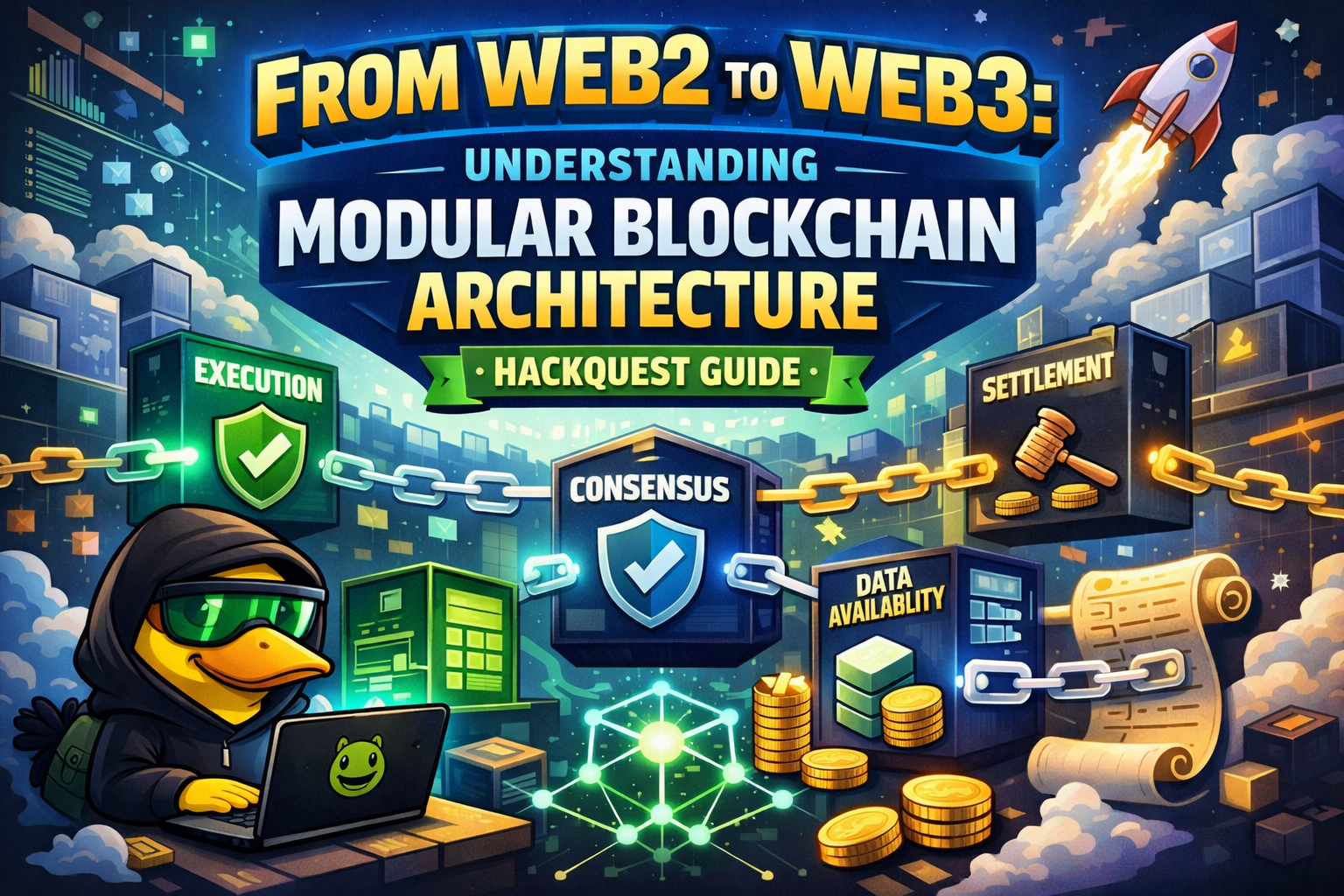
🦆 From Web2 to Web3: Understanding Modular Blockchain Architecture (HackQuest Guide)
Introduction
As Web3 grows, blockchains are expected to handle more users, more transactions, and more applications—without becoming slow or expensive.
This is where Modular Blockchain Architecture comes in.
In this blog, I’ll explain:
What modular blockchains are
Why monolithic blockchains struggle
How modular architecture improves scalability, flexibility, and performance
Why this concept matters for Web3 builders
All insights are based on learnings from HackQuest.
🧱 What Is a Monolithic Blockchain?
Traditional blockchains like early Ethereum follow a monolithic architecture, where a single layer handles:
Transaction execution
Consensus
Data availability
Settlement
Problems with Monolithic Design:
❌ Scalability bottlenecks
❌ High gas fees during congestion
❌ Limited flexibility for innovation
When everything runs on one layer, optimization becomes difficult.
🔗 What Is Modular Blockchain Architecture?
A modular blockchain separates blockchain responsibilities into different layers, each optimized for a specific task.
Core Layers in Modular Architecture:
Execution Layer
Handles smart contracts and transactionsConsensus Layer
Ensures agreement between nodesData Availability Layer
Makes transaction data accessible and verifiableSettlement Layer
Finalizes transactions and resolves disputes
Each layer can be upgraded independently, without affecting the whole system.
🚀 Why Modular Architecture Improves Performance
✅ Independent Optimization
Each layer focuses on doing one job extremely well.
✅ Better Scalability
Execution can scale separately using rollups or app-specific chains.
✅ Lower Costs
Reduced congestion → lower gas fees.
✅ Faster Innovation
Builders can experiment without risking the base layer.
🧠 HackQuest Insight: Why Builders Should Care
From HackQuest learnings, modular blockchains are not just a theory—they’re the future foundation of Web3.
For builders, this means:
Easier deployment of scalable dApps
Better performance under heavy traffic
Freedom to build app-specific chains
Understanding modular architecture gives developers a huge advantage in Web3 system design.
🛠 Example Use Case
Imagine a gaming dApp:
Needs fast transactions
Can’t afford high gas fees
Requires frequent updates
With modular architecture:
Game logic runs on a fast execution layer
Security is inherited from a strong settlement layer
Data is stored efficiently
Result → smooth gameplay + secure blockchain.
🌱 Final Thoughts
Modular blockchain architecture is a game-changer for Web3 scalability and innovation.
If you’re serious about building in Web3, learning this concept early—like we do in HackQuest—puts you ahead of the curve.
Let’s keep learning, building, and growing the Quack State 🦆💛
#Web3 #Blockchain #ModularBlockchain #HackQuest #QuackState #Web3withHQ