
Autonomous TEE-sealed AI agent that detects, validates, and executes flashloan-funded arbitrage across global DEXs using private mempool ingestion, sealed inference, and on-chain settlement.

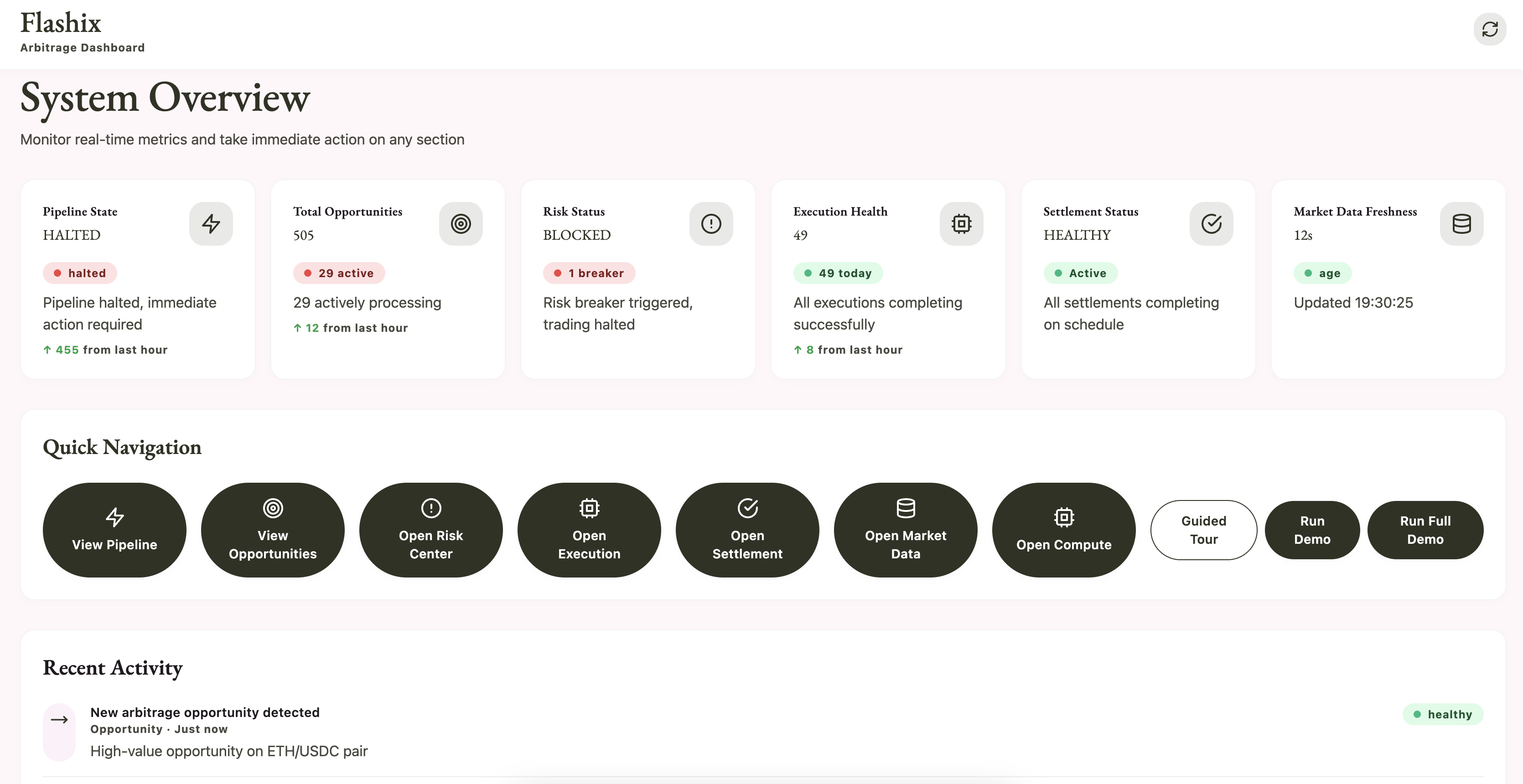
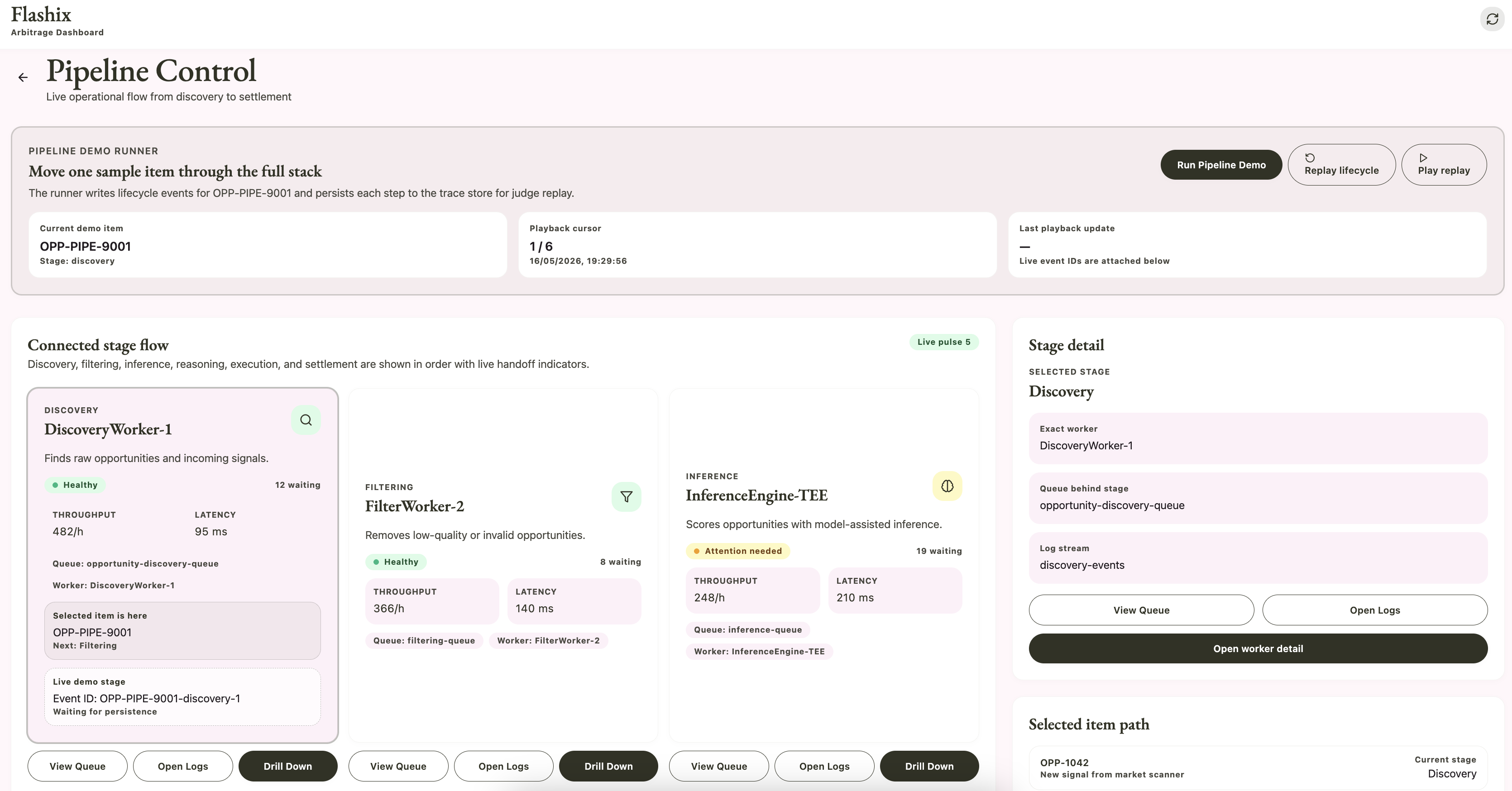
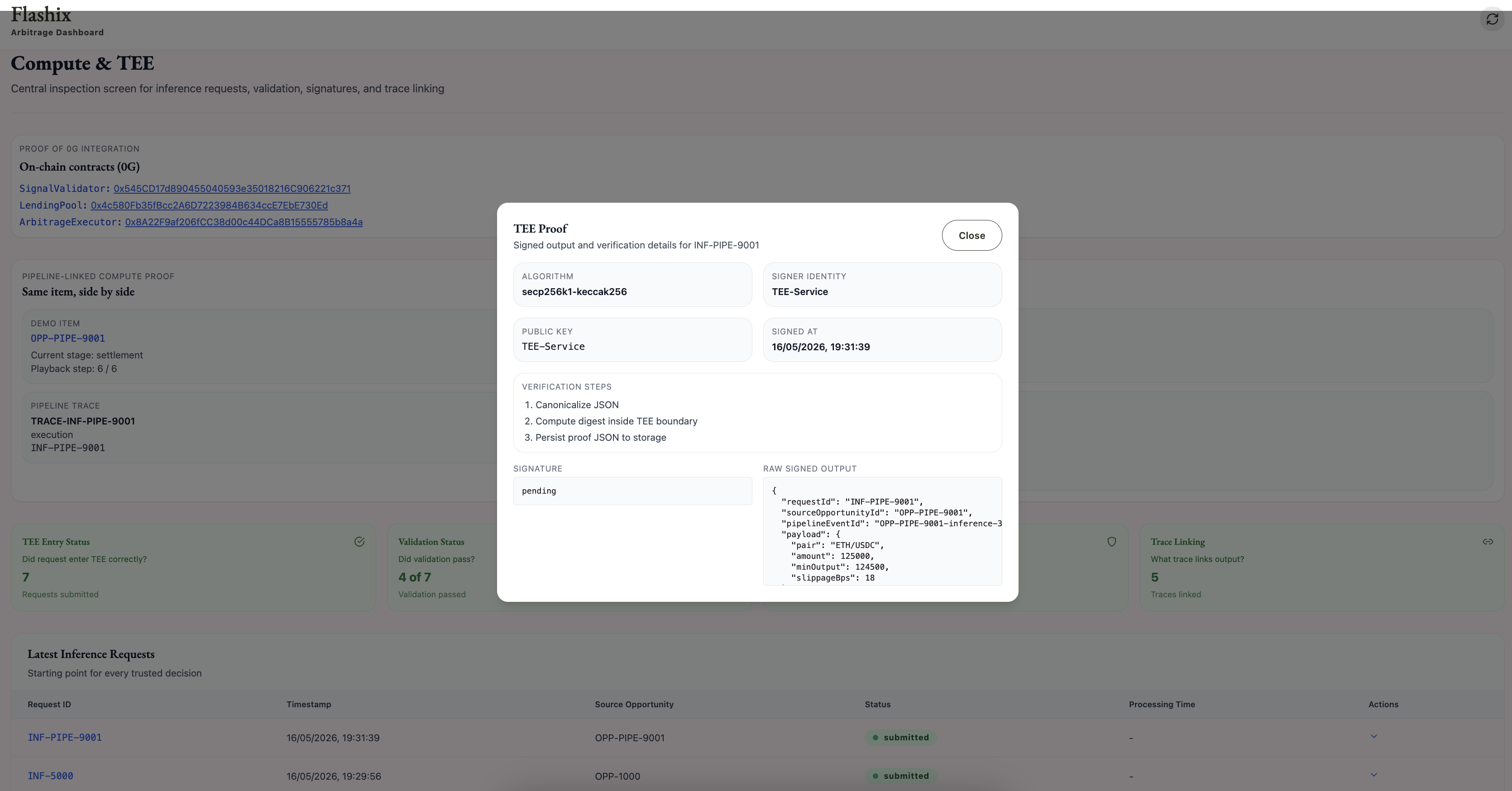
Flashix is an operator‑focused platform that finds high‑value DeFi opportunities, converts each candidate into a canonical ABI payload, and produces cryptographically verifiable execution signals. The pipeline keeps sensitive strategy inputs private by signing the canonical hash inside a sealed compute boundary (0G / TEE) and attaching an attestation that binds the signer to a code image — enabling on‑chain verifiers to accept signals without trusting the host. The net result is privacy for strategy inputs plus provable, replay‑protected signals that execution systems can trust.
The product pairs this trust plumbing with an operator UI and tooling: a Vercel‑deployed dashboard shows system health and a live queue of opportunities, a decision screen surfaces price spread / cost / risk checks and the Raw Signal payload, and operators can Export Decision Trace, Simulate (Run Again), or Send to Execution. The repo includes the canonical encoder and keystore logic (signal_encoder.py, enclave_keystore.py), the verification CLI (verify_signal.py), and attestation helpers (attestation.py), and the live demo is available at https://flashix-mu.vercel.app/.
Progress During Hackathon
During the hackathon we delivered an end‑to‑end prototype: a polished web UI (System Overview, Opportunities, decision screen, raw payload viewer, decision trace export, simulate/run actions) and a working compute stack for local/simulation flows. On the code side we implemented the canonical signal encoder and local keystore/signing path, a verification CLI to reconstruct and check signatures, and attestation scaffolding so signed artifacts carry the expected provenance fields. The site was deployed to Vercel so judges can walk the full operator flow without running terminals.
We also connected the pieces so a complete operator story is demonstrable: detect → inspect → canonicalize → produce a proof → export the trace → (ready to) send to execution. Immediate next work items identified during the hackathon are integration with a hosted 0G provider for live attestation, wiring the signed proof artifact into the frontend proof panel automatically, and a short on‑site onboarding doc that shows how to run local verification and how contracts consume the canonical format (SignalValidator.sol). These steps will convert the prototype into a deployable pilot for early adopters.
None