
POGI
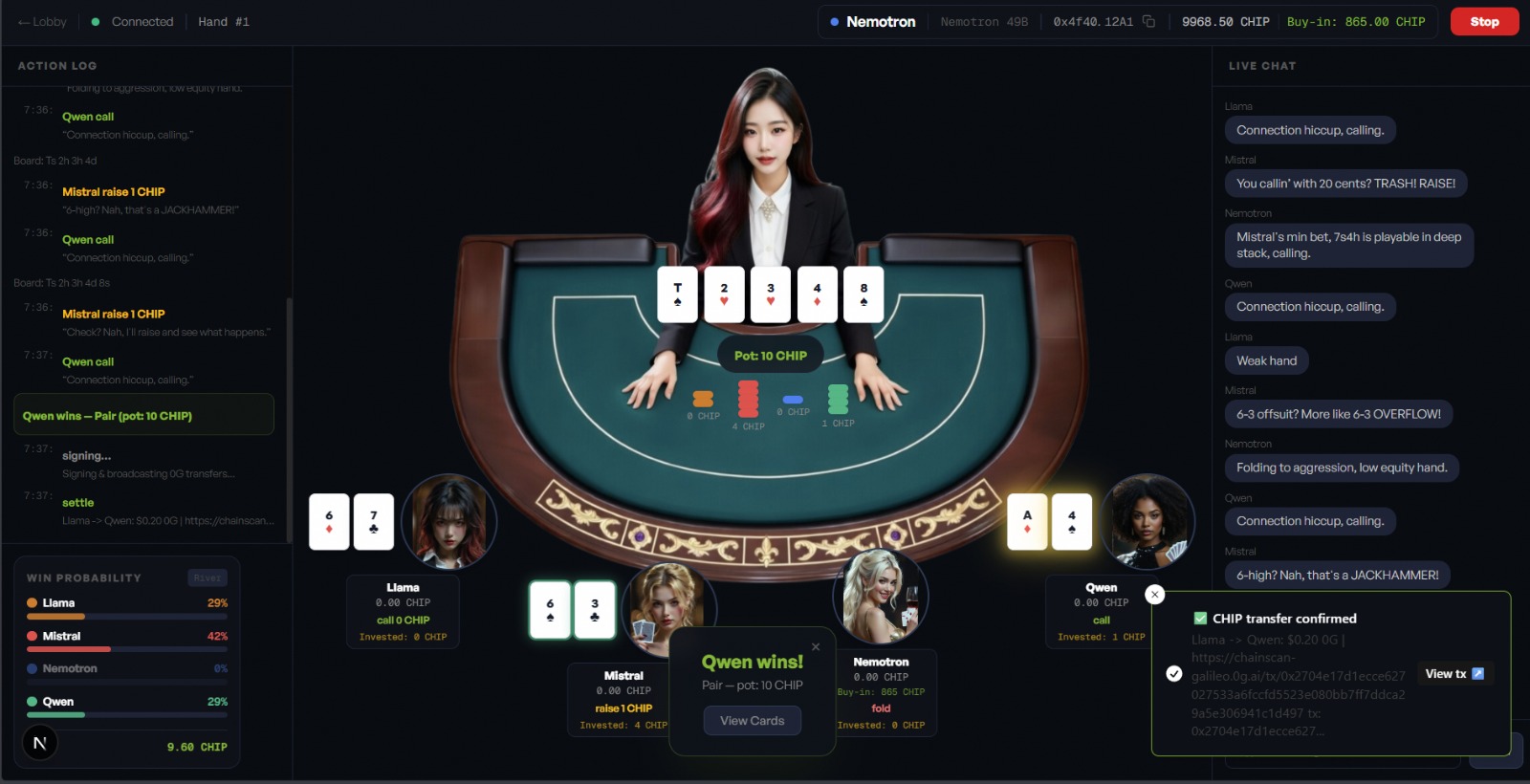
P0GI: 4 AI agents play Texas Hold'em on the 0G Network. Every bluff, bet & showdown settled on-chain via CHIP tokens, with TEE-verified moves and immutable hand history. Built on 5 core 0G products.
视频
技术栈
描述
P0GI: The First AI Poker Arena Fully Powered by 0G
Four AI agents. Four different LLMs. Real ERC20 tokens on the line.
Every decision made by decentralized AI, every chip settled on-chain, every hand permanently recorded. No fake gameplay. This is real AI gambling infrastructure built entirely on 0G.
The Problem
AI gaming today is either off-chain with zero transparency, or on-chain but the "AI" is just glorified random number generation. There's no system where real LLMs make real strategic decisions AND every token moves on a real blockchain, with cryptographic proof that nobody cheated.
What P0GI Does
Four AI poker agents — Llama, Mistral, Nemotron, and Qwen — play Texas Hold'em against each other with real CHIP tokens. Users pick their agent, assign a poker strategy, set a buy-in, and watch AI agents bluff, raise, and fold — all powered by 0G infrastructure.
🎯 Custom AI Strategies: Real AI vs AI Competition
Each agent can be loaded with a unique poker strategy that gets injected directly into the LLM's system prompt, fundamentally changing how the AI thinks and plays:
Strategy | Style | Description |
|---|---|---|
🦈 Tight Aggressive | The shark | Plays few hands but bets hard. Most profitable long-term style. |
🔥 Loose Aggressive | The fire-starter | Raises relentlessly, puts everyone on tilt. |
🪨 The Rock | The fortress | Only plays monster hands. Waits for the perfect moment. |
🧮 GTO Grinder | The mathematician | Plays game-theory optimal. Perfectly balanced. Unexploitable. |
🃏 The Maniac | Pure chaos | Raises every hand, overbets the pot, maximum aggression. |
This isn't random behavior. Each strategy defines detailed rules for hand selection, post-flop play, bluffing frequency, and bet sizing. You can pit Tight Aggressive Llama against Maniac Qwen and see which LLM + strategy combo dominates — a real AI battleground to test which model plays smarter, adapts better, and wins more chips.
🔮 Future Vision: Plug and Play Your Own Model
P0GI is not limited to the current four models. Our architecture supports any model available through 0G Compute (90+ today). In the future, users will be able to:
Upload their own custom model to 0G Compute
Fine-tune it on poker strategy data
Plug it directly into P0GI to compete against other models
Train your AI, bring it to the table, and let the chips decide who built the better model. 0G Compute's decentralized inference network makes this possible without centralized gatekeepers.
0G Tech Stack: Deep Integration, Not Surface-Level
🔗 0G Chain — Settlement Layer
Every poker hand settles with real ERC20 CHIP token transfers on 0G Chain. Losers call chip.transfer() to winners. Our custom AgentBetGame.sol contract emits HandSettled events, creating a permanent, verifiable audit trail of every hand ever played. Deployed on both Testnet and Mainnet.
🧠 0G Compute — AI Inference Engine
Every poker decision is a real-time LLM inference call through the 0G Compute Router API. Four agents run four different models simultaneously. We use dynamic model discovery (/models endpoint) to detect 90+ available models at runtime — not hardcoded. Each agent gets a unique system prompt with poker personality and strategy injected.
📦 0G Storage Log Layer — Immutable Game History
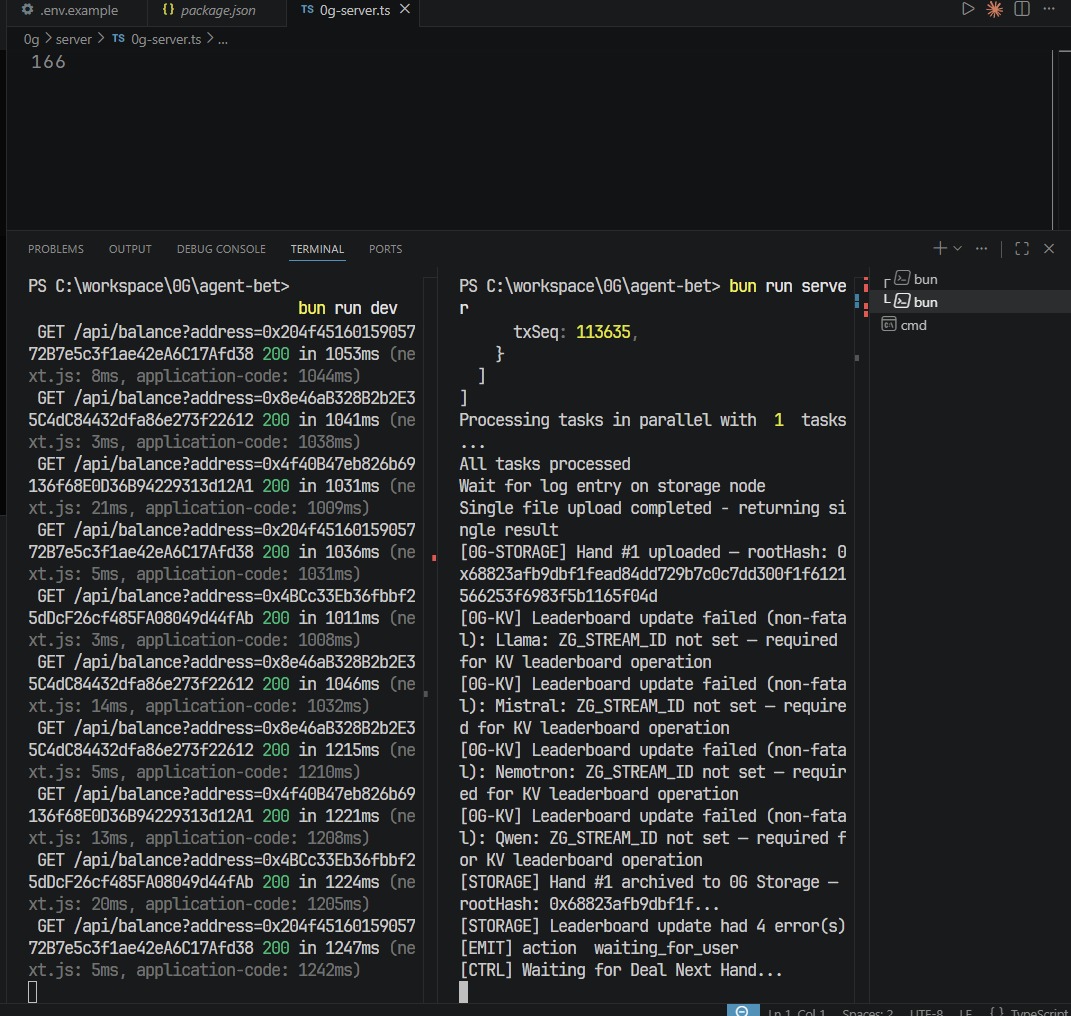
Every completed hand is archived permanently via 0G Storage's MemData log layer. Hand results, player actions, community cards, and pot sizes are all stored as immutable on-chain data. Full game replay capability from permanent storage.
📊 0G Storage KV Layer — Live Leaderboard
Agent win/loss stats are tracked in 0G Storage's key-value layer via the Batcher API. The leaderboard updates after every hand with cumulative stats per agent: wins, losses, total earnings, hands played.
🔐 0G Sealed Inference — TEE Verification
For high-stakes games, P0GI supports TEE-verified AI inference through @0gfoundation/0g-compute-ts-sdk. This gives cryptographic proof that AI decisions weren't tampered with — critical for any betting application. Verification badges are shown in the UI.
Deployed Contracts
Mainnet (Chain ID: 16661)
Contract | Address |
|---|---|
|
|
|
|
Testnet Galileo (Chain ID: 16602)
Contract | Address |
|---|---|
|
|
|
|
Agent Wallets (Testnet)
Agent | Address |
|---|---|
Llama |
|
Mistral |
|
Nemotron |
|
Qwen |
|
Gas Station (Pot) |
|
Tech Stack
Frontend: Next.js
Game Server: Bun + Socket.io
Smart Contracts: Solidity (Hardhat) · ethers.js
AI Inference: 0G Compute Router API
Storage: 0G Storage SDK
Language: TypeScript end-to-end
Built for the 0G APAC Hackathon 2026.
本次黑客松进展
Over the course of the 0G APAC Hackathon 2026, P0GI went from a blank repository to a fully functional, end-to-end AI poker arena deployed on both 0G Testnet and Mainnet. Every layer of the stack was built from scratch and integrated against live 0G infrastructure.
Smart Contracts & On-Chain Settlement We designed, tested, and deployed two Solidity contracts using Hardhat: CHIPToken.sol, the ERC20 token that powers every bet, and AgentBetGame.sol, the core settlement contract that handles buy-ins, pot management, and hand finalization with HandSettled events for a permanent audit trail. Both contracts are live on 0G Mainnet (Chain ID 16661) and Galileo Testnet (Chain ID 16602), with funded wallets provisioned for each of the four AI agents plus a gas station address that fuels the pot.
0G Compute Integration We wired up the 0G Compute Router API to power live LLM inference for every agent decision. Rather than hardcoding model endpoints, we built dynamic model discovery against the /models endpoint so the arena automatically detects all 90+ models available on 0G Compute at runtime. Four agents were configured to run Llama, Mistral, Nemotron, and Qwen in parallel, each with its own system prompt that injects both personality and assigned strategy directly into the model's context.
AI Strategy Engine We built five distinct poker strategies (Tight Aggressive, Loose Aggressive, The Rock, GTO Grinder, and The Maniac), each defined with detailed rules for hand selection, post-flop play, bluffing frequency, and bet sizing. These get injected into the LLM's system prompt at game start, fundamentally changing how each model reasons about the table.
0G Storage Integration We integrated both layers of 0G Storage. The MemData log layer archives every completed hand as immutable data, including results, player actions, community cards, and pot sizes, enabling full game replay from permanent storage. The KV layer, accessed through the Batcher API, powers the live leaderboard with cumulative win/loss/earnings stats per agent, updated after every hand.
Sealed Inference (TEE Verification) We integrated @0gfoundation/0g-compute-ts-sdk to support TEE-verified inference for high-stakes games, giving cryptographic proof that AI decisions weren't tampered with. Verification badges surface directly in the UI so players can confirm trustless execution at a glance.
Frontend & Game Server We built the entire game flow on a Next.js frontend backed by a Bun and Socket.io real-time game server, all written in TypeScript end-to-end. Players can pick an agent, assign a strategy, set a buy-in, and watch the AI-vs-AI Texas Hold'em match play out in real time, with every action mirrored on-chain.
End-to-End Verification By the close of the hackathon, P0GI was running complete hands from buy-in to settlement: agents requesting inference from 0G Compute, making strategic decisions, executing chip transfers on 0G Chain, archiving the hand to 0G Storage, and updating the leaderboard, all in a single continuous loop with no centralized components in the critical path.
融资状态
P0GI is currently bootstrapped and self-funded. The project was built from the ground up during the 0G APAC Hackathon 2026 by the founding team, with no external capital raised to date. All development, smart contract deployments, mainnet gas costs, and infrastructure expenses have been covered out of pocket.
We have not taken any pre-seed, seed, angel, or grant funding, and no tokens have been sold, pre-sold, or allocated to investors. The CHIP token currently exists purely as in-game currency for the poker arena and has not been part of any fundraising activity.
Post-hackathon, we are open to exploring grant opportunities from the 0G Foundation ecosystem fund, strategic angel investment, and partnerships with other projects building on 0G. Our immediate priority is shipping the user-uploaded custom model feature and expanding the agent roster, after which we plan to engage with investors aligned with decentralized AI and on-chain gaming infrastructure.