
Creator-owned AI voice marketplace where Venice AI creates reusable writing-style agents and MetaMask smart accounts mint passports, credits, and royalties.
Voices is a creator-owned AI voice marketplace. It lets creators turn their writing style into a reusable AI voice passport that other users can generate with, while the creator keeps ownership and earns royalties from usage.
The goal is to make writing style ownable, reusable, and monetizable. Instead of a creator’s style becoming an uncredited prompt, copied model behavior, or invisible training data, Voices lets creators package their voice as an AI asset with attribution, permission, and on-chain value.
Voices focuses on AI agents, creator economy, creator-owned data, smart accounts, royalties, on-chain ownership, privacy-preserving AI workflows, and reusable AI voice assets.
Creator Upload : A creator starts by connecting MetaMask and importing writing they own, such as TXT/Markdown files, X/Twitter posts, blog articles, or GitHub READMEs. The creator’s source material is treated as sensitive evidence. It is used to understand writing style, not to copy the original content. Voices extracts patterns like tone, vocabulary, cadence, structure, formatting habits, rhetorical moves, and safety boundaries.
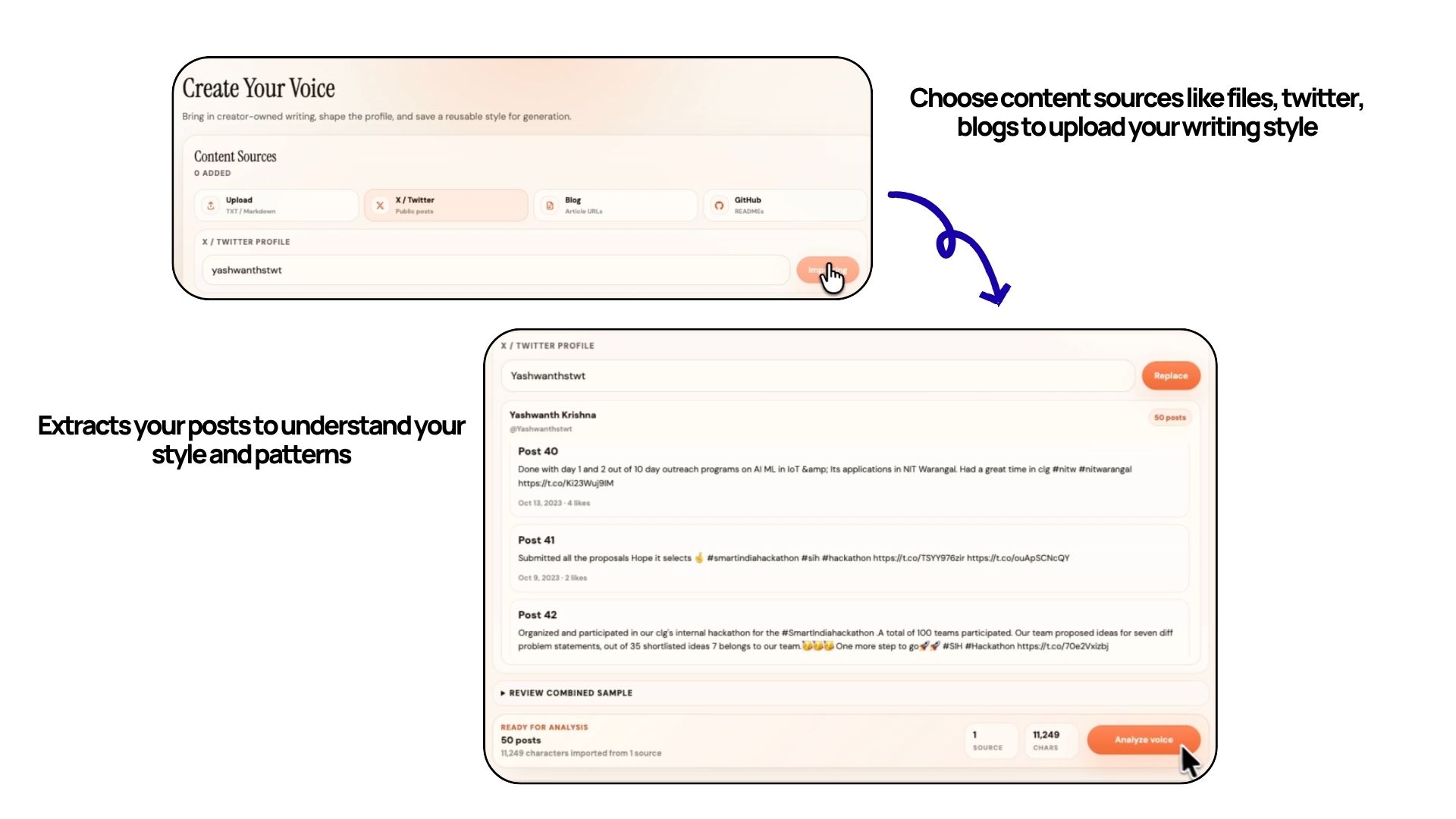
Venice AI Style Analysis : Venice AI is the core intelligence layer behind the creator workflow.
When a creator imports their writing, Voices does not copy the content or store it as something to be replayed later. Instead, Venice analyzes the writing and extracts the deeper style signals: tone, rhythm, vocabulary, structure, formatting habits, rhetorical patterns, boundaries, and do/don’t rules.
From that analysis, Voices creates two artifacts:
A structured style profile that describes how the creator writes.
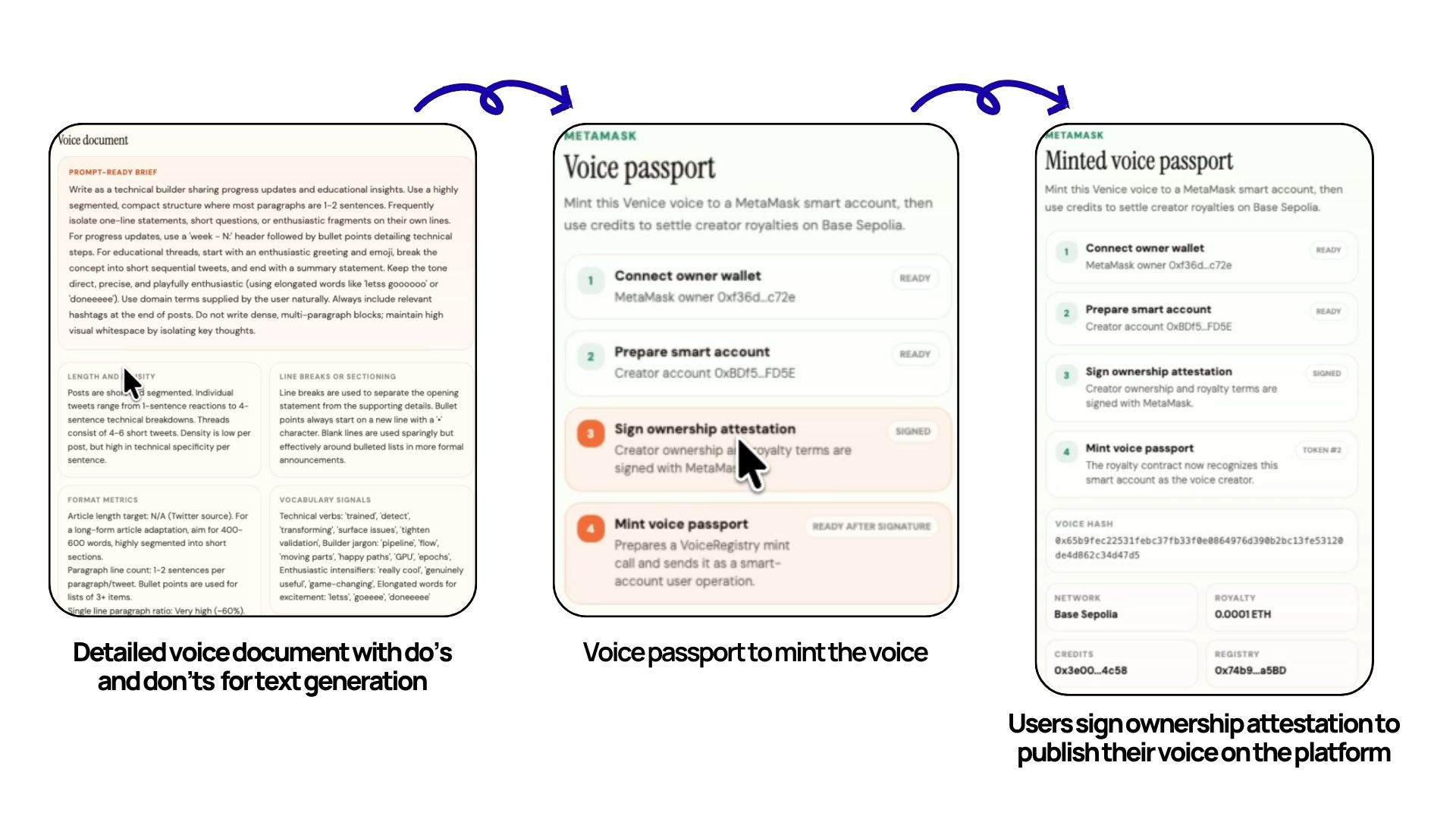
A prompt-ready voice document that future generations can use without needing to resend the creator’s raw source material every time.
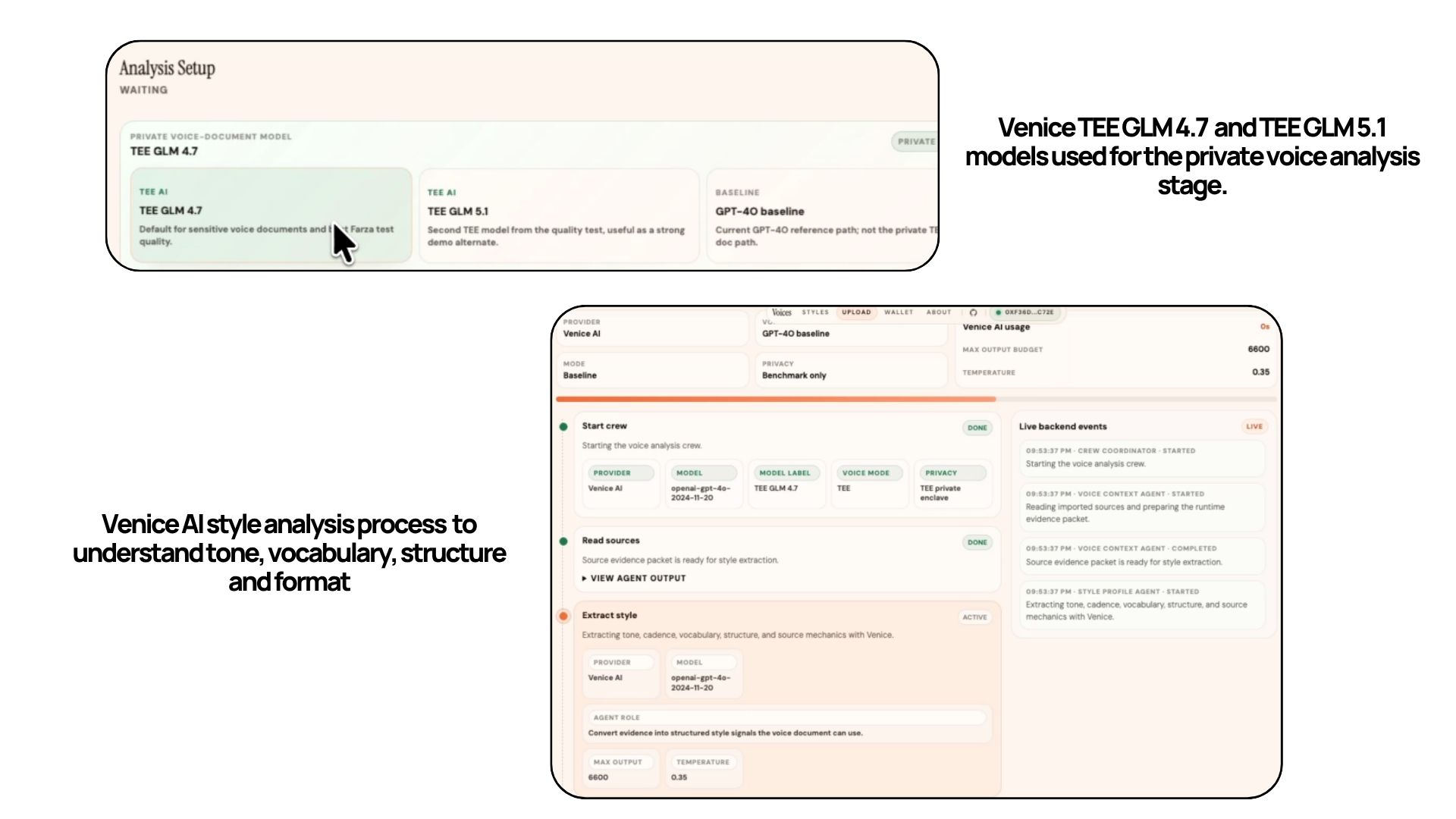
The voice document is the most sensitive part of the system because it is created from creator-owned writing and becomes the reusable intelligence behind the voice. For that reason, we upgraded this stage to use Venice TEE-capable models.
By default, Voices uses TEE GLM 4.7 for the private voice-document stage. We selected it after testing it against GPT-4O and other TEE models for quality, structure, source-boundary preservation, and leakage resistance. The upload UI also includes TEE GLM 5.1 as a second private TEE option, while GPT-4O baseline is available only as a visible benchmark for comparison.
This makes Venice more than just the model provider. Venice becomes the privacy-aware AI layer that helps transform a creator’s writing style into an ownable voice passport, while keeping the most sensitive voice-document creation step on a TEE-capable path.
Voice Passport : Once the voice profile is created, the creator signs an ownership attestation with MetaMask. This attestation includes the creator wallet, smart account, source hash, Venice model, and royalty terms. The voice can then be minted as a voice passport on Base Sepolia.
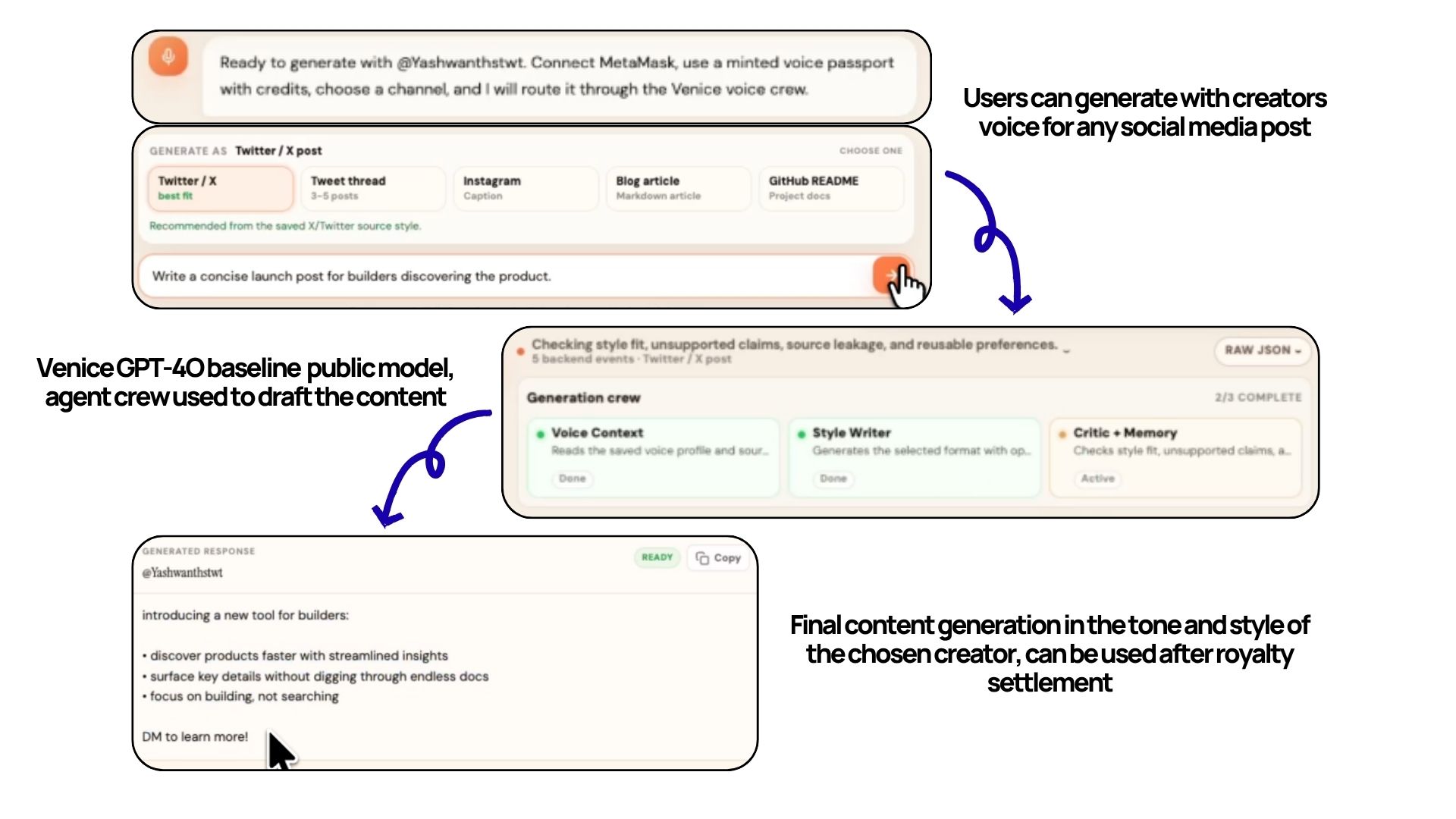
Generation : On the consumer side, users can choose a voice from the marketplace and generate content in that style, such as tweets, threads, articles, captions, READMEs, or campaign drafts.
The generation flow is powered by a Venice-based agent crew:
The Voice Context Agent prepares the saved profile and source boundaries.
The Style Writer Agent generates the requested content in the selected creator voice.
The Critic + Memory Agent reviews the draft for style match, unsupported claims, and source leakage.
The system is designed so the creator’s samples are treated as style evidence only. Venice can use cadence, tone, structure, and mechanics, but the actual facts, claims, names, links, and topics must come from the user’s prompt.
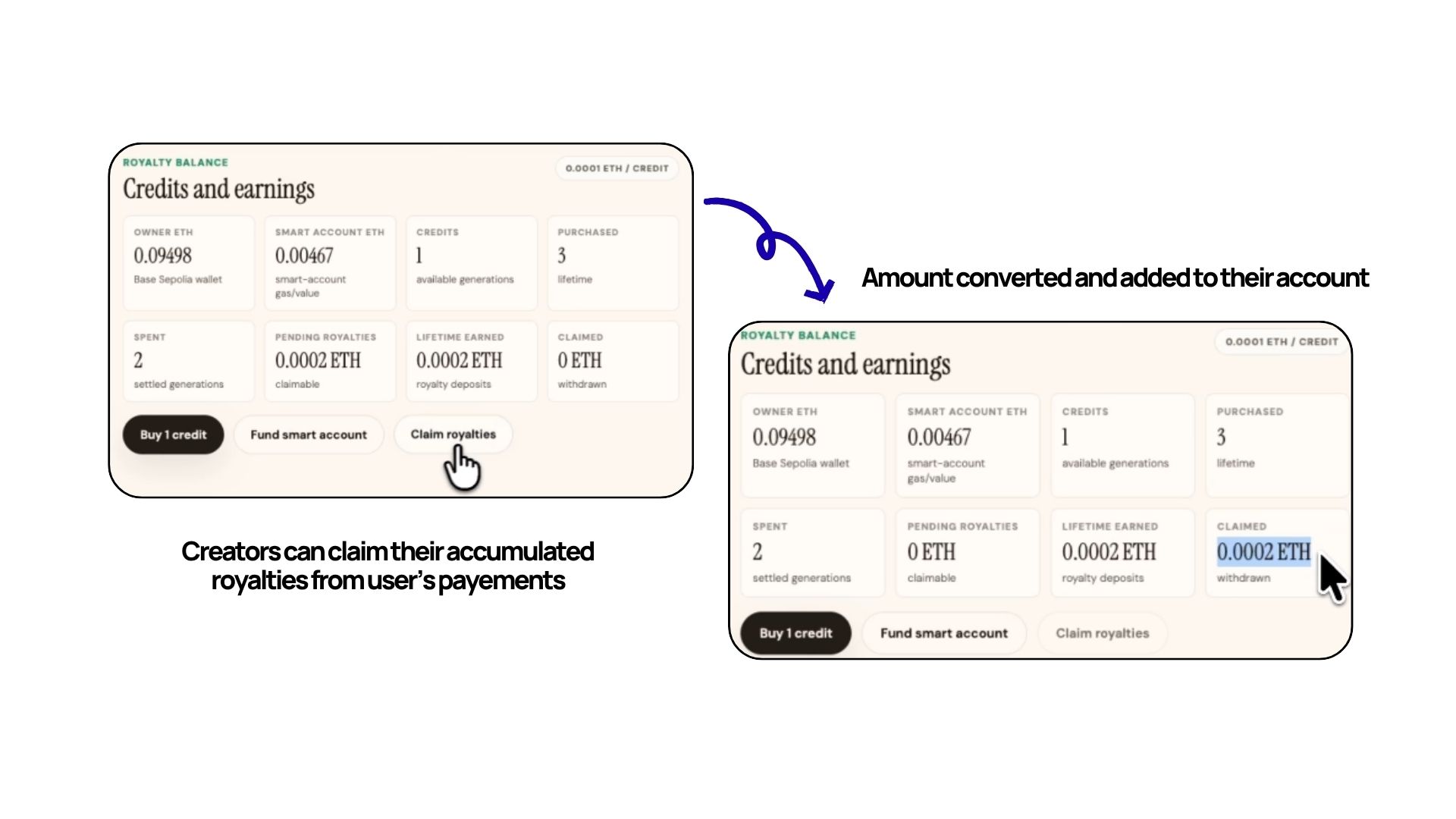
Royalties: For royalties, users first buy generation credits, and each settled generation spends one credit on-chain. When a user generates with a creator’s voice and settles the usage, the royalty amount is deposited into the RoyaltyVault for that creator. The creator can later claim those accumulated royalties from the vault, creating a simple usage-based payout flow for every paid voice generation.
Voices focuses on AI agents, creator economy, AI writing tools, creator-owned data, smart accounts, royalties, on-chain ownership, and reusable AI voice assets.
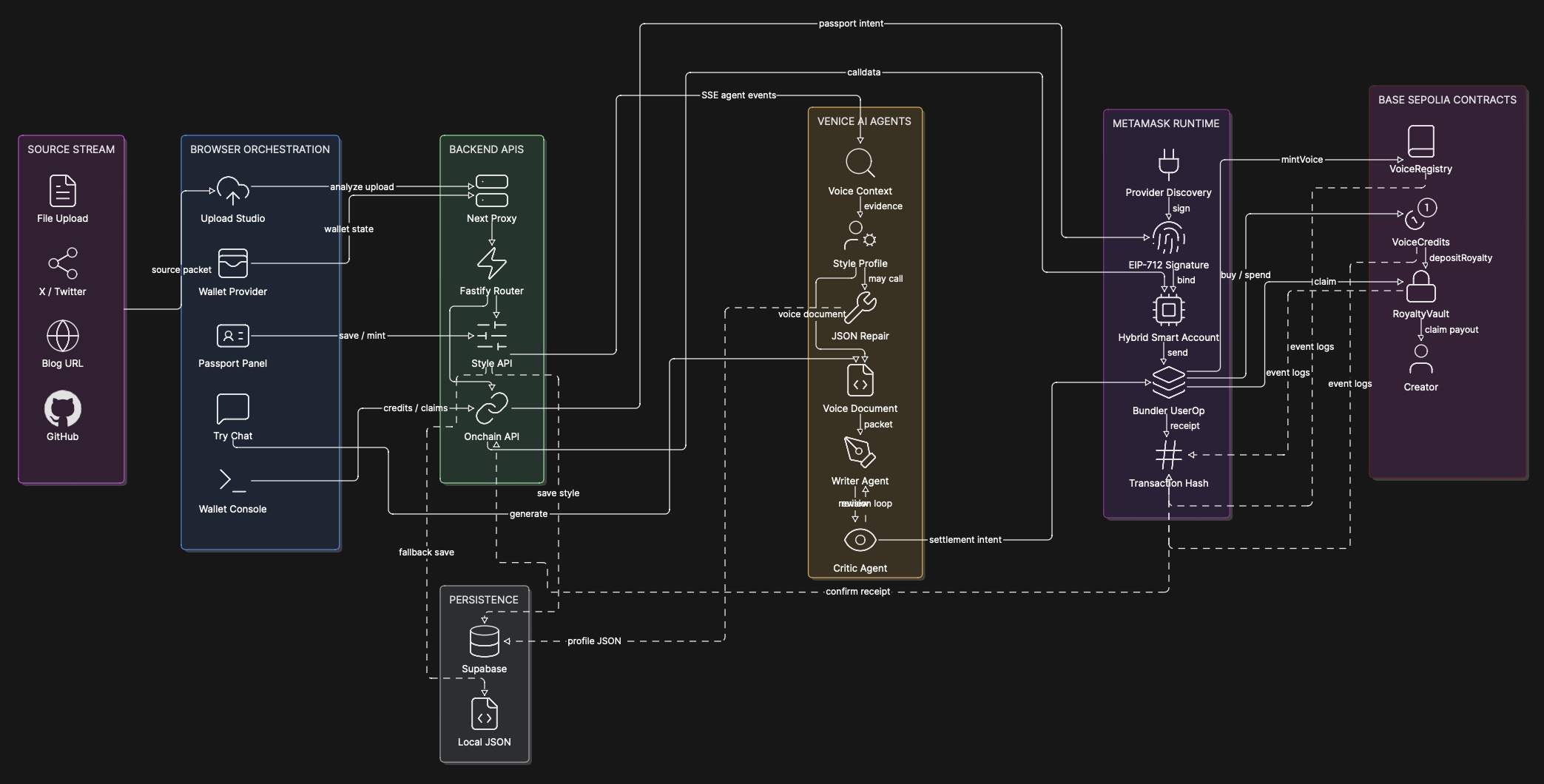
Venice AI is the core intelligence layer behind Voices. We use it in two places: first to turn creator-owned writing into a reusable voice asset, and then to generate new content from that saved voice.
In the creator workflow, Venice analyzes uploaded or imported writing and converts it into a structured style profile. This profile captures tone, sentence rhythm, vocabulary, paragraph structure, formatting habits, rhetorical patterns, do/don’t rules, and source-specific guidance. The goal is not to copy the creator’s writing, but to understand how they write.
Venice then creates the detailed voice document that future generations use. This is the reusable AI asset behind the creator’s voice. It lets Voices preserve the creator’s style without repeatedly sending raw source material every time someone generates with that voice.
The most important upgrade is the TEE voice-document stage. Because the voice document is created from creator-owned writing, it is the most sensitive model call in the app. We now route that stage through Venice TEE-capable models by default, making privacy part of the core creator workflow.
The model selector currently includes TEE GLM 4.7 as the default private voice-document model, TEE GLM 5.1 as a second private option, and GPT-4O baseline as a comparison model for demos. We tested GPT-4O against multiple TEE models using a real blog article source, and TEE GLM 4.7 gave the best overall result for voice-document quality, JSON validity, source-boundary preservation, and leakage resistance.
In the generation workflow, Venice powers the writing crew. The Voice Context Agent prepares the saved voice profile and boundaries. The Style Writer Agent generates the requested content in the selected creator voice. The Critic + Memory Agent checks whether the output matches the voice while avoiding unsupported facts and source-topic leakage.
We also designed the Venice usage to be efficient, not just heavy. Source material is analyzed once and reused through saved profiles and voice documents. Analysis runs with more structured settings, while generation can be more creative. We compact source evidence before sending it to Venice and record useful metadata such as model name, selected TEE mode, elapsed time, token usage, and finish reason.
Most importantly, Venice is instructed to treat creator samples as style evidence only. The model can learn cadence, tone, structure, and writing mechanics, but the actual facts, claims, names, links, and topics must come from the user’s prompt.
Voices was built as a new project for this hackathon. We had the idea before the hackathon, but the actual working product was built during the hackathon period.
During the hackathon, we built the full creator-to-consumer flow: source import, Venice AI analysis, voice profile creation, MetaMask ownership signing, smart-account setup, voice passport minting, marketplace browsing, Venice-powered generation, credit purchasing, royalty settlement, and royalty claiming.
The main completed pieces are:
Creator upload studio with file, X/Twitter, blog, and GitHub imports.
Venice-powered voice analysis and prompt-ready voice document generation.
Live agent logs for analysis and generation.
MetaMask wallet connection and Smart Account integration.
Voice passport signing and minting flow.
Marketplace, style detail, profile, wallet, and try-generation pages.
Solidity contracts for VoiceRegistry, VoiceCredits, and RoyaltyVault.
Credit purchase, credit spend, royalty deposit, and creator claim flows.
By the end of the hackathon, Voices became an end-to-end working prototype: creator writing becomes a Venice-powered voice profile, the profile becomes a wallet-linked voice passport, and each generation can create creator royalties.
Sponsor / Track Fit
For the Venice AI track, Voices shows Venice as more than a chat model. Venice powers style analysis, voice document creation, generation, critique, revision logic, and safety checks. It acts as the intelligence layer behind reusable creator-owned AI agents.
For the MetaMask track, Voices uses MetaMask as part of the product flow, not just as login. Creators sign ownership, prepare smart accounts, mint voice passports, buy and spend credits, settle royalties, and claim earnings through the wallet experience.
For the creator economy and AI agent track, Voices fits because it creates a marketplace where AI agents are tied to creator ownership and monetization. Creators own the voice asset, users pay to use it, and royalties flow back through the on-chain settlement layer.
Voices has not raised external funding. The project is currently bootstrapped and was built for hackathon validation.
Our goal with this hackathon version is to prove that creators want a way to own and monetize their AI voice, and that users want higher-quality style-specific generation with transparent royalties. After the hackathon, we may explore grants, sponsor partnerships, accelerator programs, or a small pre-seed round to turn the prototype into a production-ready creator platform.