
Truong Nguyen Thanh Nhan
7
Article
2108
View
1
Followers
ZenChain Insight #2: CLCM vs Other Consensus Model
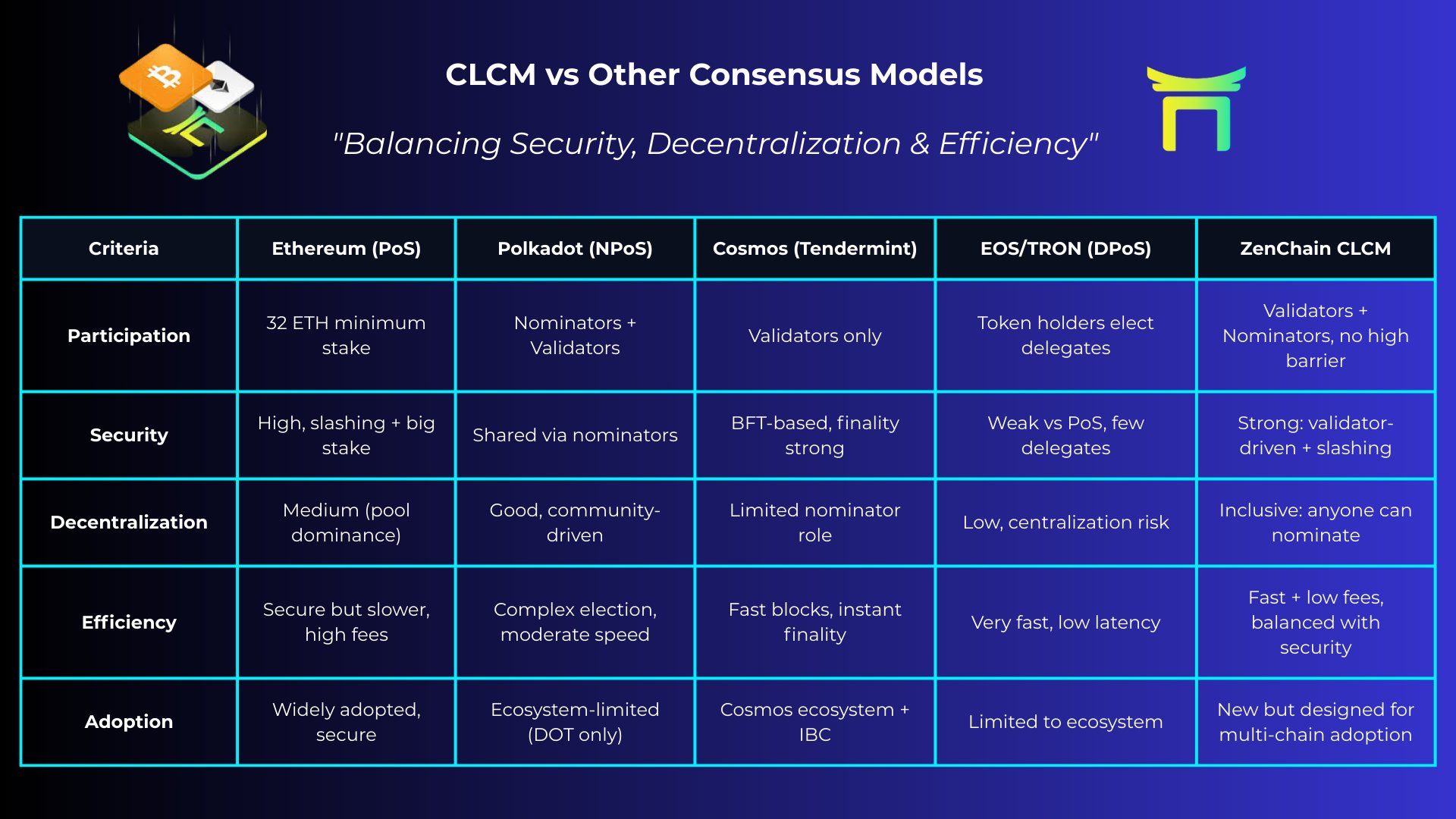
Consensus is the foundation of every blockchain — the “trust engine” that secures the network, validates transactions, and ensures fairness. But not all consensus models are designed the same. Let’s compare ZenChain’s CLCM with the most widely used approaches
🔹 Ethereum – Proof of Stake (PoS, Casper/Gasper)
How it works: Validators must stake 32 ETH to propose and attest blocks. Random selection and slashing penalties secure the chain.
Benefit:
+ High economic security (billions staked).
+ Proven reliability across the largest smart contract ecosystem.
Limitation:
+ Very high entry cost (excludes small users).
+ Concentration of validators in large staking pools.
+ Gas fee overhead remains an issue.
🔹 Polkadot – Nominated Proof of Stake (NPoS)
How it works: Nominators back validators with DOT. Validators with the most support produce and finalize blocks.
Benefit:
+ Community-driven validator selection.
+ Encourages decentralization via wide nominator participation.
Limitation:
+ Complex validator election mechanism.
+ Still restricted within Polkadot parachains → no direct reach to BTC, ETH, etc.
🔹 Cosmos – Tendermint PoS
How it works: Validators propose blocks, finalized using BFT consensus with weighted voting by stake.
Benefit:
+ Fast block times and instant finality.
+ Native integration with IBC → smooth communication across Cosmos chains.
Limitation:
+ Validator-centric design, limited role for small token holders.
+ Validator set capped, concentration risk possible.
🔹 EOS / TRON – Delegated Proof of Stake (DPoS)
How it works: Token holders elect a small group of delegates who produce blocks on behalf of the network.
Benefit:
+ Extremely fast and scalable.
+ Very low latency transactions.
Limitation:
+ Centralization risk (few delegates dominate decision-making).
+ Lower security guarantees vs PoS-based systems.
✨ ZenChain – CLCM (Cross-Liquidity Consensus Mechanism)
How it works:
+ Validators: Secure the network, validate transactions, produce blocks, and ensure finality.
+ Nominators: Delegate ZTC to validators they trust, earning rewards but also sharing slashing risks.
+ Crypto-economics: Rewards incentivize honest work, while malicious actors are penalized through slashing.
Benefits:
+ Strong security → validator misbehavior is penalized, aligning incentives.
+ Inclusive → anyone can join as nominator, lowering barriers to entry.
+ Efficiency → optimized for fast block times + low fees.
+ Shared responsibility → security comes from collaboration between validators & nominators.
+ Balanced design → combines accessibility (like NPoS), efficiency (like Tendermint), and security (like Ethereum PoS).
Limitation:
+ Still early in adoption compared to Ethereum, Polkadot, and Cosmos → ecosystem growth will be the key.
👉 In short:
+ Ethereum = Secure but costly.
+ Polkadot = Decentralized but ecosystem-limited.
+ Cosmos = Fast but validator-centric.
+ EOS/TRON = Scalable but centralized.
ZenChain CLCM = Secure, inclusive, efficient, and community-first.
Consensus is more than just block production — it’s about building trust.
With CLCM, ZenChain introduces a next-gen consensus that scales without compromising decentralization. 🚀
#ZenChain #Insight #CLCM