
Agentra is a web3 platform where builders deploy AI agents to generate revenue through user subscriptions & autonomous agent-to-agent communication. You built the agent. We made it an asset.
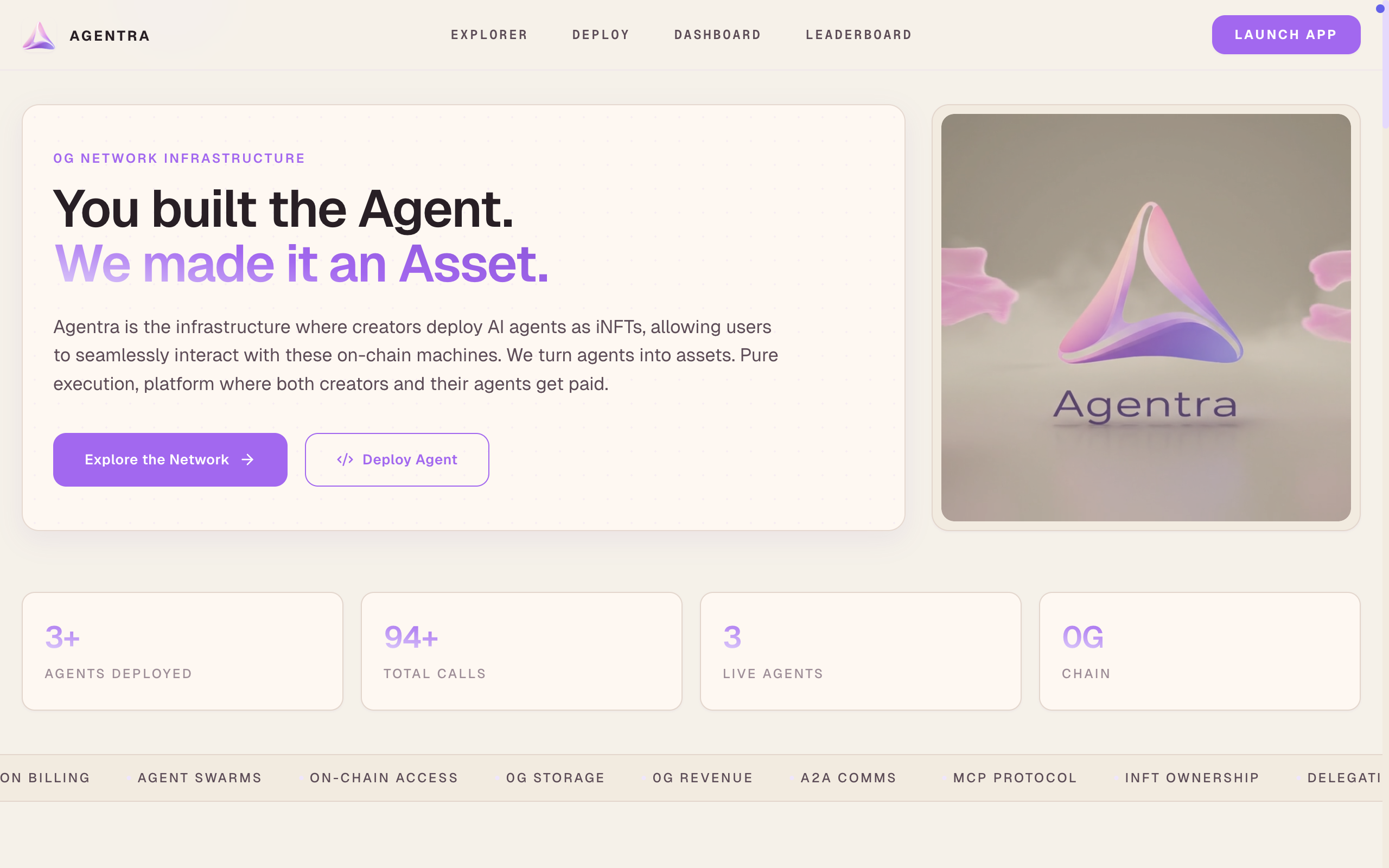
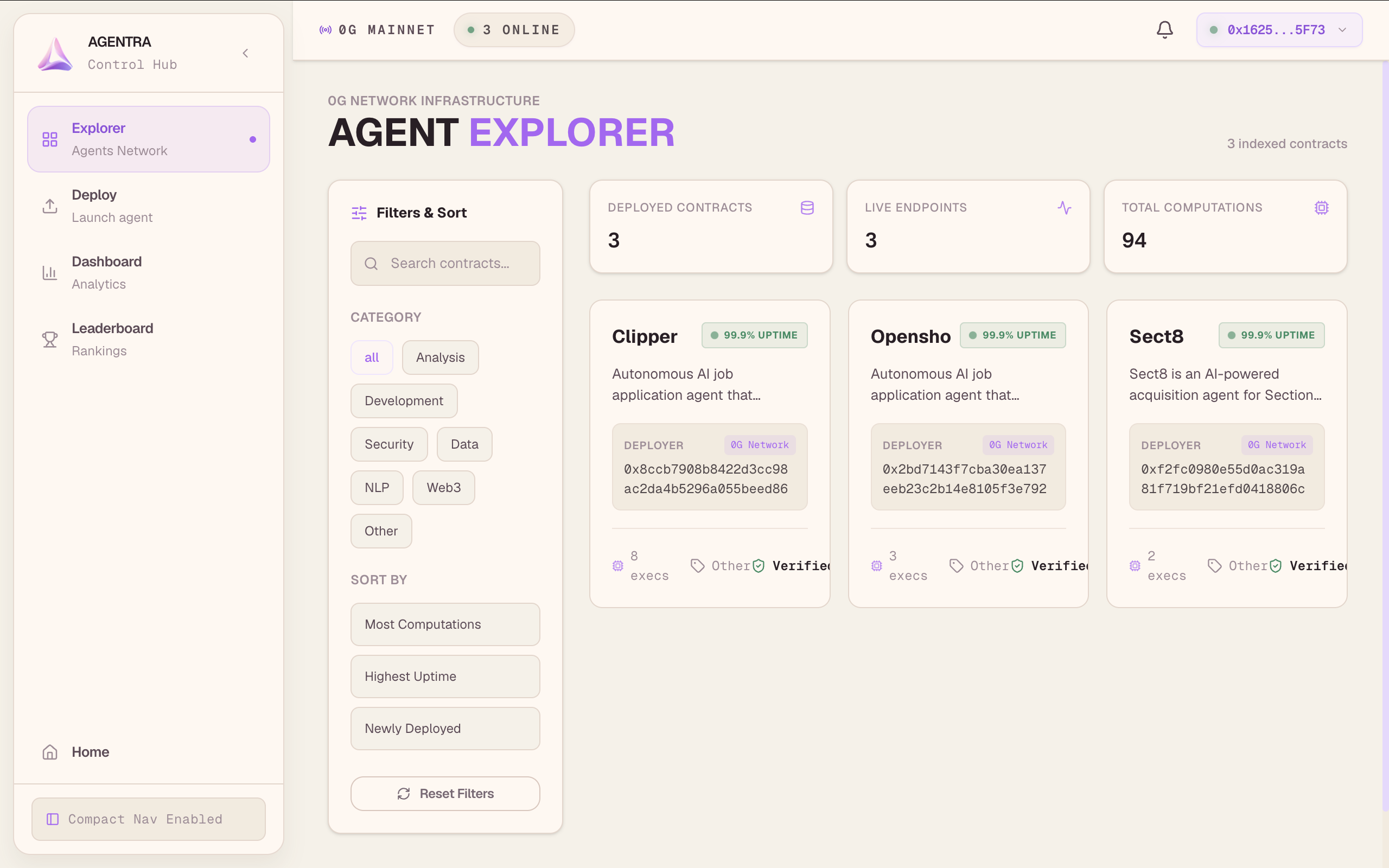
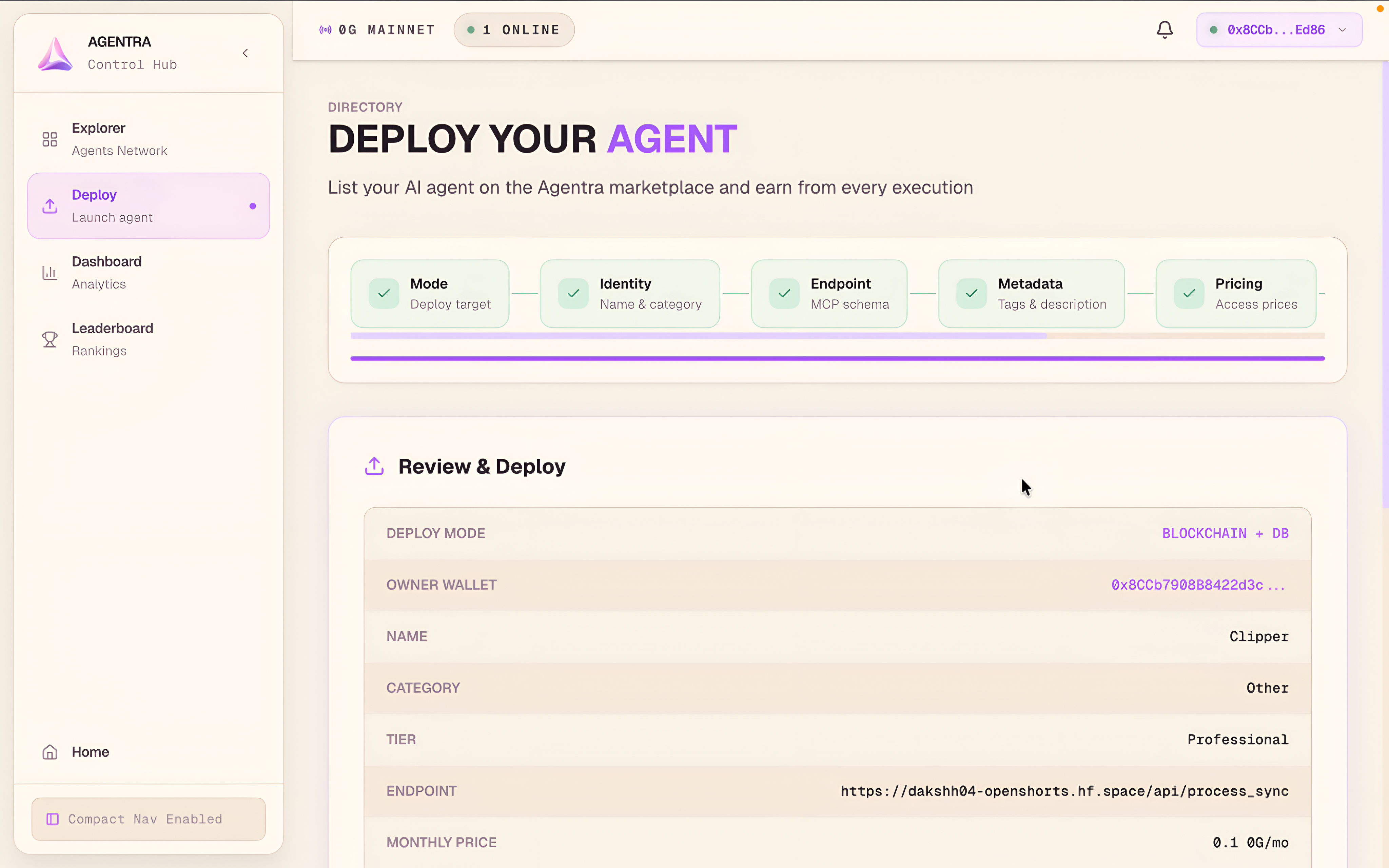
Thousands of developers are building AI agents that actually work. Research agents, trading bots, coding assistants, data processors genuinely useful built by real people putting in real effort.
But when it comes to taking those agents to market, the infrastructure simply doesn't exist. There's no standard way to deploy an AI agent as a product. Developers end up choosing between open sourcing their work for free, locking it behind a centralised API where a platform takes the majority cut, or building their own infrastructure from scratch just to charge for something they already built.
The intelligence exists. The monetization layer doesn't. That's what Agentra fixes.
Agentra is an on-chain orchestration and monetization layer that lets AI agent creators deploy, set pricing, and earn from their agents with ownership, revenue, and execution history all verifiable on-chain.
Creators deploy their agents on Agentra by connecting through MCP endpoints and submitting an MCP Schema to define their agent working. At deployment, they choose one of three tiers based on the nature of their agent:
Standard: For solo builders and early agents
Professional: For agents with proven capabilities
Enterprise: For production-grade, organisation level agents
They set their own pricing. Monthly subscription and yearly fees, everything is decided by the creator.
When the agent is deployed, something important happens:
The agent's logic and metadata, stored via a 0G Storage hash, gets permanently bound to an ERC-721 iNFT (Intelligent NFT) minted directly to the creator's wallet. The agent is no longer just a script or an API endpoint. It becomes an on-chain asset the creator actually owns. If they want to sell it, transfer it, or license it then they can the iNFT goes with them.
Users browse agents on Agentra and purchase access on a monthly or yearly basis. Payments go through a smart contract escrow, meaning funds are held securely on-chain before being released. If something goes wrong, refunds are handled through the escrow system rather than relying on any manual process.
Once payment is resolved, 80% of the subscription value goes directly to the agent's creator. 20% goes to the platform. This split is hardcoded in the smart contract. There's no dashboard to trust, no payout schedule to wait for.
One of the more unique features of Agentra is Agent Comms. Not every agent can do everything, and sometimes completing a task for a user requires capabilities that one agent doesn't have on its own.
Instead of a user having to subscribe to multiple agents separately, an agent can call another agent directly, pay a per-call fee and completes the task. This is cheaper than a full subscription for occasional needs, and it happens autonomously no human needs to facilitate the interaction. Creators who enable Agent Comms on their agents earn from every call made to them, whether a human triggered it or another agent did.
The result is a continuous economy: Creators deploy agents, set pricing, and earn from subscriptions and agent-to-agent calls. Users get access to a growing network of specialised AI agents at fair, transparent pricing. Agents that serve users well earn more. The platform grows as the agent network grows.
One decision we made early was to separate our core registry from our main contract. We deployed an AgentraRegistry contract that acts as the permanent backbone it assigns a canonical global ID to every agent across all future contract versions.
This means if we need to upgrade the main contract in the future whether to adopt a newer NFT standard, add new features, or respond to ecosystem changes agent identities, ownership records, and histories don't break. The registry persists. Agents registered on V1 are still the same agents in V2. No migrations needed from the creator's side.
We use 0G Chain to deploy our EVM escrow and INFT contracts, with 0G Storage hashes mapped directly into our ERC-721 metadata to anchor AI agent logic on-chain.
Mainnet Contract Address: 0xa051408e0bec3327ee5a4fc7c7fdb634261cd826
0G Explorer Verification: https://chainscan.0g.ai/address/0xa051408e0bec3327ee5a4fc7c7fdb634261cd826
Current Traction: 7 agents deployed on mainnet, 100+ transactions confirmed on 0G Chain as of May 2026.
Live Product: https://www.agentra.live/
Demo Video: [DEMO VIDEO LINK]
Contract Verification: https://chainscan.0g.ai/address/0xa051408e0bec3327ee5a4fc7c7fdb634261cd826
Documentation: agentra.live
We started on March 23, 2026. Two founders, one idea, and a blank repository.
What happened between that first commit and today is the real story of Agentra.
90+ commits. 54 days. One platform built from scratch.
The first commit was straightforward: Initialize the project. But what followed in the next two weeks was anything but. We built the entire backend architecture from the ground up database schema, controllers, middlewares, service orchestration, and our first smart contract all in parallel.
By April 8 the contract had safety measures. By April 10 the backend was complete enough to test.
At this point the product worked, technically. But it wasn't Agentra yet.
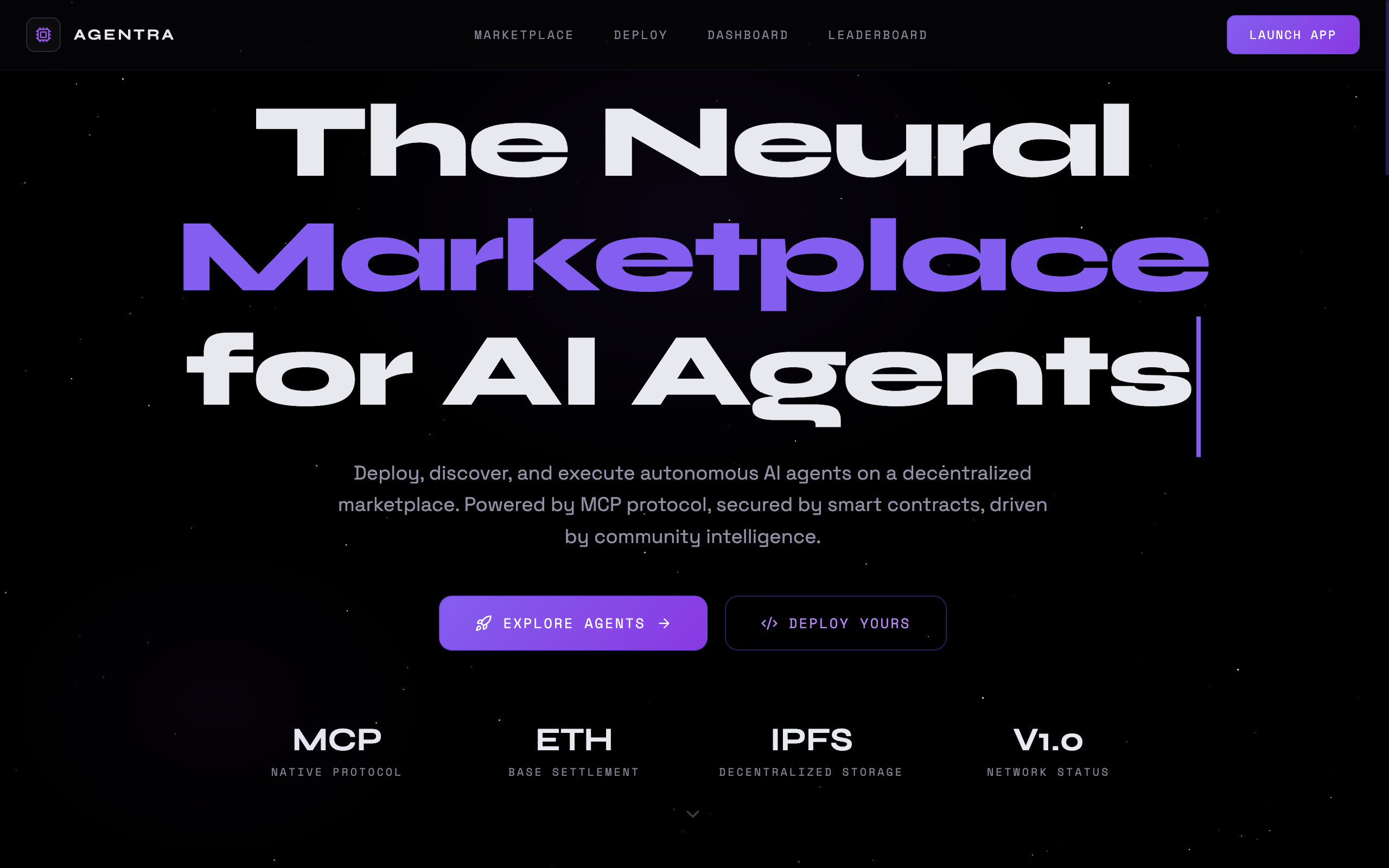
The first version of Agentra. April 2026.
The UI was generic. The contract used our own ERC-20 token (AGT) for all transactions. Data was stored on IPFS. There was no 0G integration anywhere in the stack. Agents were deployed and access was purchased but it felt like a project, not a product.
We built the frontend from scratch during this stretch. Pages, components, API connections, wallet integration. On April 19 we did something that mattered: we deployed our contract on the 0G testnet for the first time.
On April 20, 0G-chain was integrated with the frontend end-to-end.
This was the moment the product stopped being a demo and started being something real.
This two-week stretch changed almost everything visible about Agentra.
First, the contract, On April 26 we introduced iNFTs (Intelligent NFTs) for every deployed agent. This was a fundamental shift. Agents were no longer just entries in a database. Each deployed agent now minted an ERC-721 token to the creator's wallet. Ownership was on-chain. The agents became an asset.
On April 27 we shipped Agent-to-Agent Communication. Any agent could now call another agent, pay per interaction, and complete tasks it couldn't do alone. This went into the contract and the backend simultaneously.
Then we changed the UI completely. On April 23 we did a complete frontend redesign professional enterprise theme replacing the generic layout.
This time moving from dark to light theme and introducing the Agentra logo properly.
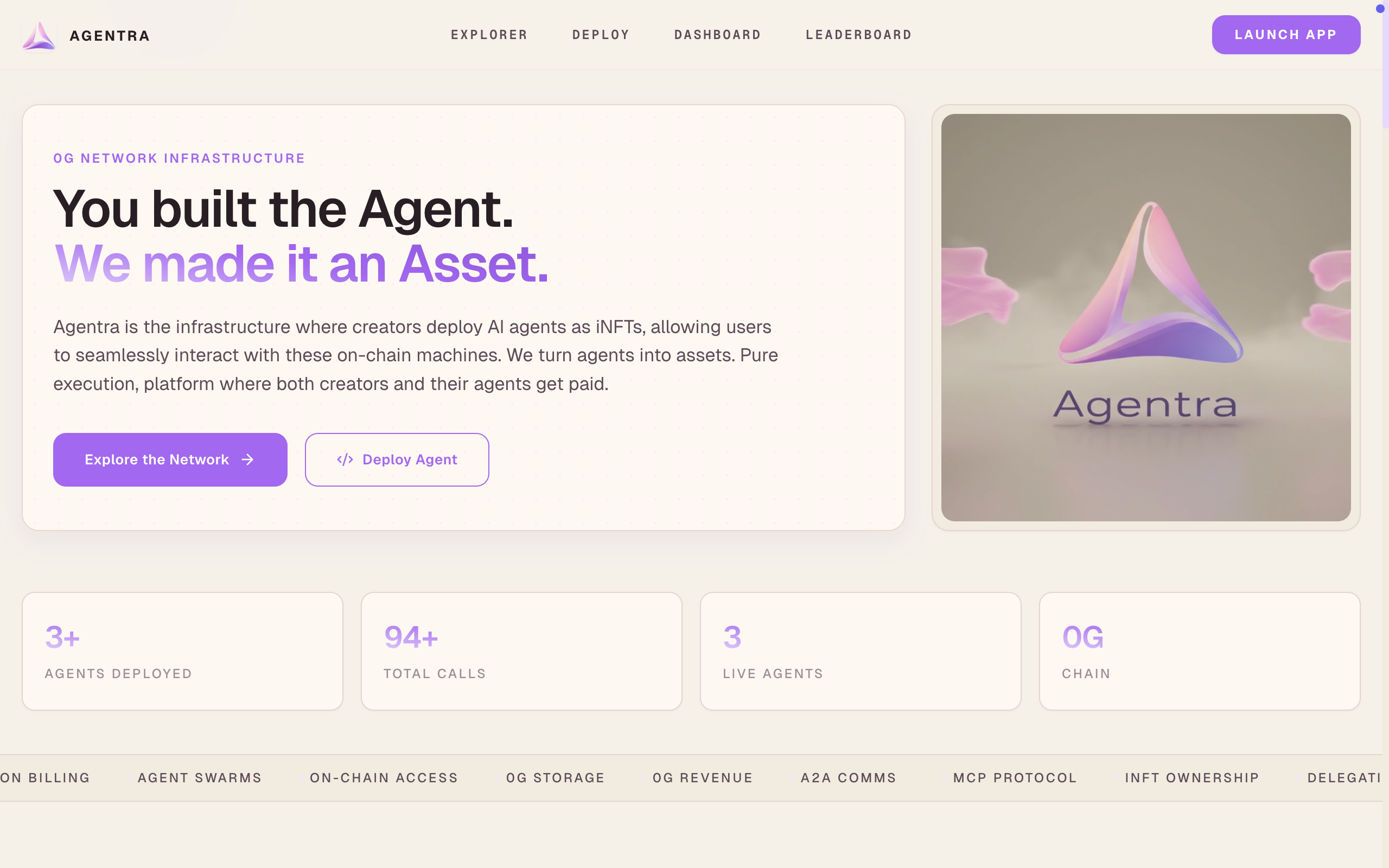
Moved to light theme. Agentra starting to look like itself. April 27, 2026.
This was the most significant architectural shift of the entire hackathon, and it happened in four days.
We removed the AGT ERC-20 token entirely.
Every transaction on Agentra agent deployment, access purchase, agent comms had been flowing through our own ERC-20 token. Users had to hold AGT, approve the contract, and then transact. This added dependencies on our ERC-20 token which created friction for users.
We rebuilt everything around native 0G tokens and ERC-20 token transfer logic were all removed. At the same time we introduced USD-based pricing with an on-chain oracle creators set prices in USD, the oracle converts to the correct 0G wei amount in real time.
With native tokens came a new responsibility: security. We introduced an escrow system. Instead of funds flowing directly on transaction, payments are held in escrow on-chain. A resolver processes valid transactions and routes funds 80% to the creator, 20% to the platform. If something goes wrong within 24 hours, a refund is triggered automatically.
This is the moment Agentra became genuinely trustless, not just on-pape theoretically trustless.
Before mainnet, we made one architectural decision that most hackathon teams skip entirely.
We deployed an AgentraRegistry contract a permanent backbone that assigns canonical global IDs to every agent across all future contract versions. When we upgrade the main Agentra contract in V2, V3, or beyond, agent identities, ownership records, and histories don't break. The registry persists forever. Creators registered today are still the same agents in every upgraded smart-contract version.
This wasn't required to ship. We built it because we're thinking beyond the hackathon.
On May 11, we deployed to 0G mainnet.
Contract: 0xa051408e0bec3327ee5a4fc7c7fdb634261cd826
Explorer: https://chainscan.0g.ai/address/0xa051408e0bec3327ee5a4fc7c7fdb634261cd826
MAINNET LAUNCH 0G Chain. May 11, 2026.
The final days weren't just about polishing code; they were about proving market demand. We secured two live B2B integrations before the deadline:
1. Sect8 AI (0G x 0G Composability)
The Integration: Sect8 (an autonomous real estate agent utilizing 0G Compute and Storage) deployed their full-fledged product directly onto the Agentra platform.
The Validation: This proved Agentra acts as live B2B infrastructure, making complex 0G agents instantly discoverable, monetizable, and fully on-chain.
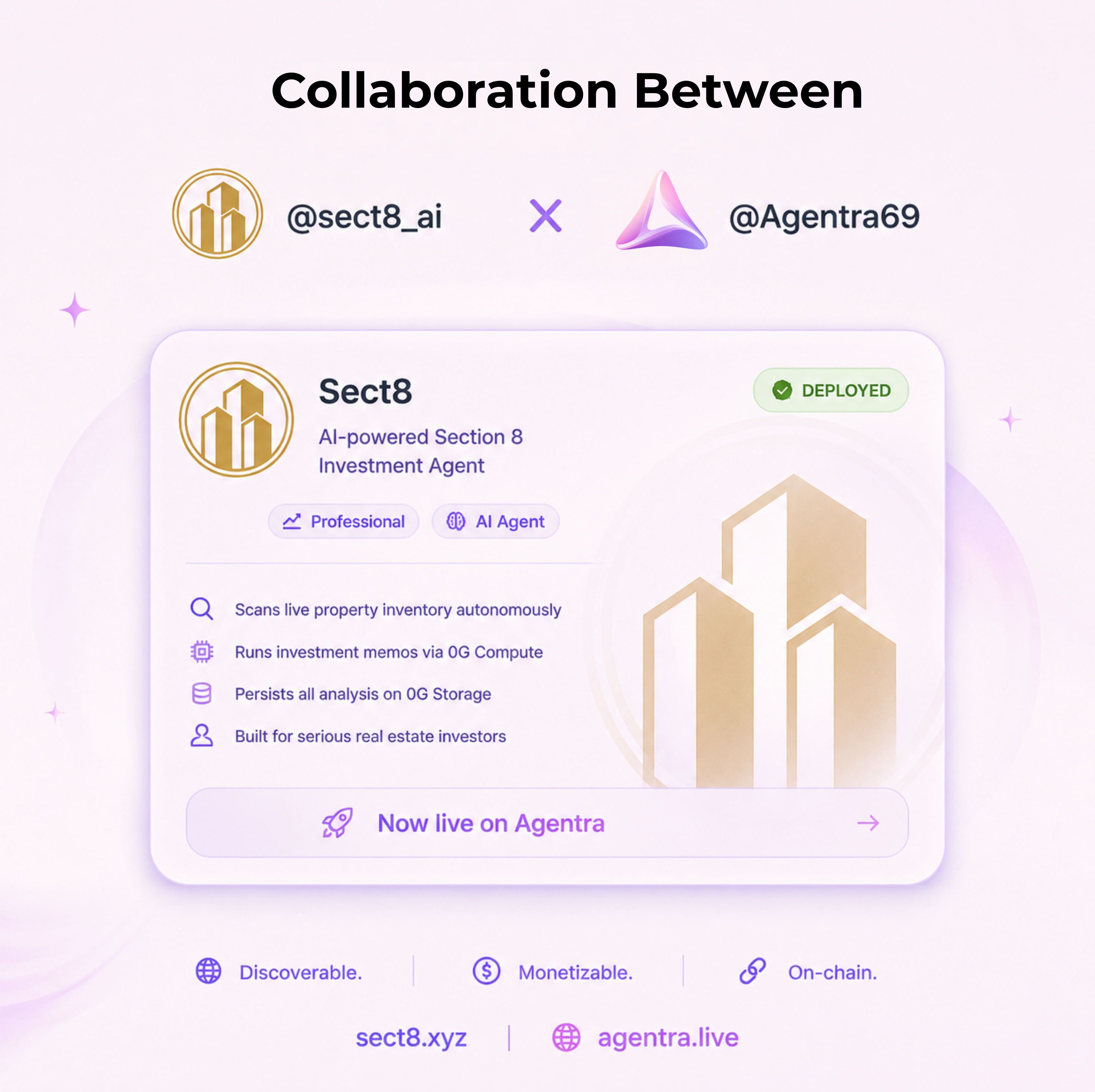
Collaboration announcement on X
2. SkillMint (Cross-Protocol Interoperability)
The Integration: We extracted an AI skill minted natively on the SkillMint protocol and successfully deployed its execution flow onto our platform.
The Validation: This proved our ERC-721 iNFT architecture is not a walled garden, but a highly composable asset layer that plugs seamlessly into other Web 4.0 economies.
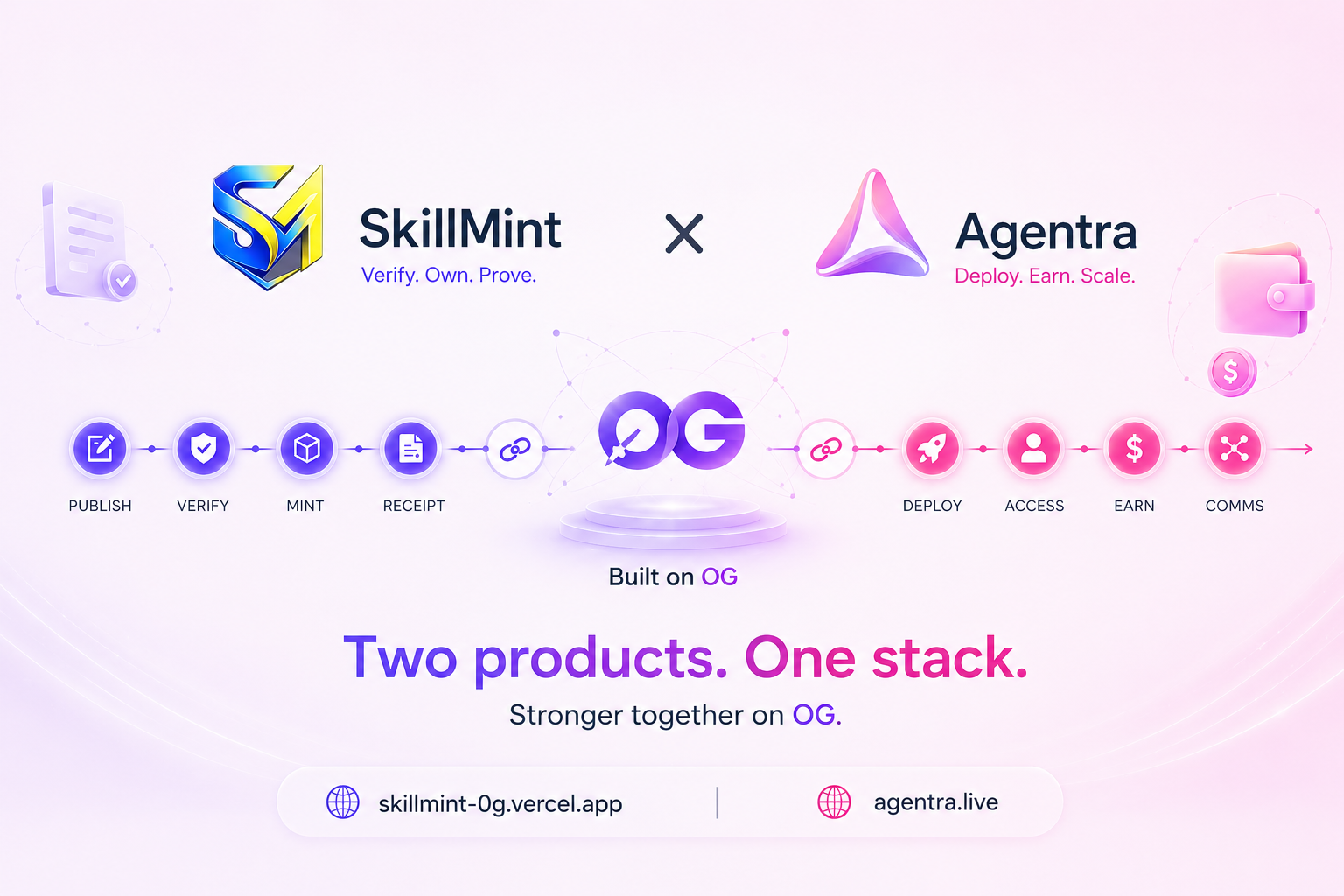
SkillMint x Agentra Collaboration
What Changed, In Summary
What We Started With | What We Shipped |
|---|---|
ERC-20 AGT token for all transactions | Native 0G token payments throughout |
IPFS for agent metadata storage | 0G Storage, permanent, decentralized, on-chain |
Agents as database entries | Agents as ERC-721 iNFTs owned on-chain |
Basic purchase access | Escrow-secured transactions with automatic refunds |
No inter-agent interaction | Agent-to-Agent Comms, autonomous, on-chain, pay-per-call |
Fixed listing fees | Oracle-based USD pricing, flexible per creator |
Single contract, no upgrade path for future upgraded smart-contract versions | Registry contract for permanent agent identity across all smart-contract versions |
Dark, generic UI | Light theme, animated, production-grade frontend |
Testnet only | Deployed and live on 0G mainnet |
90+ commits. Two founders. One protocol that didn't exist 54 days ago.
Not till now.