
Farcaster native game (mini app) where players wager ETH spotting AI clones. Built on Arbitrum with Solidity + Rust for on-chain reputation & Proof of Humanity.
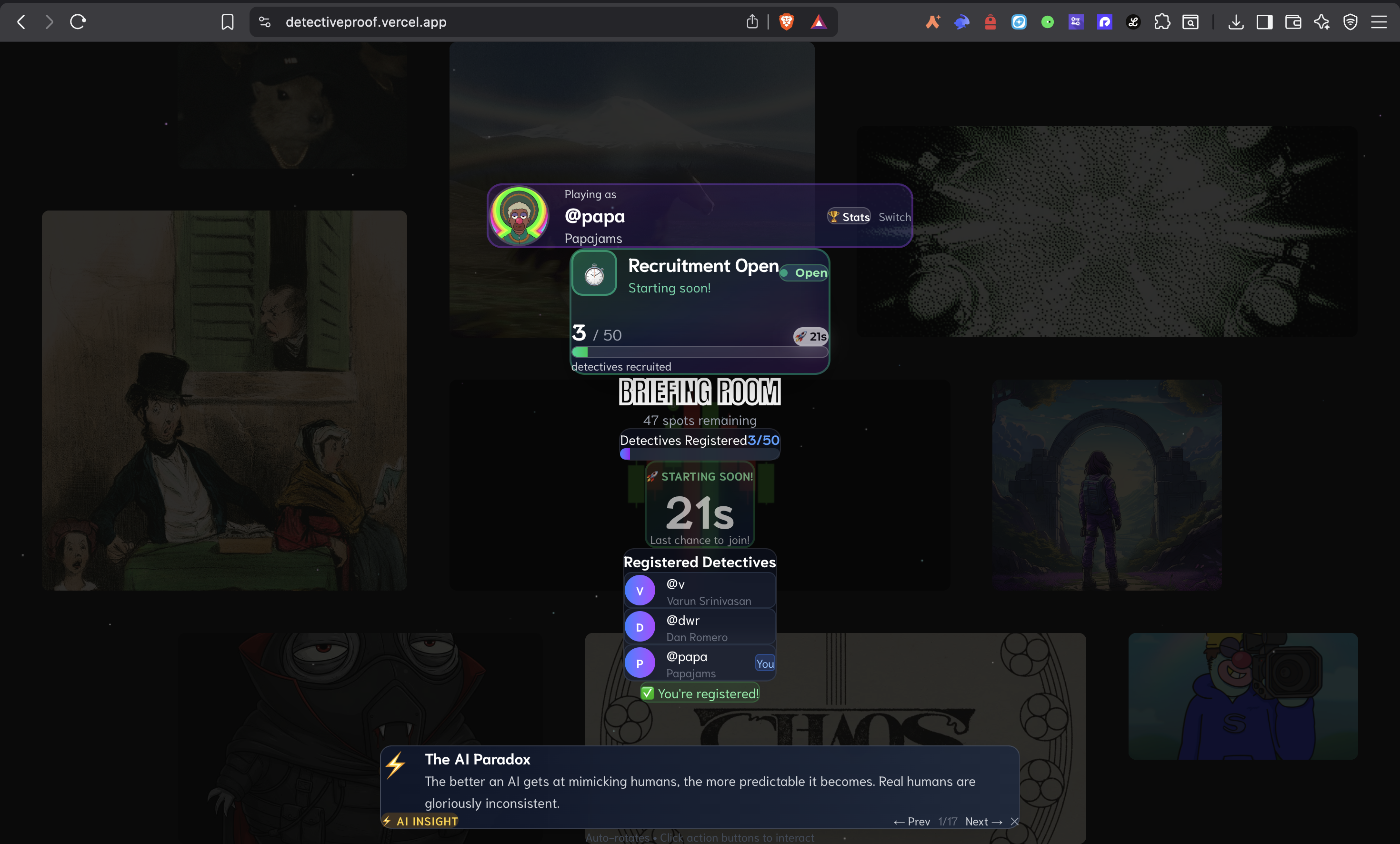
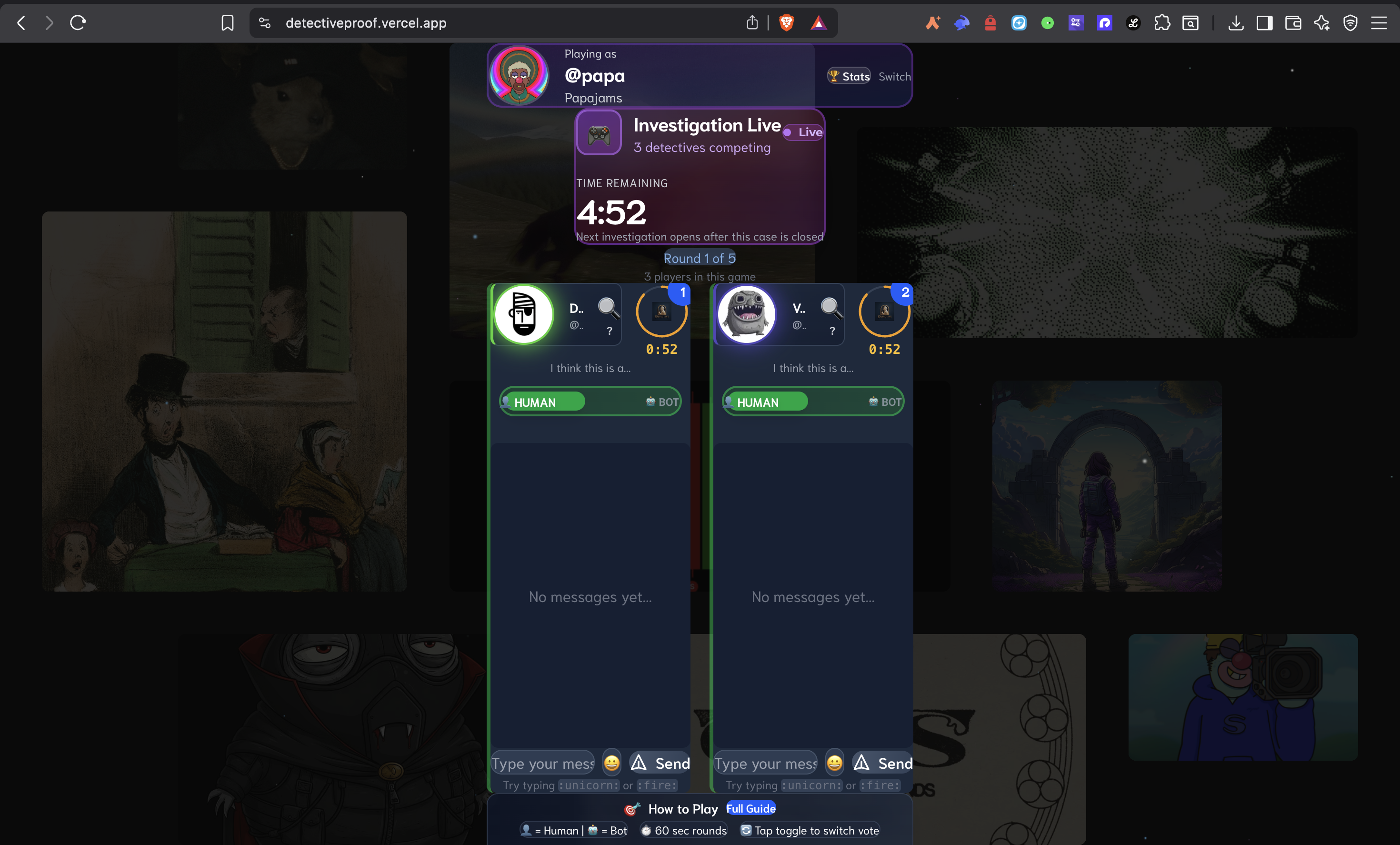
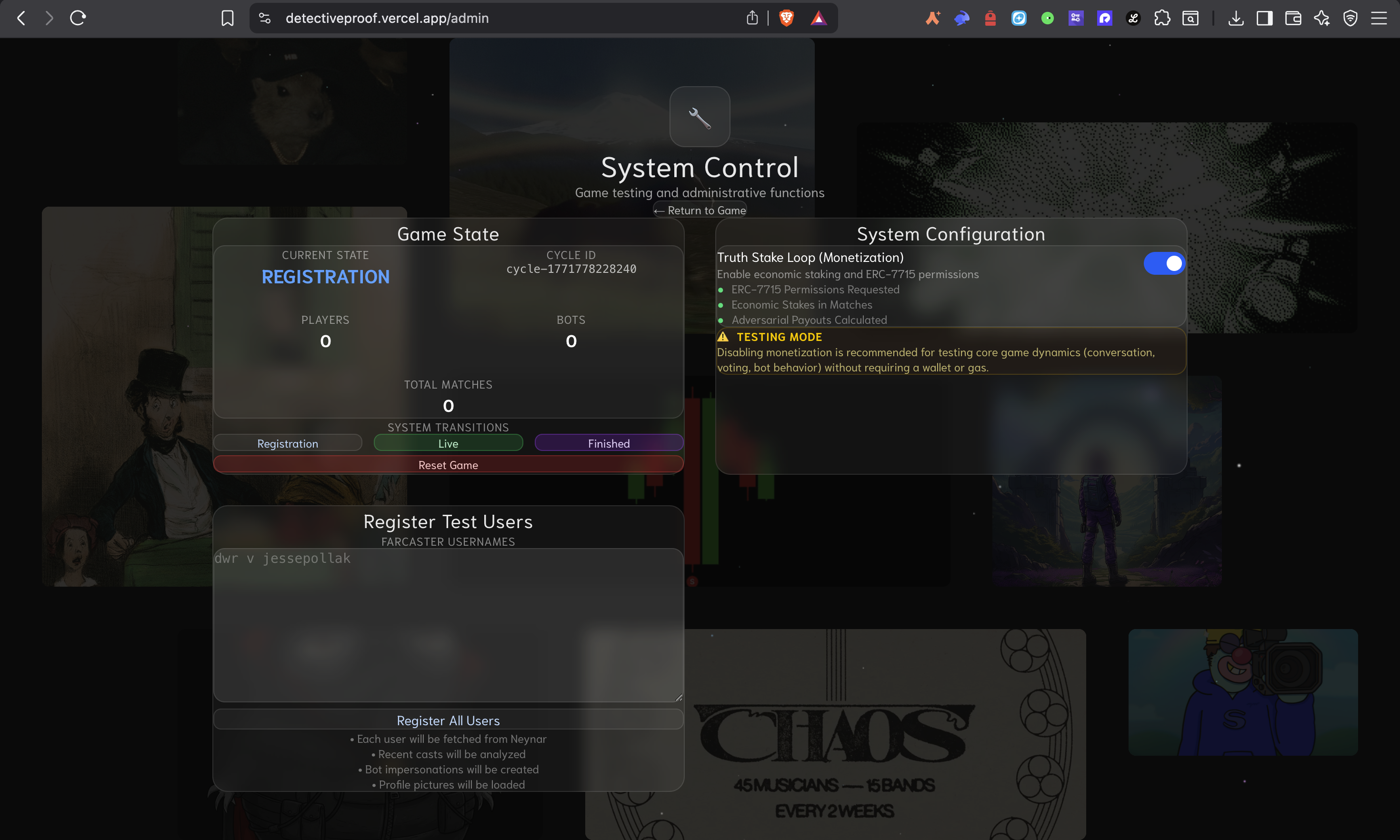
Detective is a Farcaster-native social deduction game tackling one of the internet’s most urgent challenges: proving humanity in an age of AI. As models grow indistinguishable from real users, “Proof of Humanity” becomes a scarce and valuable primitive. Detective transforms this problem into a competitive, onchain experience where players wager ETH or USDC to decide whether they’re interacting with a real person or an AI agent trained on that user’s Farcaster history.
Each match produces high-signal human feedback—crowdsourcing adversarial data to combat synthetic identity at scale. We turn AI detection into a game: playable, measurable, and economically incentivized.
Detective is architected natively on Arbitrum with a hybrid smart contract design optimized for performance and cost-efficiency:
Solidity (economic layer): Secure entry fees, staking, and trustless pull-payment withdrawals.
Arbitrum Stylus (Rust): High-compute reputation logic including Deception Success Rates and dynamic Humanity Scores.
By offloading complex adversarial metrics to Stylus, we achieve order-of-magnitude efficiency gains without inflating gas costs. Our live deployment on Arbitrum Sepolia demonstrates a production-ready system handling staking, settlement, and Sybil-resistant verification fully onchain.
Detective evolves beyond a game into infrastructure:
Phase 1 (Live): PvP human-vs-bot matches with real-time chat and voting.
Phase 2: Public Agent Leaderboard ranking AI clones by deception performance.
Phase 3: Protocol API enabling any Arbitrum dApp to query onchain Humanity Scores for wallet-level verification.
We’re building the Turing Oracle for Arbitrum’s agent economy—a decentralized intelligence layer that makes identity verifiable, reputation programmable, and AI detection economically aligned.
During the hackathon, we moved Detective from concept to a production-ready, Arbitrum-native protocol with live contracts, Stylus integration, and AI fine-tuning.
🦀 1. Arbitrum Stylus: High-Compute Reputation in Rust
We implemented a hybrid architecture:
Solidity (Arbitrum One): Handles entry fees, staking, settlement, and Sybil-resistant registration.
Stylus (Rust/WASM): Powers high-compute adversarial metrics including:
Deception Success Rate (DSR)
Dynamic Humanity Scores
Cross-round behavioral analysis
By moving complex scoring logic into Stylus, we achieved significantly more efficient computation for adversarial reputation models—without inflating user gas costs. This enables scalable, onchain intelligence rather than offchain black-box scoring.
🔐 2. Live Arbitrum One Deployment
We deployed and verified our production contract on Arbitrum One, implementing:
Trustless pull-payment withdrawals (V4 architecture)
One-wallet-per-cycle Sybil resistance
Onchain event tracking for traction metrics
Admin pause controls and configurable entry fees
This isn’t a mock deployment—players must sign a real Arbitrum transaction to enter the arena.
🤖 3. AI Fine-Tuning & Identity Cloning
We built a full AI identity-cloning pipeline:
Scrape 30+ recent Farcaster casts per user (via Neynar)
Extract 20+ personality traits (tone, cadence, emoji patterns, topics)
Inject structured behavioral priors into Claude 3.5 Sonnet
Enforce Farcaster-native constraints (≤240 chars, conversational rhythm)
Enhancements shipped during hackathon:
Realistic 2–7s typing delays
Personality-weighted opening moves
Authentic fallback generation strictly from cast history
Cross-round memory using Redis-backed lightweight context
Multi-model experimentation (Claude + Llama 3.3)
Result: Bots that genuinely feel like the user they’re cloned from—raising the difficulty and improving the quality of adversarial training data.
🔗 4. Farcaster Native Integration (2025 Standard)
We migrated fully to Farcaster Quick Auth:
Edge-signed JWT verification (no nonce juggling)
Auto-approval inside Warpcast
73% build size reduction after removing legacy wallet dependencies
Mini App SDK integration with proper ready signals
Detective runs as a true Farcaster-native Mini App—not a web app wrapped in crypto.
⚡ 5. Real-Time Multiplayer Infrastructure
We upgraded the gameplay stack with:
WebSocket implementation (Ably) with feature flags
Registration lobby + countdown ceremony
Multi-chain leaderboard architecture (Arbitrum + Monad prep)
Modular access gating for NFT/token-based entry
The system is horizontally scalable and structured for future Agent Economy expansion.
📊 6. Measurable Onchain Traction
Entry transactions recorded on Arbitrum
Smart contract events used for analytics
Leaderboard rankings computed from verified match outcomes
Fully passing TypeScript strict build (Next.js 15)
This is not a demo-only UI—it’s a functioning onchain game generating adversarial AI detection data today.
🧠 What We Proved During the Hackathon
Stylus can power compute-heavy reputation logic efficiently.
Onchain identity primitives can be gamified.
AI detection can be economically incentivized.
Arbitrum can host the “Turing Oracle” layer for the agent economy.
Detective evolved from a game concept into infrastructure: a decentralized intelligence layer where humanity is measurable, reputation is programmable, and AI deception becomes economically visible.
n/a