
DocuNet
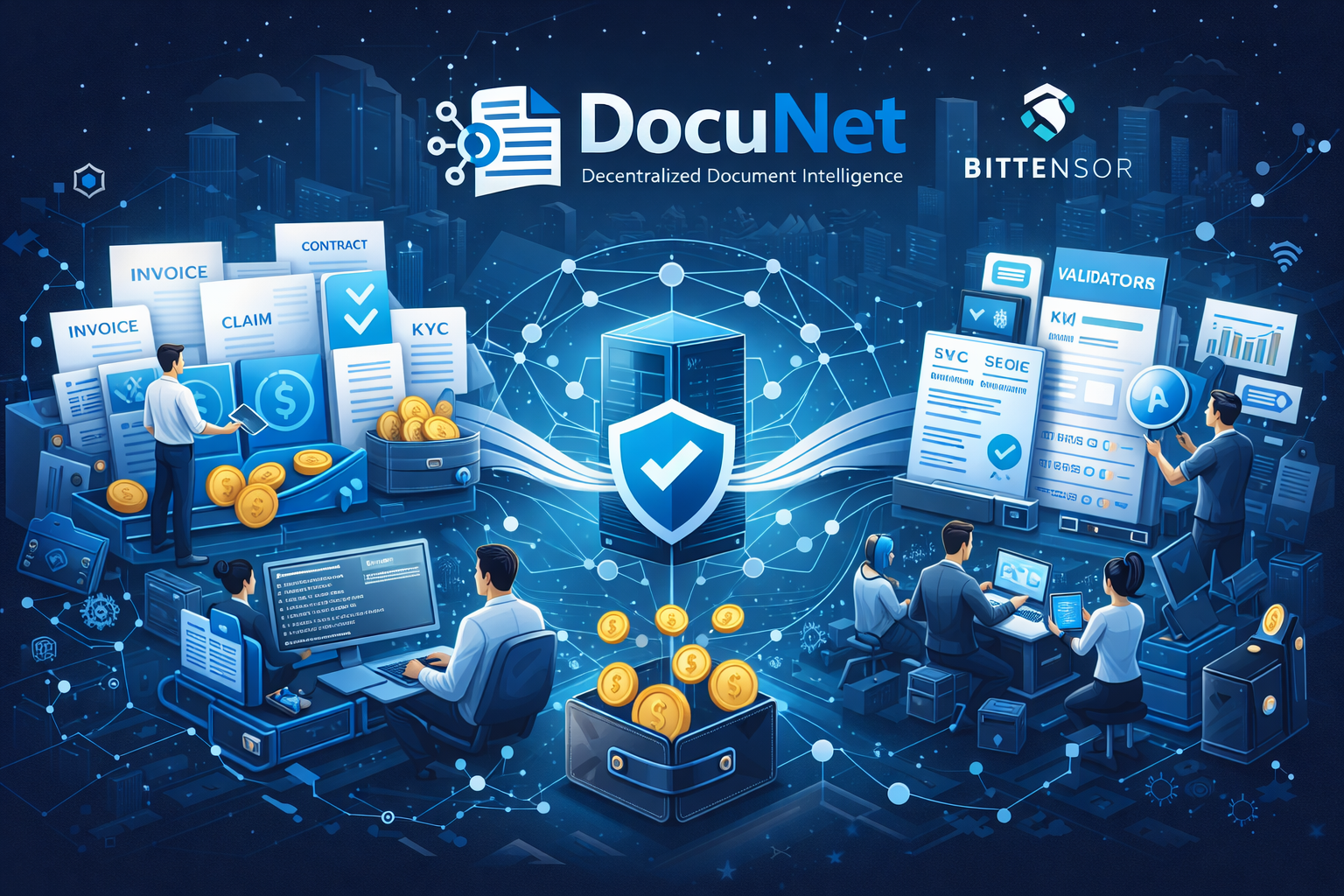
DocuNet is a decentralized AI subnet on Bittensor enabling competitive document intelligence. Miners extract structured data, validators verify accuracy, and rewards align with real enterprise demand.
Videos
Tech Stack
Description
DocuNet — Enterprise-Grade Document Intelligence Subnet on Bittensor
Overview
DocuNet is a decentralized AI subnet built on Bittensor that creates a competitive marketplace for enterprise document intelligence. It enables miners to extract structured data from complex business documents while validators verify accuracy through sampling-based adjudication. Rewards are distributed based on verified performance, aligning economic incentives with measurable intelligence.
DocuNet transforms enterprise document automation budgets into on-chain economic demand, creating a sustainable intelligence market within the Bittensor ecosystem.
Problem
Enterprises across finance, insurance, legal, and accounting sectors process millions of documents annually — invoices, contracts, claims, compliance forms, and KYC records.
Current solutions suffe
High error rates (5–20
Expensive
Vendor loc
Lack of transparent performance benchmarking
Limited incentive for continuous quality improvement
Traditional AI APIs operate as black boxes. There is no open competition that continuously rewards the most accurate models in a trust-minimized environment.
This creates inefficiency, high operational costs, and stagnation in model performance.
Solution
DocuNet introduces a decentralized competitive framework for document intelligence.
Core Idea
Miners compete to extract structured data from documents.
Validators verify outputs through randomized sampling.
Rewards are distributed proportionally to verified accuracy.
Stake and reputation mechanisms discourage low-quality participation.
The system produces a measurable stream of intelligence, not just AI output.
How It Works
1. Miner Role
Miners receive document inputs and return structured outputs in standardized JSON format:
Extracted fields (invoice number, total amount, due date, policy ID, etc.)
Confidence scores
Optional metadata
Miners can use any internal model architecture (OCR, LLM, layout-aware transformers), creating open competition.
2. Validator Role
Validators perform randomized sampling and verification against ground truth or adjudicated references.
They compute:
Verified Accuracy
Field-level precision
Confidence calibration error
Latency metrics
Validators are also incentivized, and dishonest behavior can be penalized.
3. Incentive Mechanism
At each epoch, subnet emissions are distributed using a performance-weighted scoring model:
Score_i =
0.7 × VerifiedAccuracy
0.2 × NormalizedThroughput
0.1 × Reputation
Rewards are proportional to relative performance within the subnet.
This ensures:
Accuracy dominates incentives
Speed matters but does not override quality
Long-term consistent performance is rewarded
Anti-Exploitation Design
DocuNet integrates multiple defensive layers:
Minimum stake requirement to reduce Sybil attacks
Progressive sampling for suspicious miners
Reputation decay for inconsistent accuracy
Cross-validation to prevent validator collusion
Confidence calibration penalties for overconfident false outputs
This creates a game-theoretically stable competitive environment.
Proof of Intelligence
Each epoch produces a verifiable time-series of miner performance:
Verified accuracy
Sample count
Calibration error
Uptime
This creates a transparent intelligence benchmark, aligning directly with Bittensor’s vision of measurable AI competition.
Market Opportunity
Enterprise document automation represents a multi-billion dollar global market, particularly in:
Insurance claim processing
Accounts payable automation
Legal contract parsing
Financial compliance (KYC / AML)
DocuNet offers:
Competitive performance optimization
Reduced vendor dependency
Transparent benchmarking
Economic alignment between users and intelligence providers
Enterprise payments can flow into subnet treasury, converting real-world automation budgets into sustainable on-chain incentive loops.
Why Bittensor
Bittensor is uniquely positioned to host DocuNet because:
It provides a decentralized emission model
It enables competitive AI markets
It aligns incentives between intelligence producers and validators
It supports measurable performance scoring
DocuNet exemplifies Bittensor’s core thesis: intelligence as a market.
Roadmap
Phase 1 — Ideathon
Scoring simulation engine
Miner competition modeling
Economic design documentation
Phase 2 — Testnet Deployment
Subnet implementation using Bittensor template
Basic miner & validator nodes
Live scoring dashboard
Phase 3 — Enterprise Pilot
Small-scale invoice automation pilot
SLA-based accuracy thresholds
Revenue-to-subnet treasury integration
Vision
DocuNet aims to become the standard decentralized benchmark for enterprise document intelligence.
Instead of trusting opaque AI APIs, businesses will access a competitive intelligence market where accuracy is continuously measured, incentivized, and improved.
This is not just another AI service.
It is a measurable, economically aligned intelligence layer for real-world business infrastructure.
Progress During Hackathon
During the Ideathon phase, we focused on building a solid economic and technical foundation for DocuNet rather than only conceptual design.
1. Incentive Mechanism Design
We developed and refined a performance-based reward model where emissions are allocated according to:
Verified accuracy
Normalized throughput
Reputation score
We simulated multiple miner scenarios to test:
High-accuracy / low-speed miners
High-speed / low-accuracy miners
Malicious actors attempting random outputs
The simulation confirmed that the weighting system strongly favors sustained accuracy over short-term gaming behavior.
2. Attack & Game-Theory Analysis
We analyzed potential attack vectors, including:
Sybil attacks
Validator collusion
Confidence inflation
Low-effort spam miners
Mitigation mechanisms were designed, including:
Minimum stake requirements
Progressive sampling
Reputation decay
Cross-validator auditing
This ensures long-term economic stability of the subnet.
3. Subnet Architecture Planning
We mapped the full technical architecture using:
Bittensor subnet template (Python-based)
Miner and validator role separation
JSON schema for structured extraction outputs
Epoch-based scoring logic
We also defined clear API specifications for miner input/output standardization.
4. Proof-of-Intelligence Framework
We designed a measurable scoring system that produces a time-series performance stream per miner, including:
Verified accuracy
Calibration error
Sample size
Latency
This aligns with Bittensor’s core philosophy of measurable intelligence markets.
5. Roadmap Validation
We created a realistic deployment roadmap:
Simulation environment for scoring logic
Testnet deployment plan
Initial enterprise pilot use case (invoice processing)
The focus during the Ideathon was ensuring that DocuNet is economically viable, technically implementable, and aligned with real-world demand.
Fundraising Status
Fundraising Status
DocuNet is currently in the ideation and technical design phase and has not raised external capital.
At this stage, the project is bootstrapped and focused on validating:
Incentive mechanism robustness
Subnet architecture feasibility
Market applicability in enterprise document automation
Our immediate priority is to complete simulation testing and testnet deployment before pursuing formal fundraising.
Future Funding Strategy
Following successful testnet validation, we plan to explore:
Strategic ecosystem grants within the Bittensor community
Early-stage Web3 infrastructure investors
Enterprise pilot partnerships to validate revenue flow
We believe fundraising should follow demonstrated technical viability and measurable performance, rather than precede it.
Our long-term vision is to create a sustainable intelligence market driven by real enterprise demand, minimizing reliance on speculative capital.