
Making cross-chain payments as simple as Web2 payments.
The Web3 ecosystem is highly fragmented. Users hold assets across multiple blockchains such as Ethereum, Arbitrum, Polygon, Base, Optimism, and BNB Chain.
However, making a simple payment across chains is extremely difficult and inefficient.
• Fragmented balances
Users must switch networks repeatedly just to check their balances across different chains.
• Complex payment process
If a merchant wants payment on a specific chain and token, the payer must manually bridge assets, swap tokens, and manage multiple transactions.
• Gas dependency on multiple chains
Users need native gas tokens on each blockchain, otherwise their funds remain unusable.
• Security risks with centralized systems
If payment data is stored in traditional databases, admins or attackers can modify wallet addresses and redirect funds.
• Poor user experience
Multiple steps, technical complexity, and manual processes create friction and reduce adoption.
These problems prevent Web3 from achieving seamless and user-friendly payments.
Trans-Pay is a unified cross-chain payment platform that allows users to create, share, and fulfil payment requests across multiple blockchains securely and seamlessly.
Trans-Pay abstracts all cross-chain complexity using:
• Intent-based execution
• Smart contract-secured payment requests
• Unified balance visibility
• Gasless swap and payment fulfilment
• Solver-powered liquidity execution
Users simply specify what they want to do, and Trans-Pay handles how it happens in the background.
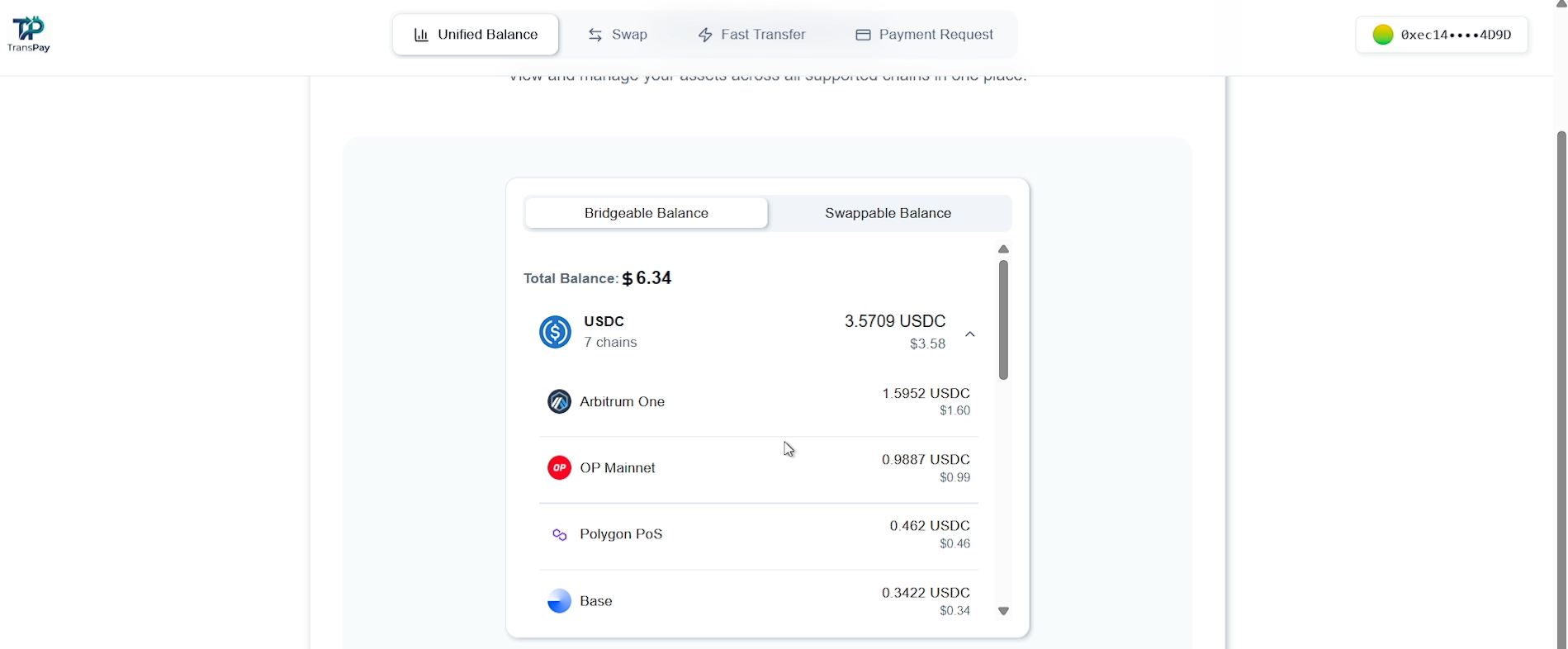
Trans-Pay provides a Unified Balance Dashboard where users can see their total balance across multiple supported blockchains in one place.
• No need to manually switch networks
• Clear visibility of total cross-chain holdings
• Instant knowledge of spendable liquidity
• Better financial awareness and control
This removes fragmentation and simplifies asset management.
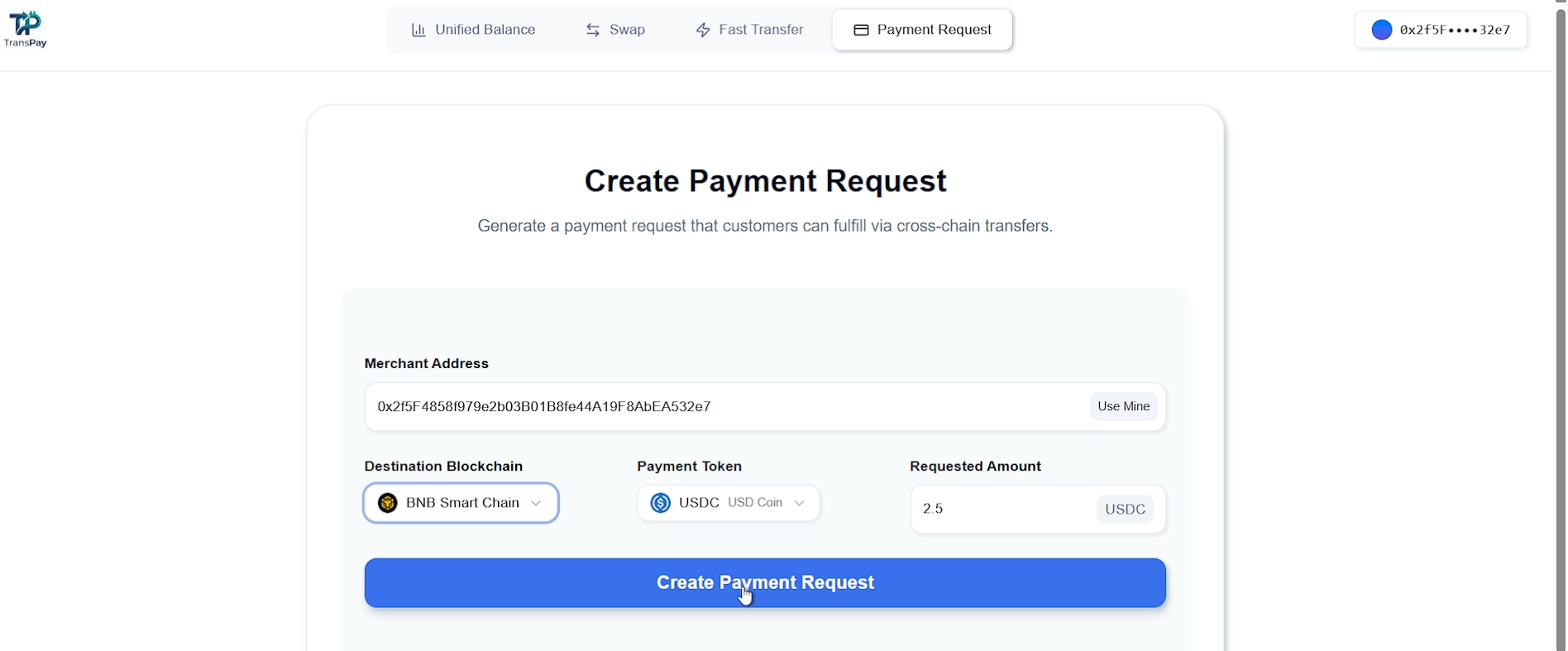
Merchants can create payment requests by specifying:
• Destination blockchain
• Preferred token
• Amount
Once created, the payment request is stored on a smart contract deployed on Arbitrum.
Traditional databases are controlled by administrators, which creates security risks such as:
• Wallet address modification
• Payment redirection attacks
• Unauthorized database changes
Smart contracts are immutable, meaning once data is stored, it cannot be modified by anyone.
This ensures:
• Complete payment security
• Tamper-proof payment requests
• Fully decentralized trust model
After creation, a unique transaction ID is generated, which is shared with the payer.
The payer enters the transaction ID to load the payment request.
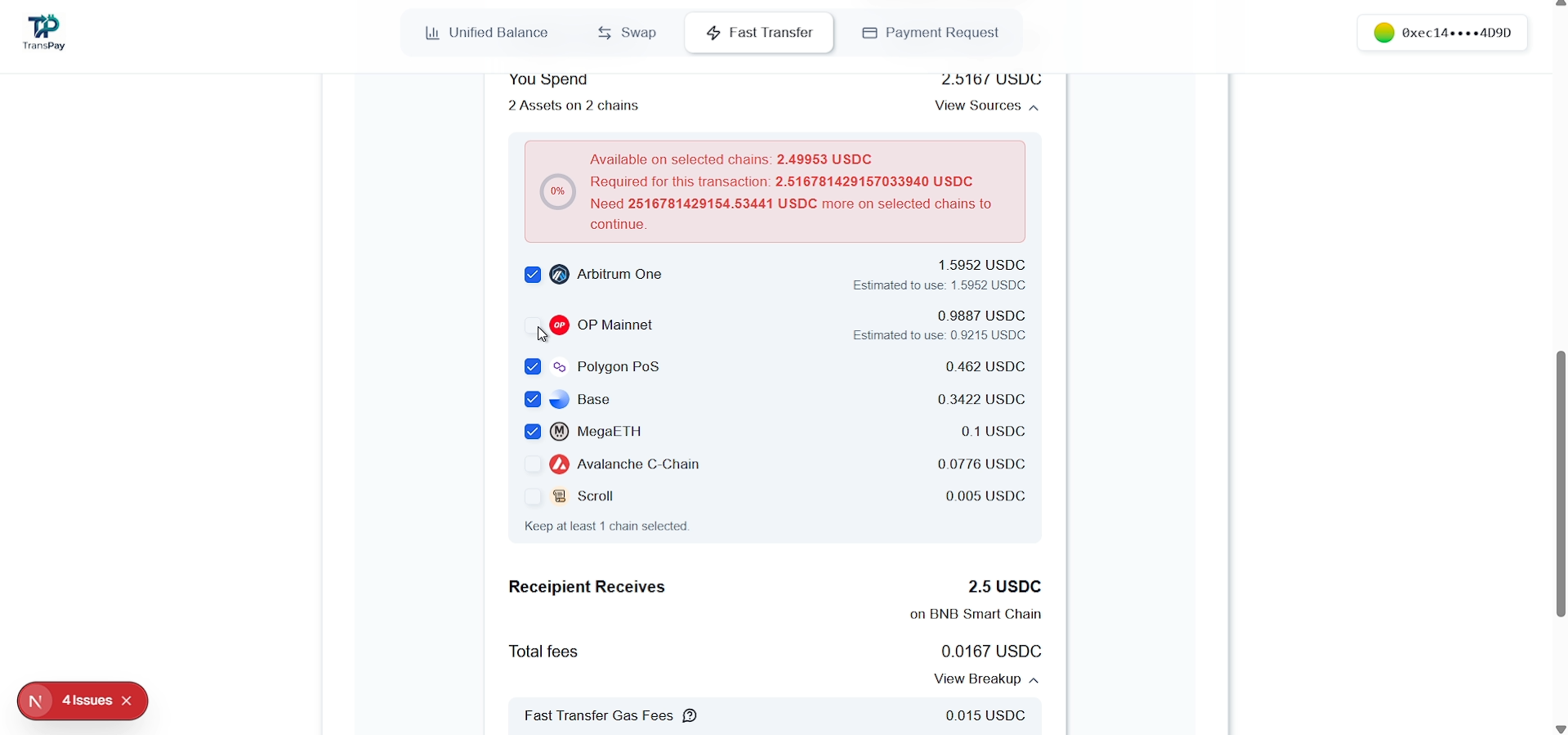
Even if the payer does not have funds on the destination chain, Trans-Pay allows them to fulfil the payment using funds from multiple source chains.
Merchant wants:
2.5 USDC on BNB Chain
Payer has USDC on:
• Arbitrum
• Polygon
• Optimism
• Base
Trans-Pay automatically:
• Sources liquidity
• Performs swap
• Bridges assets
• Completes payment
This removes manual bridging and swapping completely.
Trans-Pay uses a third-party solver to execute intents.
The solver:
• Provides liquidity on the destination chain
• Executes swap and bridge operations
• Completes the transaction seamlessly
This allows users to perform cross-chain payments in a single step.
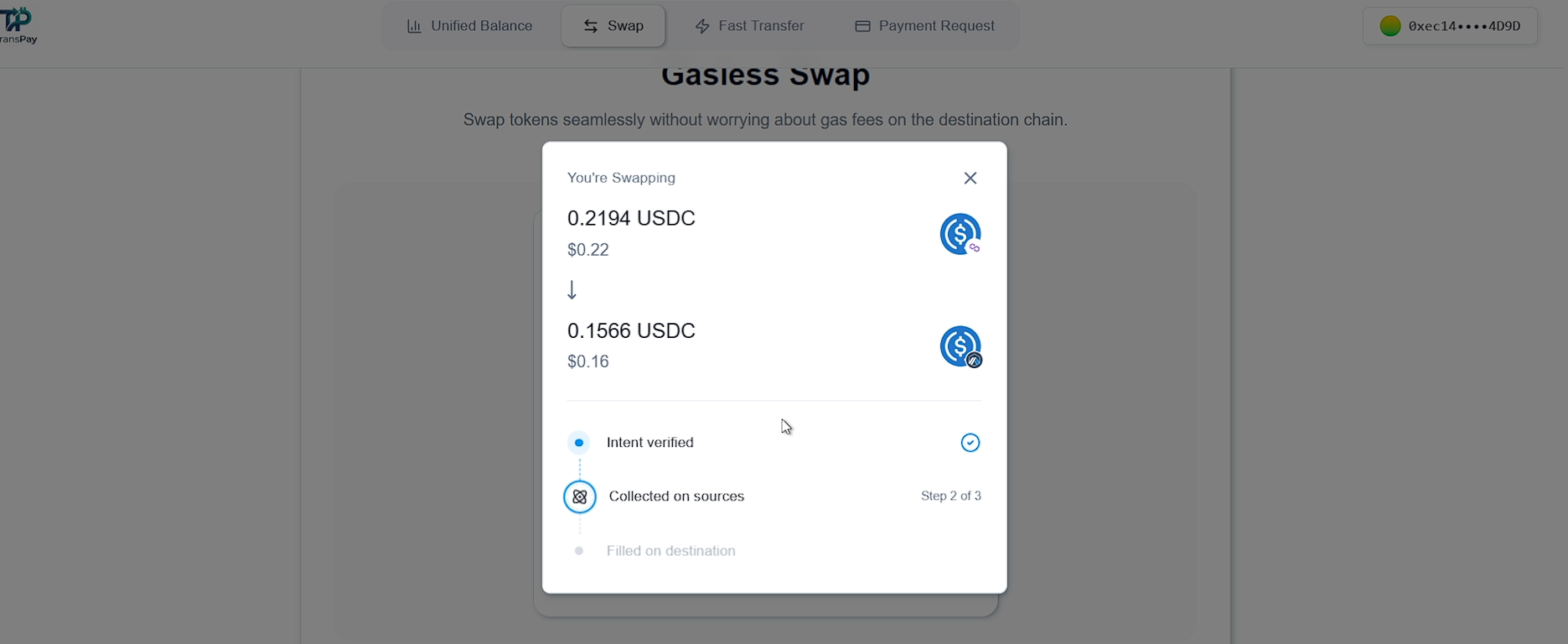
One of the biggest challenges in Web3 is gas fees.
Trans-Pay solves this by enabling gasless cross-chain swaps and payments.
Users do not need native gas tokens on multiple chains.
The solver handles:
• Gas fees
• Swap execution
• Bridge execution
This significantly improves usability and accessibility.
Users only need to approve token allowance once.
Trans-Pay provides strong security guarantees:
• Payment data stored on immutable smart contracts
• No centralized control over payment data
• Protection against wallet redirection attacks
• Protection against address poisoning attacks
• Fully transparent and verifiable transactions
Entire project is built during the hackathon.
No fund raised But looking for the funding opportunity