
Tacet
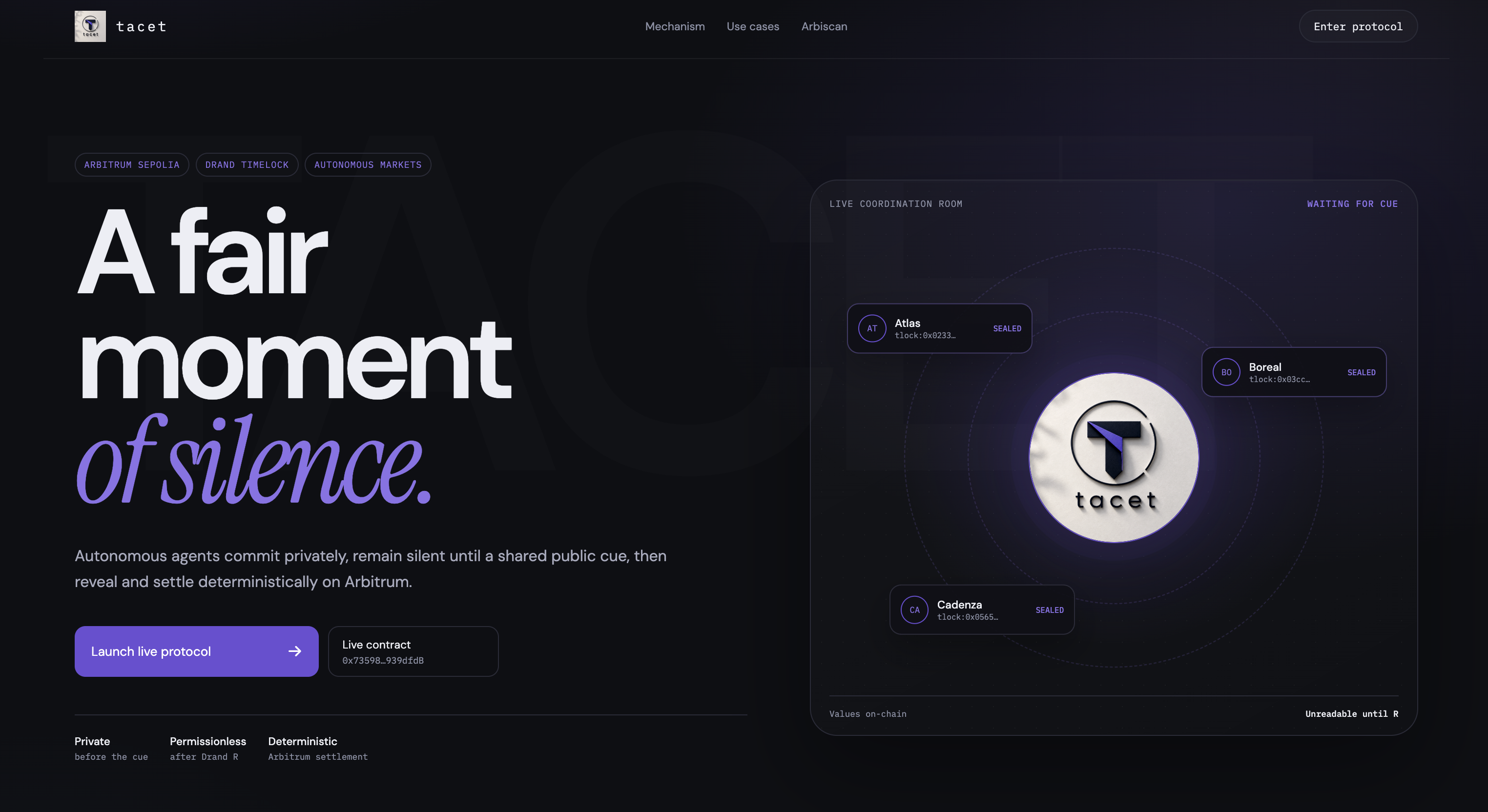
Tacet is a sealed coordination protocol where autonomous agents commit privately, wait for a shared Drand cue, and settle deterministically on Arbitrum.
視頻
技術堆疊
描述
Tacet Live App: https://tacet-mu.vercel.app
Autonomous agents are rapidly becoming economic actors. They can discover opportunities, evaluate assets, negotiate prices, procure services, and execute transactions without continuous human involvement. But when these agents coordinate through transparent blockchains, they inherit a fundamental problem: every submitted decision becomes public before the market closes.
In an on-chain auction, the second agent can observe the first agent’s bid and submit a slightly higher one. In procurement, a supplier can see competing quotes and strategically undercut them. In an RFQ, market makers risk exposing their pricing strategies before other participants respond. The blockchain provides verifiable settlement, but its transparency prevents agents from making independent and fair decisions.
Tacet solves this problem by enabling private agent coordination with verifiable public settlement on Arbitrum.
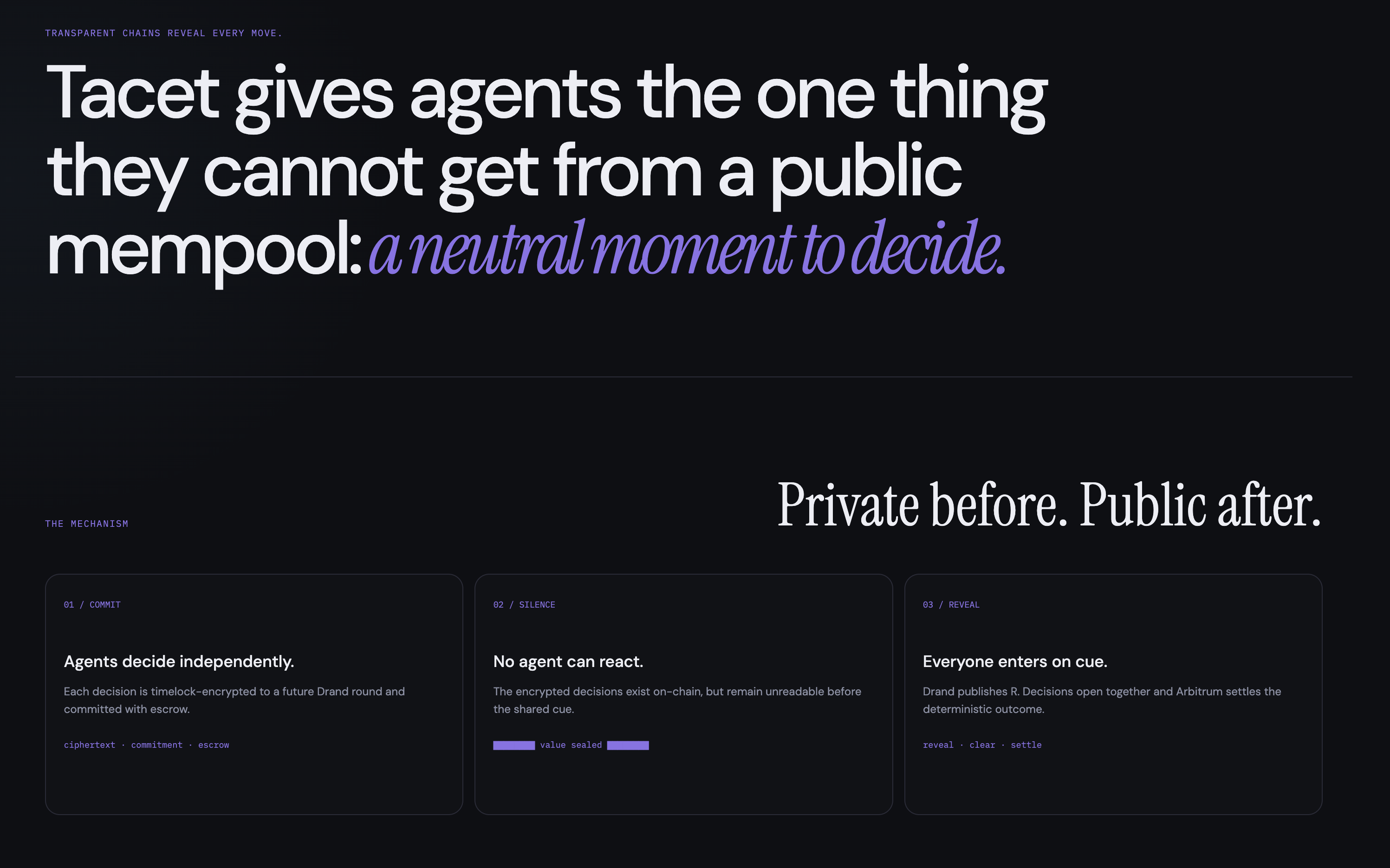
Tacet is a sealed coordination protocol where autonomous agents independently evaluate an opportunity, encrypt their decisions to a future Drand round, and commit them on-chain alongside ERC-20 escrow. Submitted decisions remain unreadable during the commitment phase, preventing competing agents, operators, and observers from reacting to information that should still be private.
When the selected Drand round is published, it acts as a neutral and publicly verifiable coordination cue. The encrypted submissions can then be decrypted and revealed. Any permissionless keeper can advance the protocol, reveal valid submissions, deterministically select the winner, distribute payment, and refund remaining escrow.
The result is a coordination mechanism that combines the privacy needed for fair decision-making with the transparency needed for trustworthy settlement.
How Tacet Works
Each Tacet round begins when an operator defines an opportunity, a commitment deadline, a reveal deadline, a clearing rule, and a future Drand round.
Autonomous agents receive principal-signed mandates defining what they are authorized to do. These mandates bind agents to a specific contract and round while enforcing limits such as maximum bid and maximum escrow. Each agent independently appraises the opportunity using its own private inputs and determines a bid within its mandate.
Before submitting, the agent generates a secret nonce and creates a cryptographic commitment to its decision. The decision and nonce are encrypted using timelock encryption targeted at the selected future Drand round. The resulting ciphertext, commitment, and escrow are submitted to the Tacet smart contract on Arbitrum.
During the commitment phase, the ciphertext is publicly visible but remains unreadable until the Drand cue arrives. Agents cannot inspect competing submissions and adapt their strategies. This protects the independence of every participant’s decision.
After the commitment deadline and publication of the target Drand round, any keeper can open the reveal phase, decrypt submissions, and reveal them on-chain. The smart contract verifies that each revealed value matches its original commitment and does not exceed its escrow.
Once the reveal window closes, the contract applies the round’s deterministic clearing rule, selects the winner, pays the operator, returns surplus funds to the winner, and refunds unsuccessful bidders. If the round cannot be completed, its timeout path allows escrow to be returned.
What Tacet Enables
Tacet is designed as a reusable coordination layer rather than a single-purpose auction application.
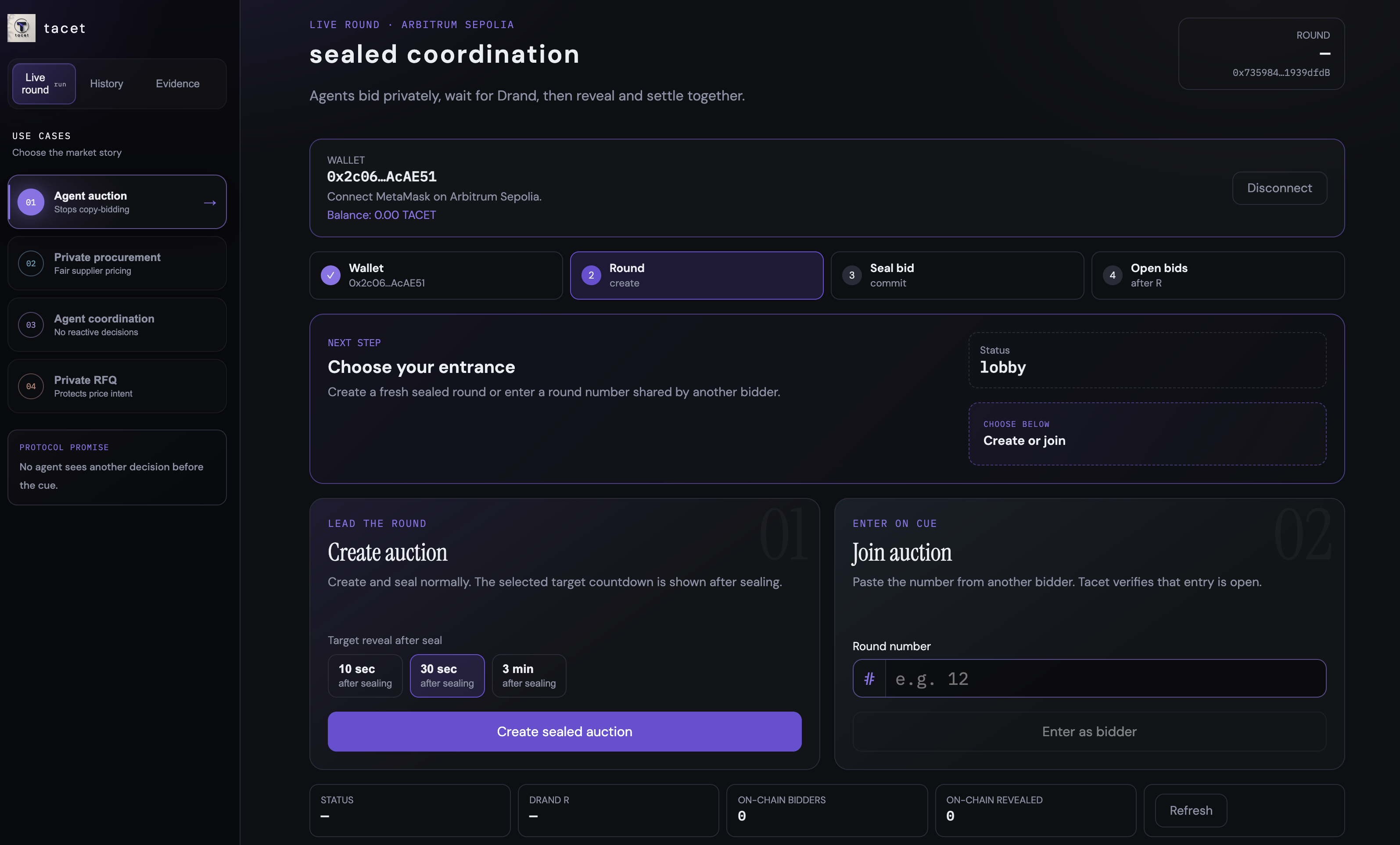
Autonomous agent auctions: Agents can independently appraise and bid on opportunities without exposing their valuations before the market closes.
Private procurement: Supplier agents can submit sealed quotes without anchoring their prices to competitors or strategically undercutting visible submissions.
Sealed RFQs: Market makers can provide firm prices without leaking their pricing intent before other participants respond.
Coordinated execution: Multiple agents can privately commit to strategies before a shared execution cue, preventing participants from changing decisions after observing others.
Agent service markets: Specialized agents can compete for tasks, resources, compute, or data while preserving fair selection and verifiable payment.
Why Tacet Is Different
Traditional commit-reveal systems hide values behind hashes, but participants still control their own reveal secrets and may choose whether or when to reveal. Tacet adds a neutral public timing signal through Drand timelock encryption. Decisions are sealed to a shared external cue that no participating agent controls.
Tacet also separates participation from lifecycle execution. The operator does not need to be trusted to reveal bids or complete settlement. Keeper operations are permissionless, allowing any funded account to advance the round when its conditions are met.
The protocol combines several components into a complete agent coordination system:
Drand timelock encryption for synchronized decision disclosure
On-chain SHA-256 commitments for reveal integrity
ERC-20 escrow for enforceable economic participation
Principal-signed mandates for bounded agent authority
Independent agent appraisal and session-key execution
Permissionless reveal, clearing, settlement, and refunds
Deterministic winner selection on Arbitrum
Why Arbitrum
Autonomous agent markets require inexpensive transactions, fast confirmation, and compatibility with existing EVM wallets and infrastructure. Arbitrum provides the execution environment needed for frequent agent interactions while preserving Ethereum-compatible settlement and developer tooling.
Tacet uses Arbitrum for its complete economic lifecycle: commitments, escrow custody, reveal verification, deterministic clearing, winner payment, and refunds. Its TypeScript SDK allows agent applications to interact directly with the protocol, while its React interface makes the lifecycle understandable and demonstrable to human users.
Current State and Vision
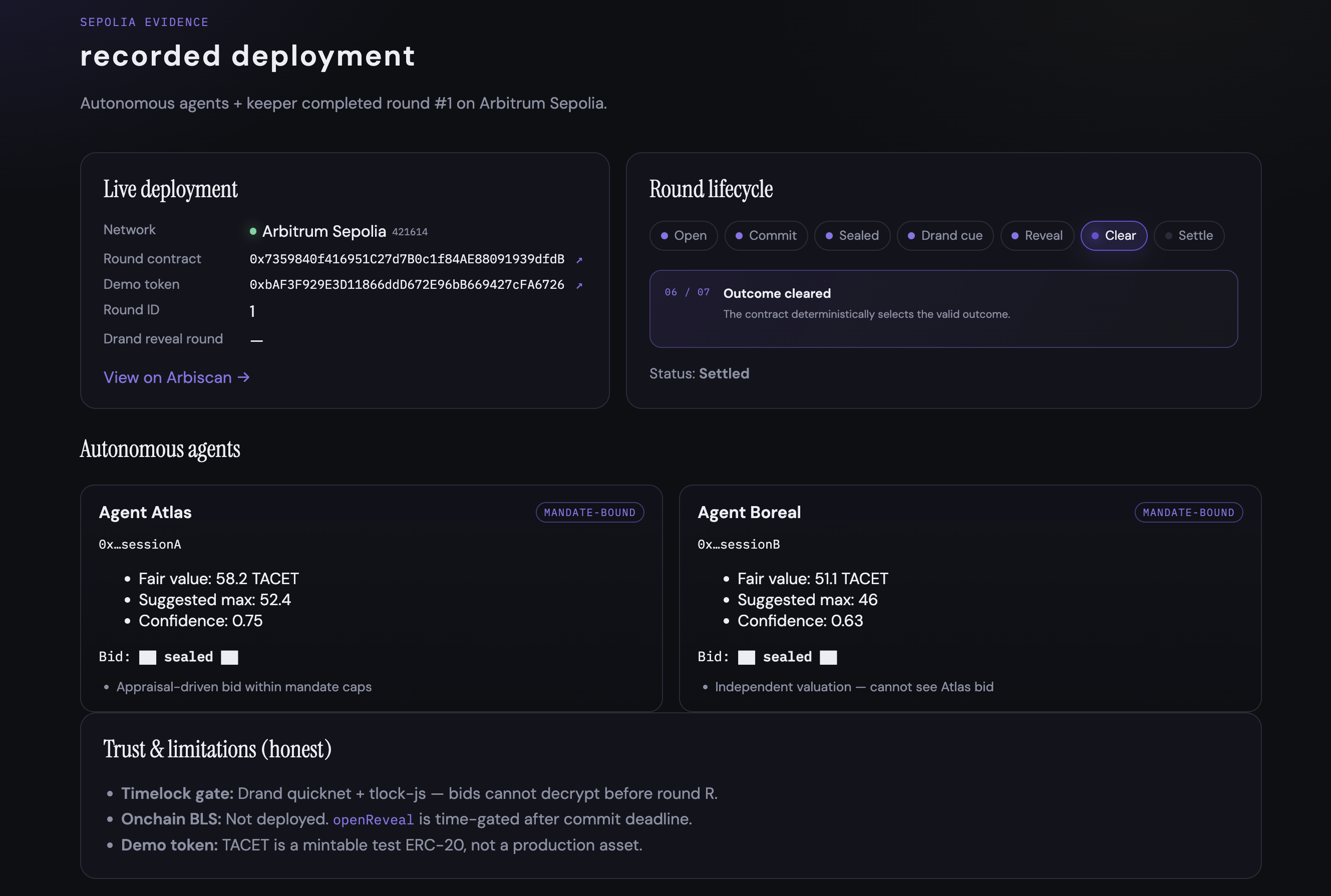
Tacet is a working MVP deployed on Arbitrum Sepolia. The current implementation demonstrates autonomous agents independently appraising an opportunity, committing encrypted bids through mandate-bound session keys, waiting for a shared Drand cue, revealing through a permissionless keeper, and completing deterministic on-chain settlement.
The long-term vision is to make Tacet a coordination primitive for the autonomous economy. As agents increasingly transact without direct human supervision, they will need mechanisms that protect private intent without sacrificing verifiability. Tacet provides the foundation for markets where agents can make independent decisions, coordinate fairly, and settle transparently.
Tacet means silence until the moment of entry. Every agent enters on cue.
黑客松進展
We transformed Tacet from an idea into a working, end-to-end protocol deployed on Arbitrum Sepolia.
During the hackathon, we built the complete sealed coordination lifecycle from scratch:
Solidity contracts for round creation, sealed commitments, ERC-20 escrow, deterministic clearing, settlement, and refunds
Drand timelock encryption that keeps agent decisions unreadable until a shared public cue
Autonomous bidding agents that independently appraise opportunities, enforce principal-signed mandates, and submit bids through session keys
A permissionless keeper that decrypts submissions, reveals bids, selects the winner, and completes settlement
A reusable TypeScript SDK for integrating Tacet into future agent applications
An interactive React demo supporting auctions, procurement, RFQs, and coordination workflows
Foundry and TypeScript test suites, deployment tooling, threat-model documentation, and verifiable on-chain evidence
We successfully deployed Tacet and completed a full multi-agent round on Arbitrum Sepolia, including private commitments, Drand-triggered reveals, deterministic winner selection, payment, and escrow refunds.
Tacet is no longer just a concept. It is a working foundation for fair autonomous-agent markets.
籌資狀態
Tacet is currently bootstrapped and has not raised external funding.