
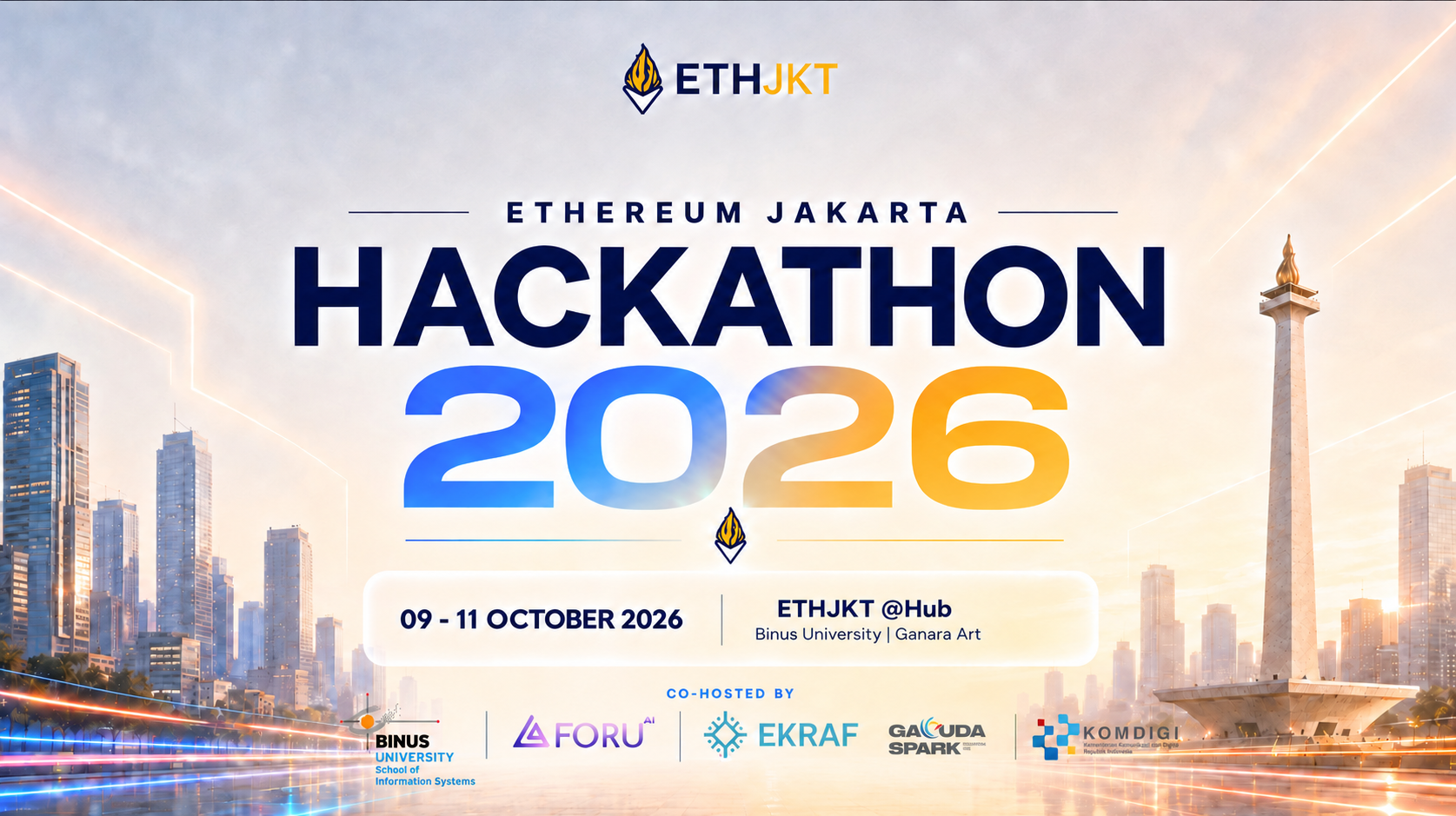
Ethereum Jakarta Hackathon 2026 — 3 Day Hybrid Web3 Hackathon with build sprint on Ethereum.
Register Countdown
Prepare with AI


Use this prompt in your AI IDE to quickly get started with this hackathon.
Recommended prompt
I am preparing for Ethereum Jakarta Hackathon 2026. Help me understand the rules, required developer resources, project ideas, and a 7-day preparation plan based on my HackQuest builder journey.
1,650 USD
Available in Prizes
Description
BUILD THE REAL WORLD ONCHAIN
Ethereum Jakarta Hackathon 2026 is a multi-day Web3 hackathon experience in Jakarta focused entirely on Real-World Assets (RWA) and the opportunities to bring real-world value, assets, and economic activity onchain.
The program brings together developers, builders, designers, founders, students, and innovators to explore how Ethereum can transform the way real-world assets are represented, accessed, managed, and exchanged.
The hackathon program begins with a series of pre-hackathon workshops from October 5–7, followed by the main hackathon, which includes an intensive 12-hour offline build sprint, continued project development and online submission, and an in-person Demo Day where selected teams showcase their projects.
📅 October 5–7, 2026
Before the main hackathon begins, participants can join a series of pre-hackathon workshops designed to help builders prepare for the RWA challenge.
The workshops will provide practical knowledge around Ethereum, smart contracts, RWA infrastructure, product development, and other technical or ecosystem topics relevant to the hackathon.
These sessions are intended to help participants:
Understand the fundamentals of RWA and onchain asset infrastructure
Learn relevant Ethereum development concepts
Explore potential RWA use cases
Prepare their technical stack and project ideas
Meet potential teammates and fellow builders
Get ready for the main hackathon build sprint
Participants can use the workshops as preparation before entering the main build phase.
📍 ETHJKT @ Hub — Jakarta Creative Hub
Day 1 is the main offline building day.
Teams will gather at ETHJKT @ Hub, Jakarta Creative Hub for a focused 12-hour build sprint, providing an intensive environment to start building, collaborate, and turn ideas into functional prototypes.
However, the hackathon is not limited to the 12-hour sprint.
The 12-hour sprint serves as the main collaborative offline build period. Teams can continue developing, testing, refining, and preparing their projects after the sprint until the official submission deadline on Day 2.
Throughout the build period, participants will have opportunities to collaborate with mentors, ecosystem contributors, and fellow builders.
Projects can explore different applications of Real-World Assets, including:
Tokenization of real-world assets
Real estate & property
Commodities
Securities & financial assets
Credit & lending
Supply chain & trade finance
Payments & stablecoins
Ownership & asset management
Identity, compliance & verification
Onchain infrastructure for traditional assets
Other applications connecting real-world value with Ethereum
The goal is to move beyond theoretical concepts and demonstrate a working onchain implementation.
🌐 Fully Online
After the offline build sprint, teams will have additional time to finalize, test, and polish their projects before submitting them online.
Submission Deadline: 12:00 PM (WIB)
Each team will submit:
Project description
Problem & solution
GitHub repository
Demo / deployed application
Tech stack
RWA use case
Demo video or presentation materials
Team information
The submission process is fully online, allowing teams to finalize their projects remotely after the offline build session.
Submissions will then be reviewed by the judging panel, with selected projects advancing to the final Demo Day.
📍 Ganara Art — Jakarta
The final day is the Ethereum Jakarta Hackathon Demo Day.
Selected teams will come together at Ganara Art to present their projects in front of judges, ecosystem partners, mentors, and fellow builders.
Teams will demonstrate their products, explain the real-world problem they are addressing, and show how Ethereum enables their RWA solution.
The Demo Day will serve as the final showcase and judging stage of the hackathon.
Ethereum Jakarta Hackathon 2026 features approximately IDR 30,000,000 worth of prizes and rewards.
🥇 1st Place — $600
🥈 2nd Place — $400
🥉 3rd Place — $300
Additional Honorable Mention awards will recognize selected projects with a combined prize value of $500, which may include ecosystem rewards, partner prizes, credits, grants, tools, or other builder benefits.
Projects will be evaluated based on:
How effectively does the project address a genuine real-world problem or use case?
How meaningfully does the project use Ethereum, smart contracts, tokenization, or other onchain infrastructure?
How novel is the solution compared to existing approaches to RWA?
Can the solution realistically be deployed, adopted, and scaled beyond the hackathon?
How clearly does the team demonstrate the product, its functionality, and its value?
The hackathon is open to:
Developers
Smart contract engineers
Web3 builders
Product designers
Founders
Students
Researchers
Creators
Innovators
You don't need to be an experienced RWA or Ethereum developer to participate.
Teams are encouraged to combine different skill sets across technology, product, design, business, finance, and research.
Projects submitted to the hackathon must be built from scratch during the official hackathon period.
Existing projects, previously launched products, or substantially pre-built solutions are not eligible.
Participants may prepare their development environment, conduct research, attend the pre-hackathon workshops, form teams, and discuss ideas before the build phase. However, the submitted product itself must be developed during the hackathon.
Existing open-source tools, libraries, protocols, APIs, SDKs, and third-party infrastructure may be used as part of your project.
However, the core hackathon submission must represent new work created during the hackathon.
If you are building on top of an existing project, clearly identify what was newly developed for this hackathon.
Projects should demonstrate a meaningful use of Ethereum or Ethereum-compatible onchain infrastructure.
Simply mentioning blockchain or using blockchain only as a database is not sufficient. Judges will evaluate how meaningfully onchain technology contributes to the solution.
All submissions must relate to the Real-World Assets (RWA) theme.
Projects should demonstrate a meaningful connection between real-world assets, economic activity, ownership, financial instruments, or real-world processes and onchain infrastructure.
Participants may build individually or as part of a team.
Teams are encouraged to combine different skills, including development, design, product, business, finance, and research.
Each team may submit one project to the hackathon.
Participants should be listed accurately in the team submission.
All required project materials must be submitted through the official submission platform by:
12:00 PM WIB on Day 2
Late submissions may not be considered for judging.
Teams should provide a GitHub repository or equivalent source-code reference for their project.
Judges may review the submitted code, documentation, demo, and other project materials when evaluating the submission.
Selected teams must be prepared to present and demonstrate their project at the Demo Day at Ganara Art, Jakarta.
Teams may be required to provide a live demo, presentation, or other demonstration of their submitted project.
Participants must submit work that they have the right to use and distribute.
Any third-party code, APIs, datasets, models, assets, or infrastructure used in the project should be properly attributed where required.
Plagiarism, fraudulent submissions, or misrepresentation of previously existing work may result in disqualification.
All participants are expected to maintain a respectful, inclusive, and professional environment throughout the workshops, hackathon, online submission period, and Demo Day.
Harassment, discrimination, cheating, malicious activity, or behavior that disrupts the event may result in removal from the hackathon.
The organizers reserve the right to disqualify submissions that violate the hackathon rules, submission requirements, code of conduct, or eligibility requirements.
The organizers' decision regarding rule violations and eligibility is final.
FAQs
BUILD THE REAL WORLD ONCHAIN
1,500 USD
BUILD THE REAL WORLD ONCHAIN
BUILD THE REAL WORLD ONCHAIN
Judging Criteria
Projects in this track should demonstrate how blockchain can bring real-world assets, financial instruments, or economic activity onchain through practical and scalable applications.
1. Real-World Utility — 25%
How effectively does the project address a genuine real-world problem or use case through onchain infrastructure?
2. Onchain Implementation — 25%
How meaningfully does the project use blockchain, smart contracts, or tokenization to enable its solution?
3. Innovation & Differentiation — 20%
How novel is the approach compared to existing RWA solutions? Does it introduce a meaningful new mechanism, product, or user experience?
4. Feasibility & Scalability — 20%
Can the solution realistically be deployed and scaled beyond the hackathon? Consider technical feasibility, adoption potential, and infrastructure requirements.
5. Demo & User Experience — 10%
How clearly does the team demonstrate the product, its functionality, and its value to users?
Honorable Mention
150 USD
Recognizing outstanding innovation and potential
A special recognition for projects that stood out through their creativity, originality, dedication, and potential for real-world impact.
Honorable Mention
Judging Criteria
Uniqueness & Creativity — 30%
Effort & Execution — 25%
Innovation & Potential Impact — 20%
Mentor Feedback / Mentor Favorite — 15%
Presentation & Demo — 10%
Schedule